
8×22 mm Nambu
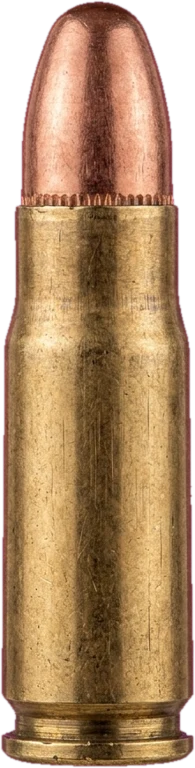
Bottlenecked semi-rimless Japanese sidearm round fielded throughout Imperial Japanese military operations.
- Designation
- —
- Standard
- —
- Origin
- —
- Introduced
- 1904
Community
Technical overview
Features a bottlenecked semi-rimless brass casing launching round-nosed jacketed lead bullets. Operating at relatively low pressures, terminal dynamics rely on uniform forward momentum without substantial fragmentation or expansion upon striking targets.
Strengths & limitations
- + Mild felt recoil impulse facilitating controlled marksmanship.
- + Smooth cycling characteristics in locked-breech Japanese sidearm designs.
- + Lightweight construction allowing reduced carry weight for officers.
- − Significantly underpowered relative to contemporary World War II service pistol cartridges.
- − Extremely rare commercial availability and high collector ammunition costs.
Ballistics & dimensions
- Bullet diameter
- 8.18 mm (0.322 in)
- Case length
- 21.80 mm (0.858 in)
- Overall length
- 31.70 mm (1.248 in)
- Bullet weight
- 6.6 g (102 gr)
- Muzzle velocity
- 290 m/s (951 ft/s)
- Energy
- 278 J (205 ft·lbf)
- Max pressure
- 1,300 bar (18,855 psi)
- Typical twist rate
- —
Military variants & loadings
No variants recorded yet.
Weapons in the catalog using it (0)
Platforms: Type A Nambu, Type 14 Nambu, Type 94 Nambu, Type 100 Submachine Gun
Related cartridges: 7.65×21mm Parabellum, 9×19mm Parabellum, 7.63×25mm Mauser
Data trust: Verified (CIP / SAAMI / Official Military Ordnance Specifications)
Doctrine & history
Designed by General Kijirō Nambu in 1904 for use in the Type A Nambu pistol. Adopted as the standard sidearm cartridge by the Imperial Japanese Army and Navy through the Second Sino-Japanese War and World War II, remaining in production until Japan's surrender in 1945.
