

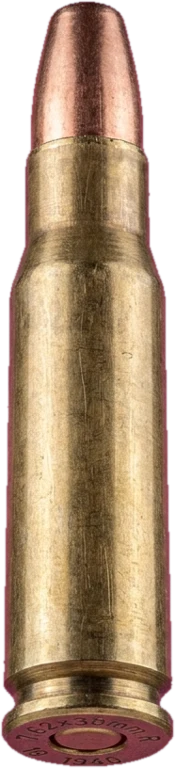
7.62×38 mm R Nagant
Unique gas-sealing revolver cartridge engineered with a fully seated internal projectile to prevent velocity loss.
- Designation
- —
- Standard
- —
- Origin
- —
- Introduced
- 1895
Community
Technical overview
Features a deep-rimmed, extended brass casing in which the bullet is seated entirely below the case mouth. Upon cocking, the revolver cylinder moves forward to bridge the cylinder-barrel gap, expanding the neck into the forcing cone to seal propellant gases completely.
Strengths & limitations
- + Complete gas seal allows effective sound suppression on revolver platforms.
- + Eliminates energy loss through the cylinder gap standard in traditional revolvers.
- + Low recoil impulse and reliable ignitions in service environments.
- − Very heavy trigger pull required to actuate the gas-seal forward cylinder camming mechanism.
- − Modest velocity and energy output by modern sidearm standards.
Ballistics & dimensions
- Bullet diameter
- 7.82 mm (0.308 in)
- Case length
- 38.80 mm (1.528 in)
- Overall length
- 38.80 mm (1.528 in)
- Bullet weight
- 7.0 g (108 gr)
- Muzzle velocity
- 272 m/s (892 ft/s)
- Energy
- 260 J (192 ft·lbf)
- Max pressure
- 1,900 bar (27,557 psi)
- Typical twist rate
- —
Military variants & loadings
No variants recorded yet.
Weapons in the catalog using it (0)
Platforms: Nagant M1895 Revolver, Pieper Revolver
Related cartridges: 7.5mm 1882 Ordnance, 7.65×21mm Parabellum, .32 S&W Long
Data trust: Verified (CIP / SAAMI / Official Military Ordnance Specifications)
Doctrine & history
Designed by Léon Nagant in Belgium for the Imperial Russian Military alongside the Nagant M1895 revolver. The round saw extensive operational employment through World War I, the Russian Revolution, World War II, and later covert applications due to its unique capability to function with sound suppressors.
