
.22 Long Rifle
Globally dominant rimfire round celebrated for low cost, minimal recoil, and recreational versatility.
- Designation
- —
- Standard
- —
- Origin
- —
- Introduced
- 1887
Community
Technical overview
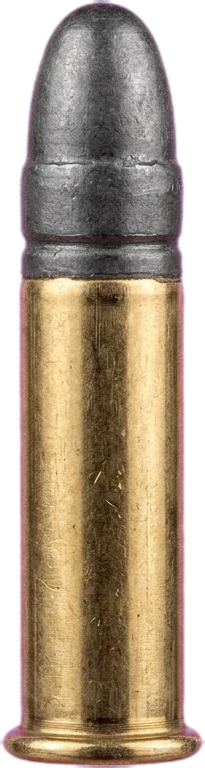
Employs a straight-walled rimed brass case loaded with a heeled lead projectile. Operating at low chamber pressures, terminal effectiveness relies on bullet design and penetration in small game targeting and target marksmanship.
Strengths & limitations
- + Extremely low per-round cost enabling extensive target practice.
- + Negligible recoil and quiet firing report suitable for novice shooters.
- + Universal commercial availability across global civilian markets.
- − Limited terminal energy and poor performance against defensive barriers.
- − Higher failure-to-fire rates inherent to rimfire ignition systems compared to centerfire.
Ballistics & dimensions
- Bullet diameter
- 5.68 mm (0.223 in)
- Case length
- 15.60 mm (0.613 in)
- Overall length
- 25.40 mm (1.000 in)
- Bullet weight
- 1.9–2.6 g (30–40 gr)
- Muzzle velocity
- 330 m/s (1,080 ft/s)
- Energy
- 141 J (104 ft·lbf)
- Max pressure
- 1,700 bar (24,656 psi)
- Typical twist rate
- —
Military variants & loadings
No variants recorded yet.
Weapons in the catalog using it (0)
Platforms: Ruger 10/22, Marlin Model 60, Smith & Wesson Victory, Browning Buck Mark, CZ 457
Related cartridges: .22 Short, .22 Long, .22 WMR, .17 HMR
Data trust: Verified (CIP / SAAMI / Official Military Ordnance Specifications)
Doctrine & history
Introduced by the J. Stevens Arms & Tool Company in 1887 by combining the case of the .22 Long with the heavier projectile of the .22 Extra Long. It evolved into the most widely produced, purchased, and utilized cartridge format in human history.
