
9×18 mm Makarov
Historic Soviet military standard sidearm round engineered to maximize energy output within direct blowback firearm actions.
- Designation
- —
- Standard
- —
- Origin
- —
- Introduced
- 1951
Community
Technical overview
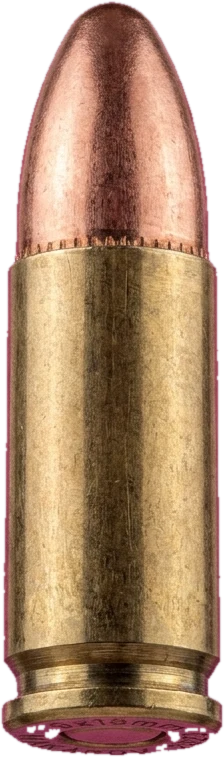
Features a tapered, rimless casing utilizing a true bullet diameter of 9.27 mm, wider than typical Western 9mm projectiles. The loading is carefully tuned to operate at the ultimate mechanical limit of simple, uncanted blowback handgun operation without requiring a locked-breech mechanism.
Strengths & limitations
- + Enables mechanically straightforward, durable, and highly reliable firearm construction.
- + Low manufacturing cost with wide historic global availability.
- + Moderate, manageable recoil impulse in compact handguns.
- − Inferior ballistic performance and kinetic energy compared to 9×19mm Parabellum.
- − Ineffective against modern hard and soft body armors.
Ballistics & dimensions
- Bullet diameter
- 9.27 mm (0.365 in)
- Case length
- 18.10 mm (0.713 in)
- Overall length
- 25.00 mm (0.984 in)
- Bullet weight
- 6.1 g (95 gr)
- Muzzle velocity
- 315 m/s (1,033 ft/s)
- Energy
- 303 J (223 ft·lbf)
- Max pressure
- 1,600 bar (23,206 psi)
- Typical twist rate
- —
Military variants & loadings
No variants recorded yet.
Weapons in the catalog using it (0)
Platforms: Makarov PM, Stechkin APS, CZ 82, FB Radom P-64, P-83 Wanad, Škorpion vz. 82, PP-91 Khedr
Related cartridges: 9×17mm Short (.380 ACP), 9×19mm Parabellum, 9×21mm Gyurza
Data trust: Verified (CIP / SAAMI / Official Military Ordnance Specifications)
Doctrine & history
Designed by Nikolay Makarov in the late 1940s to replace the 7.62×25mm Tokarev cartridge for Soviet sidearms. It served as the standardized sidearm caliber across the Warsaw Pact for decades during the Cold War and remains in extensive service with military and police forces in Eastern Europe and Asia.
