

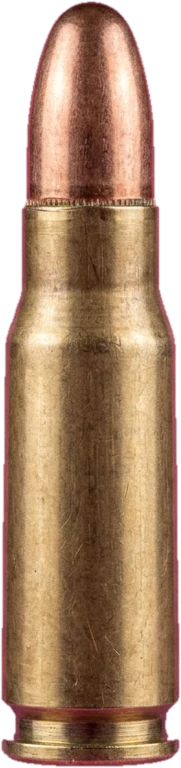
7.63×25 mm Mauser
High-velocity bottlenecked pioneer cartridge that established early 20th-century military handgun performance standards.
- Designation
- —
- Standard
- —
- Origin
- —
- Introduced
- 1896
Community
Technical overview
Employs a bottlenecked, rimless brass casing holding lightweight cupronickel or full metal jacketed bullets. Operating at high velocities for its era, the cartridge relies on deep penetration and flat trajectory characteristics to deliver terminal effectiveness at extended handgun ranges.
Strengths & limitations
- + Exceptional muzzle velocity for an early semi-automatic handgun load.
- + Flat trajectory providing effective point-of-aim shooting out to 100 meters.
- + Served as the direct baseline for the 7.62×25mm Tokarev cartridge.
- − Risk of severe firearm damage if higher-pressure 7.62×25mm Tokarev rounds are loaded in vintage arms.
- − Narrow bullet diameter limits permanent wound cavity formation without tumbling.
Ballistics & dimensions
- Bullet diameter
- 7.86 mm (0.309 in)
- Case length
- 25.15 mm (0.990 in)
- Overall length
- 34.80 mm (1.370 in)
- Bullet weight
- 5.5 g (86 gr)
- Muzzle velocity
- 441 m/s (1,450 ft/s)
- Energy
- 535 J (395 ft·lbf)
- Max pressure
- 2,000 bar (29,008 psi)
- Typical twist rate
- —
Military variants & loadings
No variants recorded yet.
Weapons in the catalog using it (0)
Platforms: Mauser C96, Astra Model 900, STAR Model A, SIG Bergmann 1920
Related cartridges: 7.65×25mm Borchardt, 7.62×25mm Tokarev, 7.65×21mm Parabellum
Data trust: Verified (CIP / SAAMI / Official Military Ordnance Specifications)
Doctrine & history
Introduced by Mauser in 1896 alongside the famous C96 "Broomhandle" pistol, based on the earlier 7.65×25mm Borchardt. It achieved worldwide popularity during the early 20th century, seeing service in World War I, the Russian Civil War, Spanish Civil War, and the Second Sino-Japanese War.
