

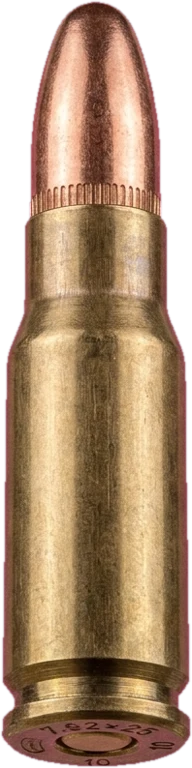
7.62×25 mm Tokarev
High-velocity bottlenecked handgun cartridge renowned for flat trajectories and penetration power.
- Designation
- —
- Standard
- —
- Origin
- —
- Introduced
- 1930
Community
Technical overview
Utilizes a bottlenecked rimless brass or steel casing derived from the 7.63×25mm Mauser geometry. The cartridge drives small-diameter, lightweight jacketed bullets to exceptionally high velocities for a handgun platform, providing intense penetration against soft armor, thick clothing, and barriers.
Strengths & limitations
- + Remarkably high velocity yielding flat trajectories at extended pistol ranges.
- + Excellent barrier penetration capabilities with standard full metal jacket loadings.
- + Large surplus availability worldwide.
- − Significant report, muzzle flash, and snappy recoil impulse.
- − Narrow selection of modern expanding defensive projectiles.
Ballistics & dimensions
- Bullet diameter
- 7.87 mm (0.310 in)
- Case length
- 25.00 mm (0.984 in)
- Overall length
- 35.20 mm (1.386 in)
- Bullet weight
- 5.5 g (85 gr)
- Muzzle velocity
- 480 m/s (1,575 ft/s)
- Energy
- 633 J (467 ft·lbf)
- Max pressure
- 2,400 bar (34,809 psi)
- Typical twist rate
- —
Military variants & loadings
No variants recorded yet.
Weapons in the catalog using it (0)
Platforms: TT-30/TT-33, PPSh-41, PPS-43, CZ 52, Sa 24, Zastava M57
Related cartridges: 7.63×25 mm Mauser, 7.65×21 mm Parabellum, 5.7×28 mm
Data trust: Verified (CIP / SAAMI / Official Military Ordnance Specifications)
Doctrine & history
Adopted by the Red Army in 1930 to replace aging revolvers, the Tokarev cartridge saw massive operational service throughout World War II in TT-33 handguns and submachine guns such as the PPSh-41. It remained a dominant military standard throughout the Eastern Bloc until superseded by the 9×18mm Makarov.
