

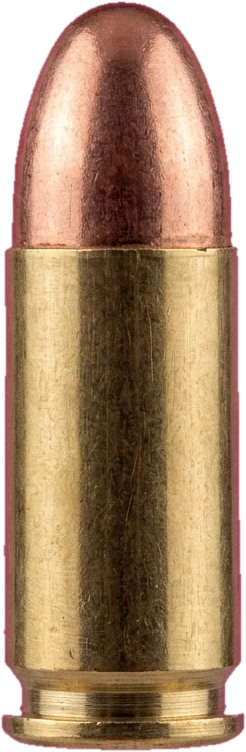
.32 ACP (7.65×17 mm)
Historic semi-rimmed handgun cartridge prized for soft recoil, intrinsic accuracy, and low muzzle report.
- Designation
- —
- Standard
- —
- Origin
- —
- Introduced
- 1899
Community
Technical overview
Employs a semi-rimmed cylindrical brass casing launching lightweight 7.65mm projectiles. Designed for simple blowback actions, terminal mechanics depend primarily on full metal jacket bullet penetration due to modest kinetic energy levels.
Strengths & limitations
- + Very low felt recoil allowing rapid, highly controlled follow-up shots.
- + Excellent functional reliability in vintage and modern blowback handguns.
- + Rich historic legacy and widespread international adoption history.
- − Limited terminal stopping power and expansion capabilities.
- − Potential for rim-over-rim magazine lockups due to semi-rimmed case design.
Ballistics & dimensions
- Bullet diameter
- 7.85 mm (0.309 in)
- Case length
- 17.20 mm (0.677 in)
- Overall length
- 25.00 mm (0.984 in)
- Bullet weight
- 3.9–4.7 g (60–73 gr)
- Muzzle velocity
- 305 m/s (1,000 ft/s)
- Energy
- 218 J (161 ft·lbf)
- Max pressure
- 1,600 bar (23,206 psi)
- Typical twist rate
- —
Military variants & loadings
No variants recorded yet.
Weapons in the catalog using it (0)
Platforms: Walther PP/PPK, FN Model 1910, Beretta M1934, Škorpion vz. 61, Kel-Tec P-32
Related cartridges: .25 ACP, .380 ACP, 7.65×21 mm Parabellum
Data trust: Verified (CIP / SAAMI / Official Military Ordnance Specifications)
Doctrine & history
Created by John Browning for the FN M1900 pistol. Known in Europe as 7.65mm Browning, it was adopted by scores of European police departments and armed forces throughout the early-to-mid 20th century, serving as a foundational pistol caliber worldwide.
