
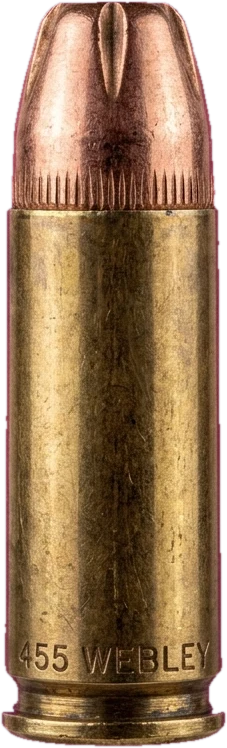
.455 Webley
Heavy-caliber British military revolver round renowned for outstanding close-range stopping power.
- Designation
- —
- Standard
- —
- Origin
- —
- Introduced
- 1891
Community
Technical overview
Employs a rimmed, straight-walled brass case loading massive 265-grain hollow-base lead projectiles. Operating at low pressure, terminal performance relies on heavy projectile mass and soft lead deformation to maximize momentum transfer inside targets at close distances.
Strengths & limitations
- + Formidable close-range stopping power due to massive bullet diameter and mass.
- + Low pressure ensures long service life for vintage break-top revolver frames.
- + Consistent performance even under severe field conditions.
- − Low muzzle velocity causes significant bullet drop over medium distances.
- − Obsolete commercial standing makes factory ammunition expensive and hard to source.
Ballistics & dimensions
- Bullet diameter
- 11.55 mm (0.455 in)
- Case length
- 19.50 mm (0.768 in)
- Overall length
- 31.20 mm (1.228 in)
- Bullet weight
- 17.2 g (265 gr)
- Muzzle velocity
- 190 m/s (620 ft/s)
- Energy
- 310 J (229 ft·lbf)
- Max pressure
- 900 bar (13,053 psi)
- Typical twist rate
- —
Military variants & loadings
No variants recorded yet.
Weapons in the catalog using it (0)
Platforms: Webley Revolver (Mk I–VI), Colt New Service, Smith & Wesson Triple Lock, Enfield No. 1 Mk I
Related cartridges: .45 Colt, .45 ACP, .38/200, .454 Casull
Data trust: Verified (CIP / SAAMI / Official Military Ordnance Specifications)
Doctrine & history
Adopted by the British Military in 1891 (Mk I) and refined through Mk II to Mk VI variations. It served as the primary handgun cartridge for British and Commonwealth forces across the Boer War, World War I, and World War II before being replaced by the .38/200 cartridge.
