

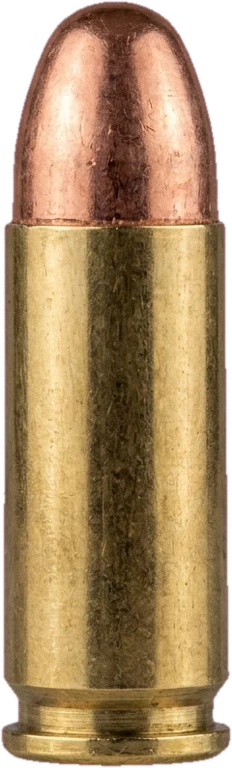
.38 Super
High-velocity semi-rimmed 9mm derivative favored for barrier penetration and competition sports.
- Designation
- —
- Standard
- —
- Origin
- —
- Introduced
- 1929
Community
Technical overview
Built on the semi-rimmed .38 Auto case geometry but loaded to significantly higher pressures. Its high velocity provides flat trajectories and intense penetration against hard targets, while modern competition barrels headspace off the rimless case mouth for enhanced accuracy.
Strengths & limitations
- + Flat trajectory and exceptional velocity yield high accuracy in custom match guns.
- + Generates ample gas volume for highly effective muzzle compensators.
- + Strong historical record for penetrating early automobile body panels and body armor.
- − Semi-rimmed design can cause feeding jams in poorly fitted magazines.
- − Premium pricing and limited availability compared to standard 9×19mm Parabellum.
Ballistics & dimensions
- Bullet diameter
- 9.02 mm (0.355 in)
- Case length
- 22.86 mm (0.900 in)
- Overall length
- 32.51 mm (1.280 in)
- Bullet weight
- 8.4–8.7 g (125–130 gr)
- Muzzle velocity
- 425 m/s (1,395 ft/s)
- Energy
- 737 J (544 ft·lbf)
- Max pressure
- 2,500 bar (36,259 psi)
- Typical twist rate
- —
Military variants & loadings
No variants recorded yet.
Weapons in the catalog using it (0)
Platforms: Colt Super 38, STI 2011 Race Guns, Tanfoglio Witness, Kimber Custom .38 Super
Related cartridges: .38 ACP, 9×23 mm Winchester, 9×19 mm Parabellum, .357 SIG
Data trust: Verified (CIP / SAAMI / Official Military Ordnance Specifications)
Doctrine & history
Introduced by Colt in 1929 for the M1911 platform to give law enforcement a round capable of penetrating body armor and vehicle doors used by Prohibition-era criminals. It later found massive second-life popularity in IPSC/USPSA practical shooting competition.
