

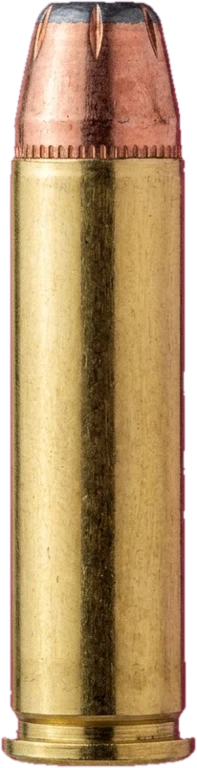
.357 Magnum
Iconic high-pressure revolver cartridge setting benchmark standards for handgun stopping power.
- Designation
- —
- Standard
- —
- Origin
- —
- Introduced
- 1935
Community
Technical overview
Features a lengthened .38 Special rimmed brass case engineered to handle high operating pressures. Terminal performance delivers high velocity, rapid expansion, and deep tissue displacement across varied target barriers.
Strengths & limitations
- + Outstanding terminal effectiveness and barrier penetration capabilities.
- + Versatile chambering allowing the use of milder .38 Special loads for practice.
- + Flat trajectory suitable for medium-game hunting and defense.
- − Significant recoil impulse and intense muzzle flash in compact handguns.
- − Cylinder capacity typically limited to 6–8 rounds in revolver platforms.
Ballistics & dimensions
- Bullet diameter
- 9.09 mm (0.357 in)
- Case length
- 33.00 mm (1.290 in)
- Overall length
- 40.00 mm (1.590 in)
- Bullet weight
- 7.1–11.7 g (110–180 gr)
- Muzzle velocity
- 440 m/s (1,450 ft/s)
- Energy
- 790 J (583 ft·lbf)
- Max pressure
- 3,000 bar (43,511 psi)
- Typical twist rate
- —
Military variants & loadings
No variants recorded yet.
Weapons in the catalog using it (0)
Platforms: Smith & Wesson Model 27, Smith & Wesson Model 66, Colt Python, Ruger GP100, Desert Eagle .357
Related cartridges: .38 Special, .357 SIG, .357 Remington Maximum, 9×19 mm Parabellum
Data trust: Verified (CIP / SAAMI / Official Military Ordnance Specifications)
Doctrine & history
Developed in 1935 by Elmer Keith, Phillip Sharpe, and Smith & Wesson to counter motor-bandit armor during the Prohibition era. It gained legendary status in law enforcement and civilian self-defense, helping usher in the magnum handgun era.
