
.38 Special
Classic American service revolver round celebrated for manageable recoil, accuracy, and versatility.
- Designation
- —
- Standard
- —
- Origin
- —
- Introduced
- 1898
Community
Technical overview
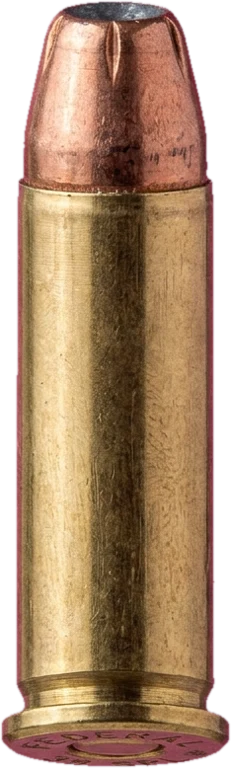
Utilizes a rimmed, straight-walled brass casing originally loaded with black powder. Modern smokeless loadings rely on controlled lead expansion or hollow-point cavity disruption under low-to-moderate working pressures.
Strengths & limitations
- + Low felt recoil and excellent target accuracy.
- + Can be safely fired in all .357 Magnum revolvers.
- + Widespread commercial availability and diverse projectile selection.
- − Lower muzzle energy compared to modern auto-pistol duty cartridges.
- − Rimmed design limits high-capacity semi-automatic magazine implementation.
Ballistics & dimensions
- Bullet diameter
- 9.09 mm (0.357 in)
- Case length
- 29.30 mm (1.155 in)
- Overall length
- 39.40 mm (1.550 in)
- Bullet weight
- 7.1–10.2 g (110–158 gr)
- Muzzle velocity
- 270 m/s (890 ft/s)
- Energy
- 310 J (229 ft·lbf)
- Max pressure
- 1,200 bar (17,405 psi)
- Typical twist rate
- —
Military variants & loadings
No variants recorded yet.
Weapons in the catalog using it (0)
Platforms: Smith & Wesson Model 10, Smith & Wesson Model 36, Colt Official Police, Ruger LCR, Taurus Model 85
Related cartridges: .38 Long Colt, .357 Magnum, .38 Short Colt, 9×19 mm Parabellum
Data trust: Verified (CIP / SAAMI / Official Military Ordnance Specifications)
Doctrine & history
Designed by Smith & Wesson in 1898 as an upgrade to the .38 Long Colt following performance deficiencies in the Philippine-American War. It served as the standard sidearm round for most American police departments from the 1920s to the 1990s and remains popular for concealed carry.
