

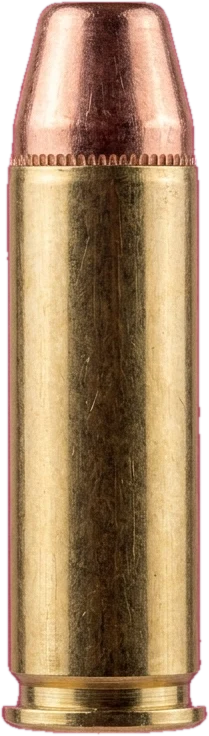
.44 Special
Smooth-shooting, accurate large-bore revolver cartridge that served as the foundational parent to the .44 Magnum.
- Designation
- —
- Standard
- —
- Origin
- —
- Introduced
- 1907
Community
Technical overview
Features a straight-walled, rimmed brass case derived by lengthening the .44 Russian cartridge. Operating at low standard pressures, terminal dynamics rely on heavy .429-inch lead projectiles for steady momentum and controlled expansion.
Strengths & limitations
- + Mild recoil combined with large bullet diameter for self-defense.
- + Can be fired safely in all .44 Magnum revolvers.
- + Exceptional intrinsic accuracy potential.
- − Factory loads are conservative due to older firearm structural limits.
- − Higher cost and reduced retail availability compared to .38 Special.
Ballistics & dimensions
- Bullet diameter
- 10.89 mm (0.429 in)
- Case length
- 29.50 mm (1.160 in)
- Overall length
- 40.00 mm (1.615 in)
- Bullet weight
- 11.7–16.2 g (180–250 gr)
- Muzzle velocity
- 260 m/s (850 ft/s)
- Energy
- 450 J (332 ft·lbf)
- Max pressure
- 1,070 bar (15,519 psi)
- Typical twist rate
- —
Military variants & loadings
No variants recorded yet.
Weapons in the catalog using it (0)
Platforms: Smith & Wesson Triple Lock, Charter Arms Bulldog, Ruger GP100 .44, Smith & Wesson Model 24
Related cartridges: .44 Russian, .44 Magnum, .44-40 Winchester, .45 Colt
Data trust: Verified (CIP / SAAMI / Official Military Ordnance Specifications)
Doctrine & history
Introduced by Smith & Wesson in 1907 for the New Century (Triple Lock) revolver. Experimentation by ballisticians like Elmer Keith pushing .44 Special loads to higher pressures eventually led directly to the development of the .44 Magnum in 1956.
