

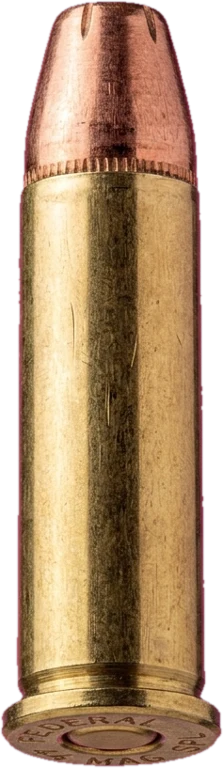
.44 Magnum
Legendary large-bore magnum cartridge famous for devastating energy output and big-game hunting capabilities.
- Designation
- —
- Standard
- —
- Origin
- —
- Introduced
- 1956
Community
Technical overview
Built on a lengthened .44 Special rimmed case designed to handle intense chamber pressures. Terminal ballistics feature heavy projectile momentum, vast hydrostatic shock, and deep penetration through dense tissue and bone.
Strengths & limitations
- + Tremendous kinetic energy suitable for big-game hunting and wilderness protection.
- + Widespread availability of diverse hunting and defensive factory loads.
- + Can chamber lighter .44 Special rounds for lower recoil shooting.
- − Heavy recoil impulse requiring disciplined grip and technique.
- − Significant blast and noise profile in enclosed or short-barrel settings.
Ballistics & dimensions
- Bullet diameter
- 10.89 mm (0.429 in)
- Case length
- 32.64 mm (1.285 in)
- Overall length
- 40.89 mm (1.610 in)
- Bullet weight
- 11.7–22.0 g (180–340 gr)
- Muzzle velocity
- 440 m/s (1,450 ft/s)
- Energy
- 1,500 J (1,106 ft·lbf)
- Max pressure
- 2,800 bar (40,611 psi)
- Typical twist rate
- —
Military variants & loadings
No variants recorded yet.
Weapons in the catalog using it (0)
Platforms: Smith & Wesson Model 29, Ruger Redhawk, Desert Eagle .44, Marlin Model 1894, Ruger Super Blackhawk
Related cartridges: .44 Special, .444 Marlin, .454 Casull, .357 Magnum
Data trust: Verified (CIP / SAAMI / Official Military Ordnance Specifications)
Doctrine & history
Developed in 1956 by Elmer Keith and Remington Arms Company alongside Smith & Wesson for the Model 29 revolver. Pop-culture popularity in the 1970s cemented its status, and it remains a global baseline for heavy handgun hunting cartridges.
