
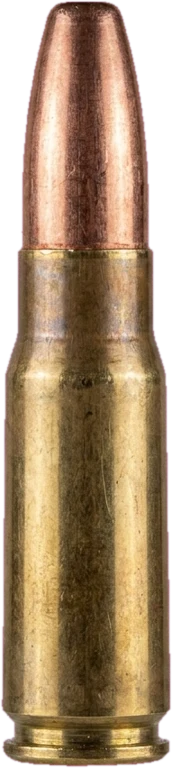
9×39 mm
Specialized heavy-caliber subsonic rifle cartridge engineered for suppressed armor-piercing applications.
- Designation
- —
- Standard
- —
- Origin
- —
- Introduced
- 1987
Community
Technical overview
Created by necking up the 7.62×39mm case to accept broad 9.2mm heavy projectiles weighing upwards of 250 grains. Designed specifically to maintain flight stability strictly below the speed of sound, suppressing acoustic signatures while utilizing large tungsten or hardened steel cores to punch through infantry armor.
Strengths & limitations
- + Superior noise suppression characteristics when paired with integral suppressors.
- + High momentum and energy retention out to intermediate ranges despite subsonic speeds.
- + Exceptional armor-defeating capabilities (specifically the SP-6 and PUB variants).
- − Steep ballistic trajectory requiring precise distance estimation.
- − Heavy projectile weight limits total magazine payload capacity by mass.
Ballistics & dimensions
- Bullet diameter
- 9.25 mm (0.364 in)
- Case length
- 38.80 mm (1.528 in)
- Overall length
- 56.00 mm (2.205 in)
- Bullet weight
- 16.0–17.3 g (247–267 gr)
- Muzzle velocity
- 300 m/s (984 ft/s)
- Energy
- 720 J (531 ft·lbf)
- Max pressure
- 2,800 bar (40,611 psi)
- Typical twist rate
- —
Military variants & loadings
No variants recorded yet.
Weapons in the catalog using it (0)
Platforms: VSS Vintorez, AS Val, SR-3 Vikhr, OTs-14-4A Groza, AK-9, AMB-17
Related cartridges: 7.62×39 mm, .300 AAC Blackout, 8.6 Blackout
Data trust: Verified (CIP / SAAMI / Official Military Ordnance Specifications)
Doctrine & history
Developed in the Soviet Union during the late 1980s by NII-735 to provide Spetsnaz and specialized reconnaissance units with a lethal, armor-piercing suppressed system. It gained extensive real-world usage during conflicts in Chechnya and remains a staple of specialized Russian internal security forces.
