
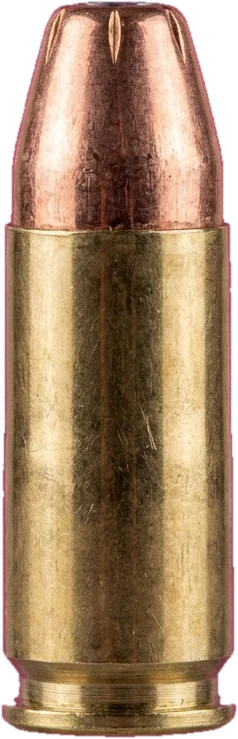
.40 S&W
Mainstream American law-enforcement cartridge bridging 9mm magazine capacity with .45 ACP heavy terminal performance.
- Designation
- —
- Standard
- —
- Origin
- —
- Introduced
- 1990
Community
Technical overview
Features a straight-walled rimless case derived by shortening the 10mm Auto cartridge. Terminal mechanics excel at barrier penetration and soft tissue displacement using medium-to-heavy 10mm jacketed hollow point projectiles.
Strengths & limitations
- + Excellent combination of stopping power, barrier penetration, and magazine payload.
- + Fits standard 9mm frame footprints, allowing easy platform conversion.
- + Extensive defensive ammunition choices developed for police contracts.
- − Snappy recoil impulse and higher snap acceleration than standard 9mm Parabellum.
- − Increased wear on handgun recoil springs and internal components over time.
Ballistics & dimensions
- Bullet diameter
- 10.16 mm (0.400 in)
- Case length
- 21.59 mm (0.850 in)
- Overall length
- 28.83 mm (1.135 in)
- Bullet weight
- 10.0–11.7 g (155–180 gr)
- Muzzle velocity
- 315 m/s (1,030 ft/s)
- Energy
- 568 J (419 ft·lbf)
- Max pressure
- 2,400 bar (34,809 psi)
- Typical twist rate
- —
Military variants & loadings
No variants recorded yet.
Weapons in the catalog using it (0)
Platforms: Glock 22/23, Smith & Wesson M&P40, SIG Sauer P229, HK USP40, Beretta 96
Related cartridges: 10mm Auto, 9×19 mm Parabellum, .357 SIG, .45 ACP
Data trust: Verified (CIP / SAAMI / Official Military Ordnance Specifications)
Doctrine & history
Developed jointly by Smith & Wesson and Winchester in 1990 following the 1986 FBI Miami shootout, aiming to match 10mm Lite ballistic criteria inside a 9mm-sized frame. It dominated American law enforcement agencies for over two decades before recent shifts back toward 9mm.
