KH-11 Kennen / Crystal (Keyhole)
Country:  United StatesManufacturer: Lockheed Martin
Developed by the NRO in the mid-1970s under Project Kennen to replace film-return reconnaissance satellites (KH-8 Gambit and KH-9 Hexagon).
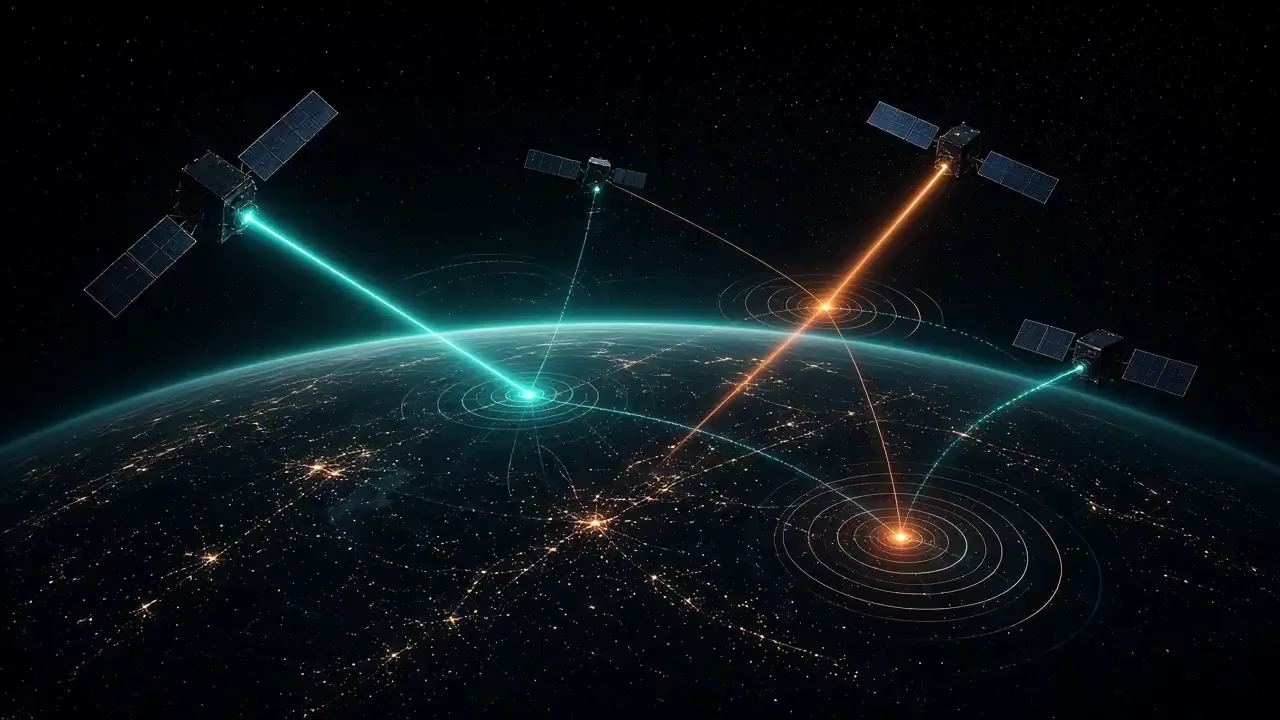
Generic satellite illustration — not a depiction of the actual system. CLASSIFIED is a visual label, not an official classification statement.
Community
Identity5 fields
- Country
- United States
- Manufacturer
- Lockheed Martin Space
- Introduction
- 1976
- Status
- In service
- Category
- Reconnaissance satellite
Mission9 fields
- Orbit
- Sun-Synchronous Orbit (SSO) / Low Earth Orbit (LEO)
- Operator
- National Reconnaissance Office (NRO)
- Payload
- 2.4-meter primary mirror electro-optical telescope (Cassegrain reflector) with multi-spectral CCD/IR digital imaging sensors
- Altitude & Inclination
- ~260 km × 1,000 km elliptical (varies by block) | 97.9° inclination
- Launch Mass
- ~13,500–19,600 kg (Block-dependent)
Data trust
- Reliability
- Unverified
- Sources
- Sources pending review
- Last reviewed

Historical profile
Developed by the NRO in the mid-1970s under Project Kennen to replace film-return reconnaissance satellites (KH-8 Gambit and KH-9 Hexagon). The KH-11 was the world's first operational spy satellite to utilize real-time digital electro-optical imaging transmitted via relay satellites (SDS), eliminating the delay and vulnerability of physical film capsule recovery. Its optical architecture shares heritage with NASA's Hubble Space Telescope, which utilized an identical 2.4-meter mirror blank class.
Provided continuous strategic intelligence throughout the Cold War, Operation Desert Storm (1991), operations in Iraq and Afghanistan, and real-time monitoring of global missile launches and troop movements.
Variants and blocks: Block I (1976), Block II (Crystal, 1984), Block III (Improved Crystal, 1992), Block IV (Evolved Enhanced Crystal, 2005), Block V (2019–present).