
Yaogan-30 / Yaogan-35 (CX-5 ELINT Constellation)
Country:  ChinaManufacturer: Innovation Academy for Microsatellites (IAMCAS — Chinese Academy of Sciences)
Publicly described by Chinese state media as electromagnetic environment detection satellites, the Yaogan-30 and successor Yaogan-35/36/39 series operate as a dedicated space-based Naval Ocean Surveillance System (NOSS equivalent).
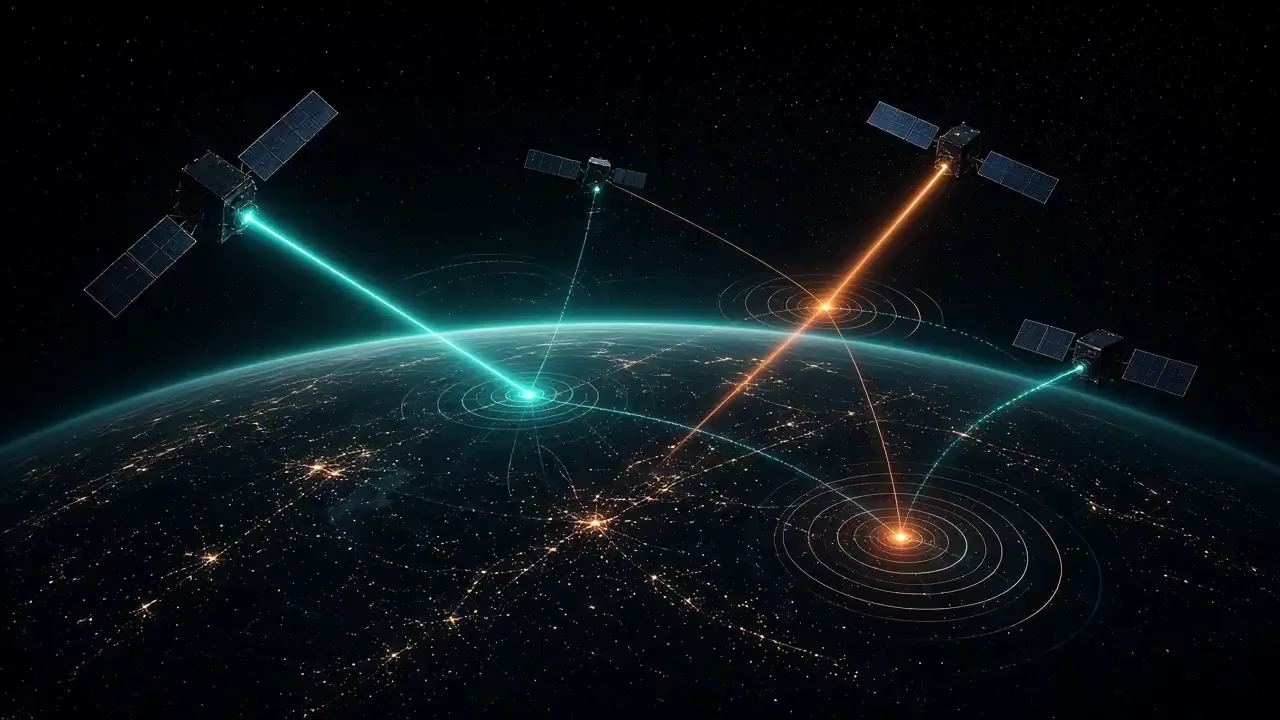
Generic satellite illustration — not a depiction of the actual system. CLASSIFIED is a visual label, not an official classification statement.
Community
Identity5 fields
- Country
- China
- Manufacturer
- Innovation Academy for Microsatellites (IAMCAS — Chinese Academy of Sciences)
- Introduction
- 2017
- Status
- In service
- Category
- Signals intelligence satellite
Mission8 fields
- Orbit
- Low Earth Orbit (LEO) — Multi-plane triplet formation
- Operator
- People's Liberation Army Aerospace Force (PLAASF) / Strategic Support Force heritage
- Payload
- Passive multi-band radio-frequency (RF) receivers, radar emitter direction-finding arrays, and inter-satellite cross-links
- Altitude & Inclination
- ~600 km circular | 35° inclination
- Launch Mass
- ~300–500 kg per satellite (launched in clusters of 3)
Data trust
- Reliability
- Unverified
- Sources
- Sources pending review
- Last reviewed
Historical profile
Publicly described by Chinese state media as electromagnetic environment detection satellites, the Yaogan-30 and successor Yaogan-35/36/39 series operate as a dedicated space-based Naval Ocean Surveillance System (NOSS equivalent). By flying in synchronized triplets at a 35° inclination, the constellation concentrates revisit passes over low- and mid-latitude maritime corridors.
Forms the primary space-based targeting and maritime domain awareness layer for the PLA's Anti-Access/Area-Denial (A2/AD) kill chain, providing real-time passive geolocation of carrier strike groups and naval surface combatants for anti-ship ballistic missiles (DF-21D, DF-26).
Variants and blocks: Yaogan-30 (Groups 01–10, 30 satellites), Yaogan-35 / 36 / 39 / 42 (next-generation follow-on triplets expanding constellation density).
