
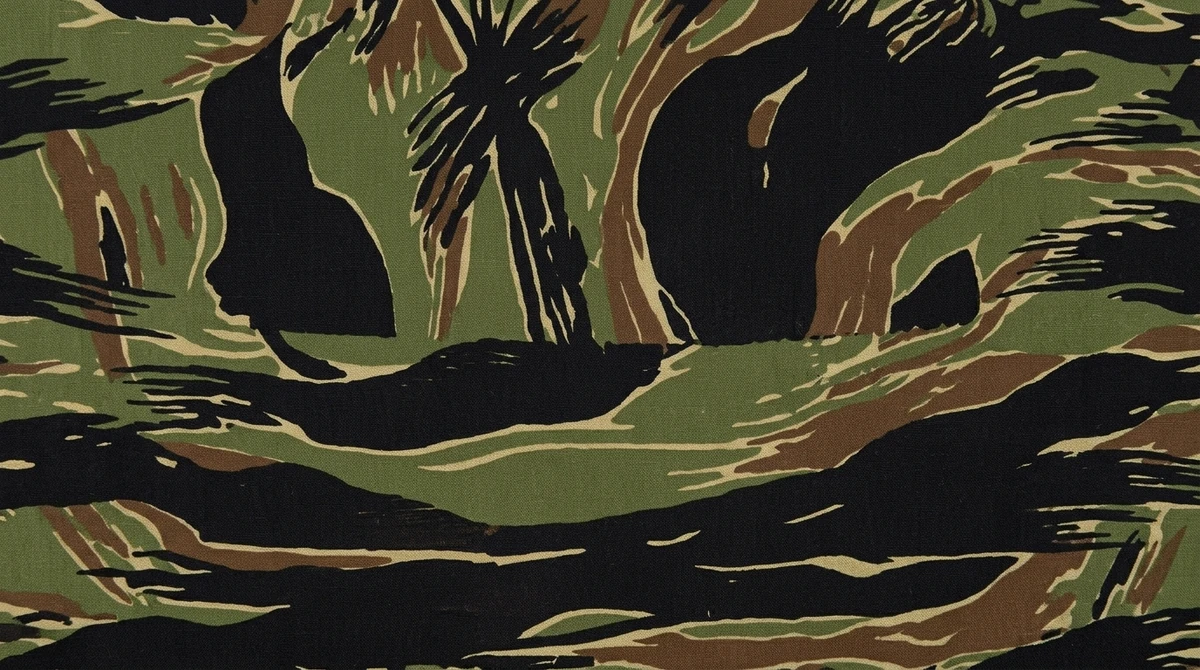
Camouflage pattern
Tigerstripe
Evolved in the early 1960s from the French Tenue Léopard (Lizard) airborne camouflage used during the First Indochina War. Tailored for South Vietnamese Rangers (Biệt Động Quân) and Marines, Tigerstripe narrowed and elongated the French horizontal brush strokes to mimic dappled sunlight filtering through dense Southeast Asian jungle foliage.
Community
Loading…
Pattern
- Country
- Vietnam / United States (use)
- Adopting service(s)
- South Vietnamese forces, US special operations (Vietnam War)
- Pattern type
- jungle
- Era
- Cold War
- Years in use
- 1960s–1970s
- Colours
- green, brown, black horizontal stripes on khaki/olive
- Predecessor
- French lizard
- Successor
- ERDL
- Data Trust
- Partial — public secondary sources; not fully verified
Variants
| Name | Years | Notes |
|---|---|---|
| many unofficial production variants | — | — |
Specifications
- Category
- Camouflage pattern
- Country
- South Vietnam / United States
- Manufacturer
- South Vietnamese Textile Contractors / U.S. Military Assistance Command (MACV-SOG) / Tiger Stripe Products
- Introduced
- 1962
- Status
- Active (Specialized / Partner Forces & OPFOR Training)
- Protection level
- —
- Material
- Lightweight 100% cotton twill and poplin (Vietnam-era "Advisor" and "John Wayne" dense cuts) or modern 50/50 NYCO ripstop
- Weight
- —
- Users
- —
- Color Palette
- 4-color horizontal interlocking stripe pattern: Light Olive/Sage or Golden-Tan background overlaid with bold horizontal Brush-Green, Dark Brown, and dense Black tapered stripes
- Spectral & NIR Performance
- Legacy 1960s cotton weaves lacked NIR treatment; modern licensed variants (e.g., Desert Tiger Stripe and All-Terrain Tiger) incorporate full Near-Infrared (NIR) compliance on 50/50 NYCO fabrics
- Environmental Optimization
- Dense tropical rainforest, bamboo jungle, mangrove swamps, and dappled canopy shadows
- Variants & modernizations
- Vietnamese Marine Pattern, John Wayne Dense (JWD), Advisor Sparse (ADS), Golden Tigerstripe, Desert Tigerstripe (2000s), and All-Terrain Tiger (ATT).
History
Rapidly adopted by U.S. Special Forces (Green Berets), MACV-SOG reconnaissance teams, Navy SEALs, and LRRP units during the Vietnam War due to its unmatched close-range concealment in triple-canopy jungle. Later saw specialized use in Desert Tiger variants during CIA/USSOCOM operations in Afghanistan (2001–2002) and continues in service across Southeast Asian militaries and U.S. OPFOR units.
Related systems
—
Sources
- Data trust: Verified (U.S. Army Special Operations Historical Archives & Vietnam-Era Quartermaster Records)
- Pattern reference
- Data trust: partial (public secondary sources; not fully verified)
Community
Loading…
