
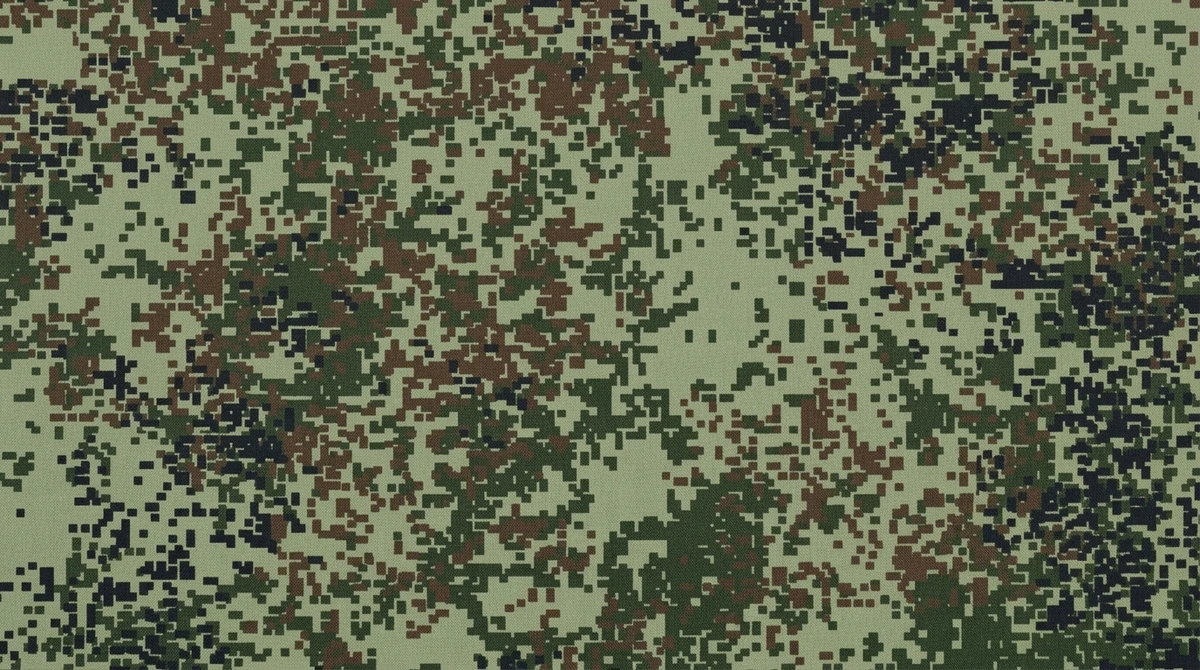
Camouflage pattern
EMR Digital Flora
Introduced in 2008 under the Yedinaya Maskirovochnaya Raskraska (EMR — "Unified Camouflage Coloration") designation to replace the legacy Flora (VSR-98) pattern across the Russian Armed Forces. EMR employs ultra-fine micro-pixels designed to create visual noise that dissolves the soldier's outline into foliage at medium-to-long distances.
Community
Loading…
Pattern
- Country
 Russia
- Adopting service(s)
- Russian Armed Forces
- Pattern type
- digital
- Era
- current
- Years in use
- 2008–present
- Colours
- green, light green, brown, black (temperate)
- Predecessor
- VSR-98 Flora
- Successor
- —
- Data Trust
- Partial — public secondary sources; not fully verified
Variants
| Name | Years | Notes |
|---|---|---|
| temperate/summer | — | — |
| autumn | — | — |
| spring | — | — |
| desert | — | — |
| winter/arctic | — | — |
| MVD variants | — | — |
Specifications
- Category
- Camouflage pattern
- Country
- Russia
- Manufacturer
- TsNIIShP (Central Research Institute of the Garment Industry)
- Introduced
- 2008
- Status
- Active (Standard Issue Russian Armed Forces — Ratnik System)
- Protection level
- —
- Material
- Ripstop cotton-polyester blends (65/35 and 50/50), flame-resistant aramid tanker suits (Cowboy 6B15), and 1000D/500D Cordura load-bearing gear
- Weight
- —
- Users
- —
- Color Palette
- 4-color fine micro-pixelated matrix: Pale Green-Grey background with Dark Olive, Dark Forest Green, and Black micro-pixels
- Spectral & NIR Performance
- NIR-remission treated fabrics integrated across VKPO/VKBO (All-Season Field Uniform Set) and Ratnik combat gear to reduce contrast under Gen 2+/3 night-vision systems
- Environmental Optimization
- Eurasian temperate forests, steppe grasslands, and mixed woodland terrain
- Variants & modernizations
- EMR Leto (Summer/Temperate standard), EMR Steppe/Desert (Syria deployment variant), EMR Arctic/Winter, and Sever / Gorod internal security colorways.
History
Standardized across Russian Ground Forces, VDV Airborne, Naval Infantry, and Strategic Rocket Forces since 2009–2011, serving as the primary uniform and equipment camouflage across Syria and the Russo-Ukrainian War.
Related systems
—
Sources
- Data trust: Verified (Russian Ministry of Defense VKBO / Ratnik Technical Specifications)
- Pattern reference
- Data trust: partial (public secondary sources; not fully verified)
Community
Loading…
