
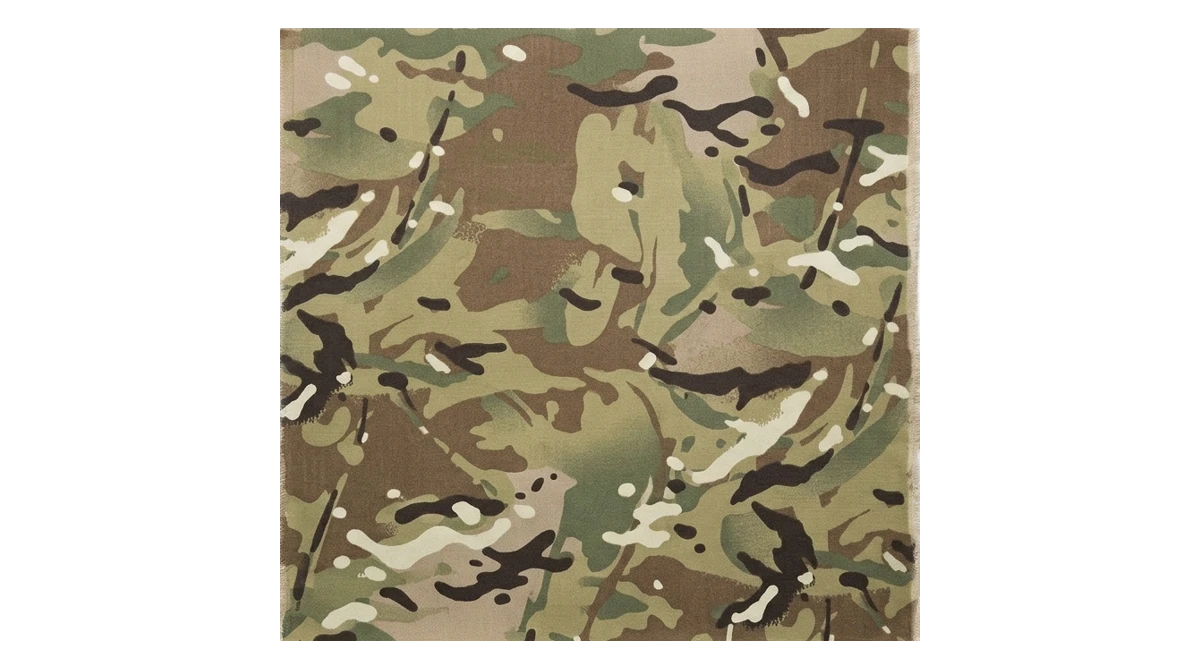
Camouflage pattern
Multi-Terrain Pattern (MTP)
Commissioned urgently in 2009 by the UK Ministry of Defence after British forces in Helmand Province, Afghanistan found themselves transitioning rapidly between arid desert and lush irrigated river valleys ("Green Zone") where neither Desert DPM nor Temperate DPM provided consistent concealment. Dstl partnered with Crye Precision to fuse MultiCam's color palette with traditional British DPM brushstroke shapes.
AI render based on photo by Amanda Reynolds, Ministry of Defence photographer, OGL v1.0
Community
Loading…
Pattern
- Country
 United Kingdom
- Adopting service(s)
- British Armed Forces
- Pattern type
- multi-environment
- Era
- current
- Years in use
- 2010–present
- Colours
- MultiCam-based palette with DPM shapes
- Predecessor
- DPM
- Successor
- —
- Data Trust
- Partial — public secondary sources; not fully verified
Variants
| Name | Years | Notes |
|---|---|---|
| MTP | — | — |
| MTP arid | — | limited |
Specifications
- Category
- Camouflage pattern
- Country
- United Kingdom
- Manufacturer
- Crye Precision / Defence Science and Technology Laboratory (Dstl)
- Introduced
- 2010
- Status
- Active (Standard Issue UK Armed Forces)
- Protection level
- —
- Material
- Windproof cotton-polyester gabardine, 50/50 NYCO ripstop, flame-retardant UBACS (Under Body Armour Combat Shirt) torso fabrics, and 1000D Cordura nylon
- Weight
- —
- Users
- —
- Color Palette
- 7-color transitional gradient palette blending Crye MultiCam's multi-environment spectrum (tan, light green, mid-green, olive, brown, cream highlights) with the iconic brushstroke shape geometry of British DPM
- Spectral & NIR Performance
- Engineered to UK Defence Standard Infrared-Reflective (IRR) tolerances across Personal Clothing System (PCS) textiles and Virtus/Osprey Mk 4 load-bearing equipment
- Environmental Optimization
- Transitional multi-environment performance spanning Helmand-style green zones, arid scrubland, temperate European forests, and urban terrain
- Variants & modernizations
- MTP PCS (Personal Clothing System — 2011+ uniform cut), MTP Tropical, and MTP FR (Flame Retardant aircrew/armored crew variants).
History
First issued to troops deploying to Afghanistan (Operation Herrick 12) in March 2010 and rolled out across the entire British Army, Royal Marines, Royal Navy, and Royal Air Force by 2013, replacing both Temperate and Desert DPM.
Related systems
—
Sources
- Data trust: Verified (UK Ministry of Defence / Dstl Technical Reports & Crye Precision Specifications)
- Pattern reference
- Data trust: partial (public secondary sources; not fully verified)
Community
Loading…
