
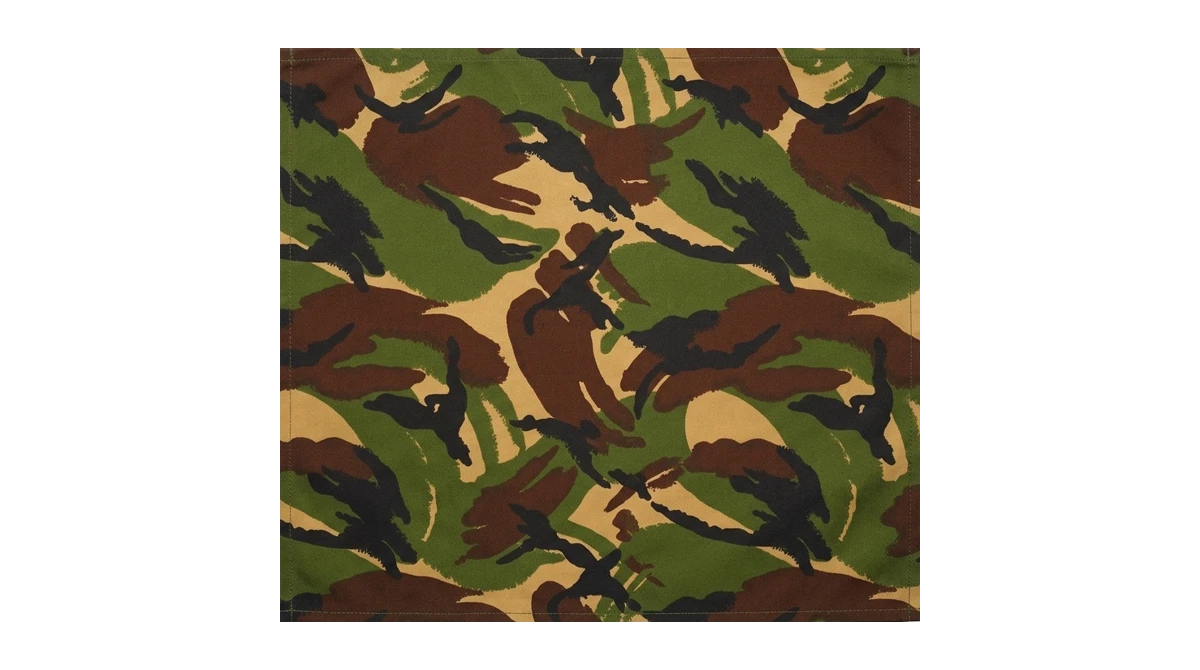
Camouflage pattern
Disruptive Pattern Material (DPM)
Tracing its lineage to WWII British Denison airborne smocks, DPM was formally standardized in the late 1960s to replace monochrome olive-drab battle dress. Characterized by bold, sweeping organic brushstrokes bordered by fine stippled edges that soften color transitions, DPM became one of the most widely adopted camouflage families of the Cold War.
Community
Loading…
Pattern
- Country
 United Kingdom
- Adopting service(s)
- British Armed Forces
- Pattern type
- woodland
- Era
- Cold War → post-Cold War
- Years in use
- 1960s–2011
- Colours
- green, brown, black, sand
- Predecessor
- —
- Successor
- MTP
- Data Trust
- Partial — public secondary sources; not fully verified
Variants
| Name | Years | Notes |
|---|---|---|
| temperate DPM | — | — |
| desert DPM | — | — |
| many national derivatives | — | — |
Specifications
- Category
- Camouflage pattern
- Country
- United Kingdom
- Manufacturer
- UK Ministry of Defence / War Office Clothing & Textiles Research
- Introduced
- —
- Status
- Retired (Replaced by Multi-Terrain Pattern — MTP in 2010–2013; still active in Commonwealth & partner forces)
- Protection level
- —
- Material
- Cotton-polyester gabardine and ripstop weaves (CS95 smocks, trousers, and PLCE webbing/Osprey Mk 1–3 carriers)
- Weight
- —
- Users
- —
- Introduction dates
- 1966 (Pattern 60/68 standardization)
- Color Palette
- 4-color organic brush-stroke disruptive pattern:; Temperate Woodland: Sand/Tan base with Mid-Brown, Olive Green, and Black brushstroke/stippled transitions; *Desert DPM:* 2-color (later 3-color) Light Sand and Mid-Brown organic waves
- Spectral & NIR Performance
- Infrared-reflective (IRR) dye formulations introduced from Pattern 84/95 Combat Soldier 95 (CS95) onward to suppress thermal/NIR blooming under night-vision optics
- Environmental Optimization
- Northern and Central European temperate woodlands (Temperate DPM) and arid desert theaters (Desert DPM)
- Variants & modernizations
- Pattern 60/68, Pattern 84, Combat Soldier 95 (CS95 — refined dark contrast and IRR fabric), 2-Color Desert DPM (1990), and Tropical Jungle DPM.
History
Worn by the British Armed Forces through Northern Ireland (Operation Banner), the Falklands War (1982), the Persian Gulf War (1991), the Balkans, Iraq, and early Afghanistan deployments, while being adopted or adapted by over 40 Commonwealth and allied militaries (including the Netherlands, New Zealand, Oman, Indonesia, and Romania).
Related systems
—
Sources
- Data trust: Verified (UK Ministry of Defence Clothing & Textiles Specifications)
- Pattern reference
- Data trust: partial (public secondary sources; not fully verified)
Community
Loading…
