
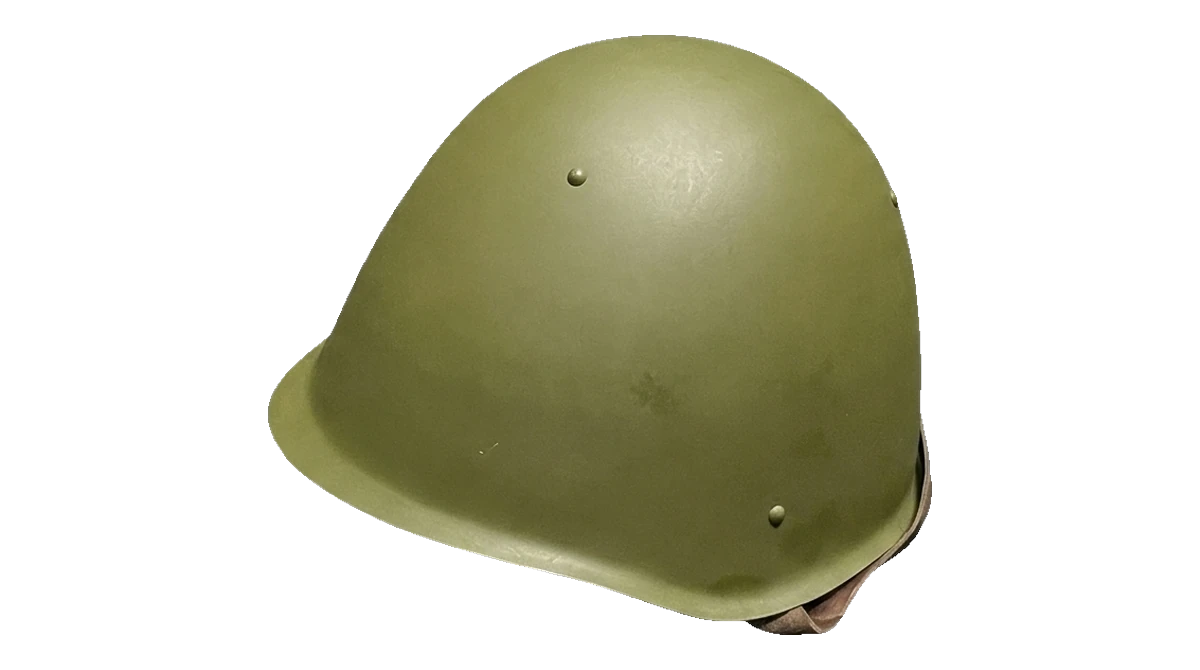
Ballistic helmet
SSh-68
Developed as an evolution of the WWII-era SSh-40 and post-war SSh-60 helmets, the SSh-68 (Stalnoy Shlem 68) introduced a steeper frontal slope to increase bullet deflection angles and stronger alloyed steel to enhance fragment resistance while keeping manufacturing simple and inexpensive for mass conscript armies.
Community
Loading…
Specifications
- Category
- Ballistic helmet
- Country
- Soviet Union
- Manufacturer
- Krasny Oktyabr (Stalingrad/Volgograd) / Lysva Metallurgical Plant
- Introduced
- 1968
- Status
- Reserve / Legacy Service
- Protection level
- GOST Class 1 equivalent; protects against shell fragments, shrapnel (V50 ≈ 320–350 m/s), and 9×18 mm Makarov / 7.62×25 mm Tokarev low-velocity pistol projectiles
- Material
- High-strength alloyed steel (Grade 38KhN3MFA / hardened ballistic steel, ~1.9–2.0 mm thickness)
- Weight
- ~1.30–1.50 kg (2.87–3.31 lb)
- Users
- —
- Suspension / Liner
- Four-petal artificial leather / vinyl crown suspension riveted directly to the shell interior with canvas chinstrap
- Accessories & Mounting
- Reversible KLMK / Dubok / Flora camouflage fabric covers, cold-weather ushanka winter cap compatibility
- Variants & modernizations
- SSh-68 (baseline riveted suspension), SSh-68M (modernized 2000s retrofit incorporating an internal aramid ballistic layer and three-point suspension harness), SSh-68N.
History
Standardized by the Soviet Armed Forces in 1968 and issued across all Warsaw Pact nations and Soviet-aligned states. It saw extensive combat during the Soviet-Afghan War, the Chechen Wars, and remains in reserve or secondary use in Eastern Europe today.
Related systems
—
Sources
- Data trust: Verified (Soviet Ministry of Defense GRAU Index 6B14 / Technical Specifications)
Community
Loading…
