
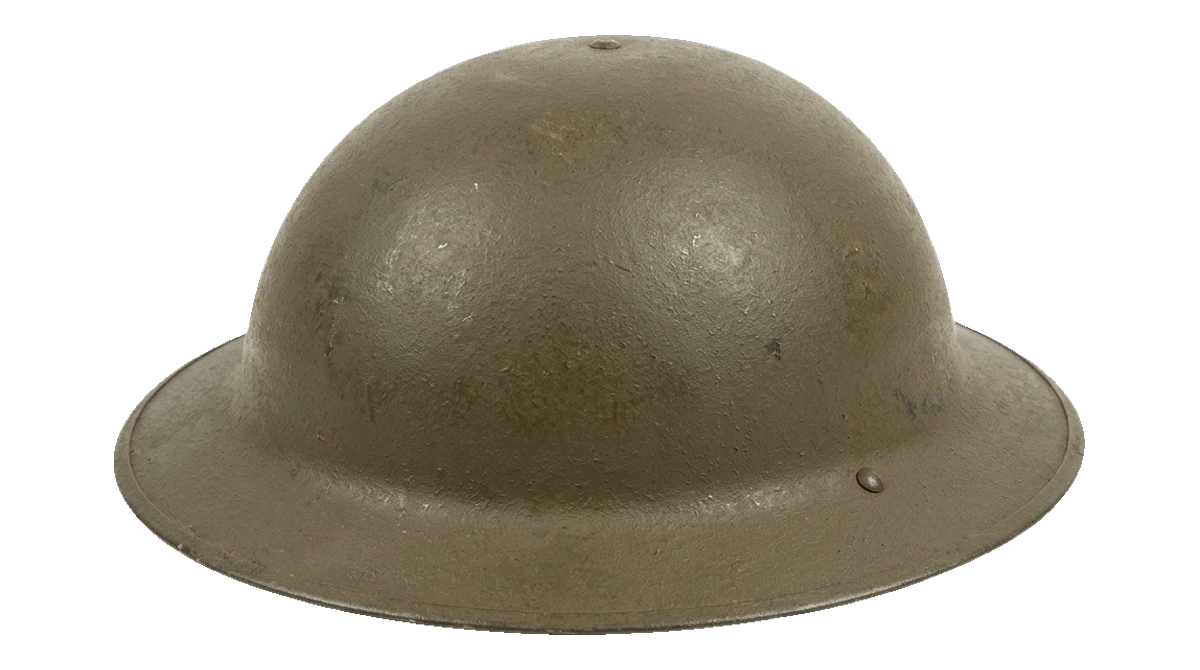
Ballistic helmet
Brodie helmet
Patented in August 1915 by Latvian-born British inventor John Leopold Brodie, the helmet featured a wide, flat brim and shallow circular crown specifically optimized to shield soldiers standing in World War I trenches from overhead artillery shrapnel bursts while being cheap and rapid to press from a single sheet of manganese steel.
Community
Loading…
Specifications
- Category
- Ballistic helmet
- Country
- United Kingdom
- Manufacturer
- John Leopold Brodie / Hadfields Ltd (Sheffield) / Briggs Motor Bodies
- Introduced
- 1915
- Status
- Retired
- Protection level
- Overhead shrapnel, artillery airburst fragments, and falling trench debris (V50 ≈ 210–240 m/s); limited lateral/nape coverage due to shallow dome geometry
- Material
- Single-piece pressed Hadfield manganese steel (non-magnetic, high work-hardening alloy)
- Weight
- ~0.68–1.10 kg (1.5–2.4 lb) depending on Mk I vs. Mk II rim reinforcement
- Users
- —
- Suspension / Liner
- Oilcloth and felt-padded crown cushion with asbestos heat-insulating pad, rubber ring buffer, and leather chinstrap
- Accessories & Mounting
- Hessian burlap scrim covers, camouflage netting, painted tactical unit flashes
- Variants & modernizations
- Type A (raw edge, 1915), Type B / Mk I (folded mild steel rim, improved liner, 1916), U.S. M1917 / M1917A1, and WWII Mk II (1938, featuring upgraded cruciform rubber-bumper liner and non-magnetic rim).
History
Adopted by the British Army in late 1915 and issued across the British Empire and Commonwealth forces through World War I and World War II. The United States Army also adopted the design as the M1917 helmet before transitioning to the M1 in 1941.
Related systems
—
Sources
- Data trust: Verified (UK War Office Ordnance Records & Imperial War Museums Archives)
Community
Loading…
