
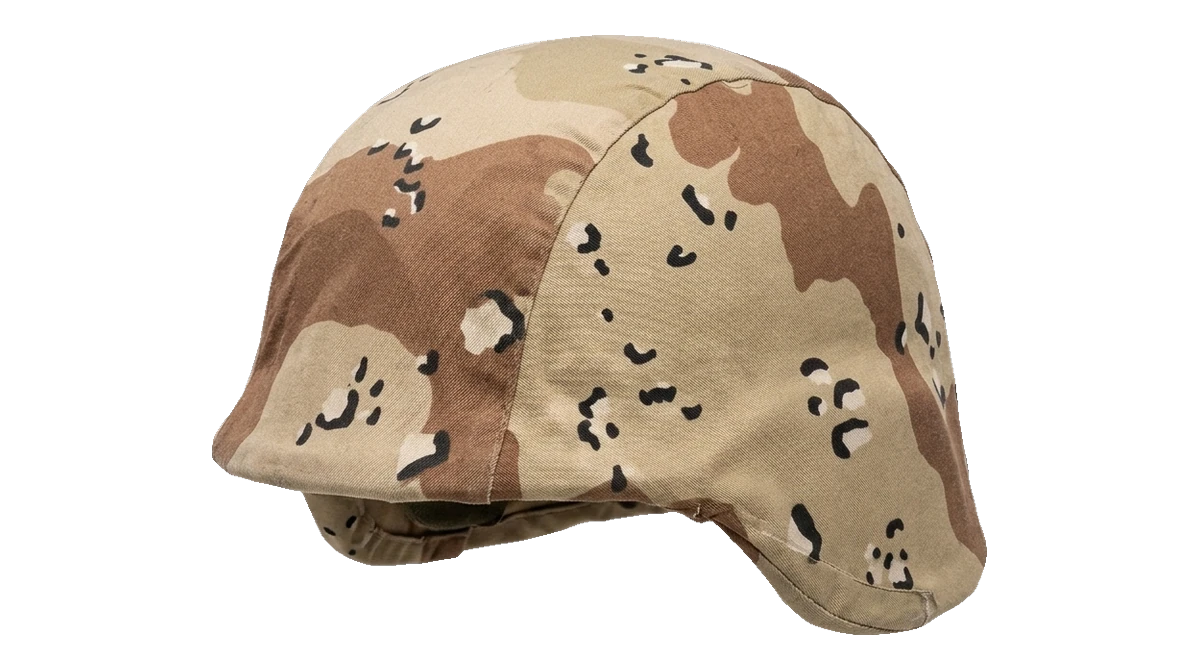
Ballistic helmet
PASGT helmet
Developed by the U.S. Army Natick Research, Development and Engineering Center in the late 1970s as part of the Personnel Armor System for Ground Troops (PASGT). It was the first standard-issue U.S. military helmet constructed entirely from DuPont Kevlar aramid fibers, featuring a distinctive brimmed profile with flared ear guards for improved lateral protection.
Community
Loading…
Specifications
- Category
- Ballistic helmet
- Country
- United States
- Manufacturer
- Gentex Corporation / UNICOR / Specialty Plastic Products
- Introduced
- 1983
- Status
- Retired (Replaced by ACH/ECH/LWH; still used by allied forces & reserve units)
- Protection level
- NIJ Level II / IIIA fragment standard (V50 ≈ 610 m/s (2,000 ft/s) against 17-grain [1.1 g] FSP — a ~50% ballistic improvement over the steel M1)
- Material
- Multi-layer Kevlar 29 para-aramid fabric bonded with phenolic/PVB resin (~19 layers)
- Weight
- ~1.41–1.91 kg (3.1–4.2 lb) depending on shell size (XS to XL)
- Users
- —
- Suspension / Liner
- Riveted cotton webbing cradle suspension with sweatband and two-point chinstrap (later retrofitted with Oregon Aero pad kits)
- Accessories & Mounting
- M81 Woodland, Chocolate Chip, and DCU camouflage covers, AN/PVS-7 / AN/PVS-14 night-vision shroud and strap mount, ballistic goggles
- Variants & modernizations
- Standard PASGT (XS–XL), USMC Lightweight Helmet (LWH — reduced weight by ~170 g with 4-point nape strap and pad suspension).
History
Debuted operationally during Operation Urgent Fury in Grenada (1983) and served as the primary U.S. military combat helmet throughout Operation Just Cause (Panama), Operation Desert Storm (1991), Balkans peacekeeping, and the initial stages of Operation Enduring Freedom and Operation Iraqi Freedom.
Related systems
—
Sources
- Data trust: Verified (U.S. Army NATICK Technical Reports & MIL-H-44099A Standard)
Community
Loading…
