
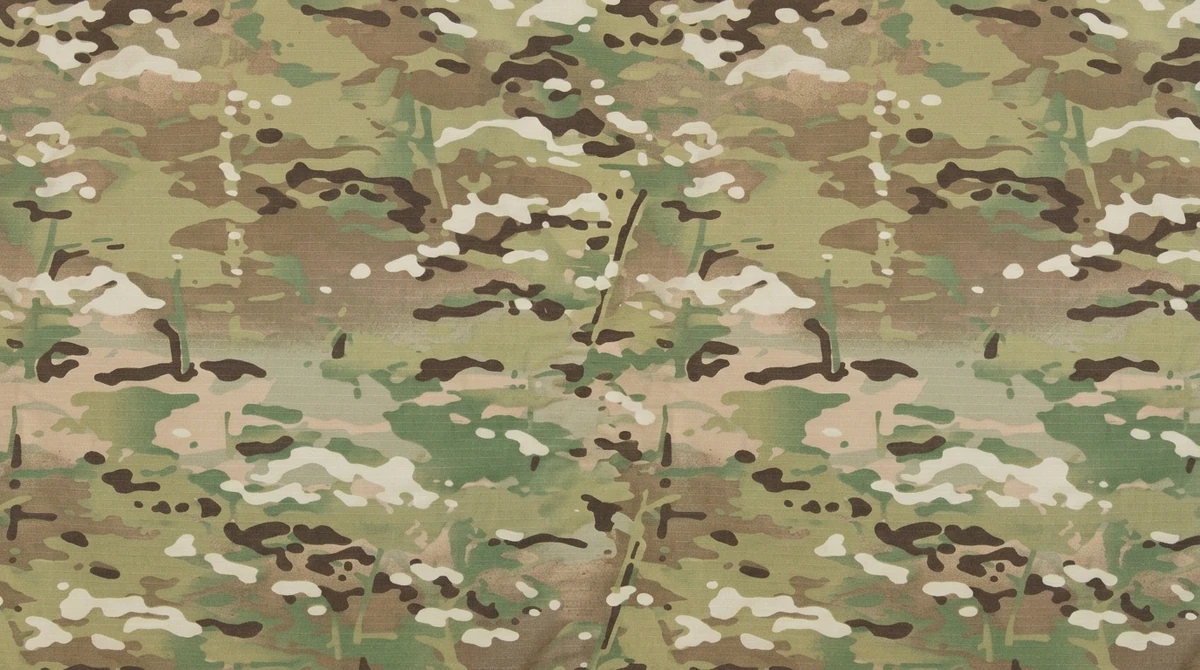
Camouflage pattern
MultiCam / OCP
Developed by Caleb Crye and Gregg Thompson of Crye Precision under the U.S. Army Objective Force Warrior program in 2002. Instead of relying on high-contrast macro-shapes or digital pixelation, MultiCam uses continuous tone gradients and dual-scale shapes that trick the human eye into perceiving background terrain colors through optical reflection.
Community
Loading…
Pattern
- Country
 United States (Crye Precision)
- Adopting service(s)
- US Army (Afghanistan 2010), many forces incl. UK MTP base, Australia AMCU
- Pattern type
- multi-environment
- Era
- current
- Years in use
- 2002–present
- Colours
- tan, browns, greens, cream
- Predecessor
- —
- Successor
- OCP Scorpion W2 (US Army, derived)
- Data Trust
- Partial — public secondary sources; not fully verified
Variants
| Name | Years | Notes |
|---|---|---|
| MultiCam | — | — |
| Arid | — | — |
| Tropic | — | — |
| Alpine | — | — |
| Black | — | — |
Specifications
- Category
- Camouflage pattern
- Country
- United States
- Manufacturer
- Crye Precision (in collaboration with U.S. Army Natick Soldier Research Center)
- Introduced
- —
- Status
- Active (Global Military & Special Operations Standard)
- Protection level
- —
- Material
- Typically printed on 50/50 Nylon-Cotton (NYCO) ripstop, 500D/1000D Cordura nylon, and flame-resistant Defender M / Nomex blends
- Weight
- —
- Users
- —
- Introduction dates
- 2002 (Operational adoption 2010)
- Color Palette
- 7-color gradient palette transitioning from tan/cream base through light green, olive, and dark brown with small light-cream and dark-brown disruptive micro-flecks
- Spectral & NIR Performance
- Engineered with controlled Near-Infrared (NIR) reflectance across all 7 pigments to match natural foliage and mineral terrain signatures under night-vision image intensifiers
- Environmental Optimization
- Multi-environment transitional effectiveness across arid, semi-arid, woodland, and temperate terrain
- Variants & modernizations
- MultiCam Standard, MultiCam Arid, MultiCam Tropic, MultiCam Alpine, MultiCam Black, and official military derivatives (OCP / Scorpion W2, UK MTP, Australian AMCU).
History
Though initially passed over by the U.S. Army in 2004 in favor of UCP, MultiCam was adopted by USSOCOM and fielded urgently in 2010 as Operation Enduring Freedom Camouflage Pattern (OEF-CP) in Afghanistan. It subsequently inspired the U.S. Army's Scorpion W2 (OCP), British MTP, and Australian AMCU, and is used by military and special operations forces in over 40 countries.
Related systems
—
Sources
- Data trust: Verified (Crye Precision Technical Documentation & U.S. Army PEO Soldier Records)
- Pattern reference
- Data trust: partial (public secondary sources; not fully verified)
Community
Loading…
