
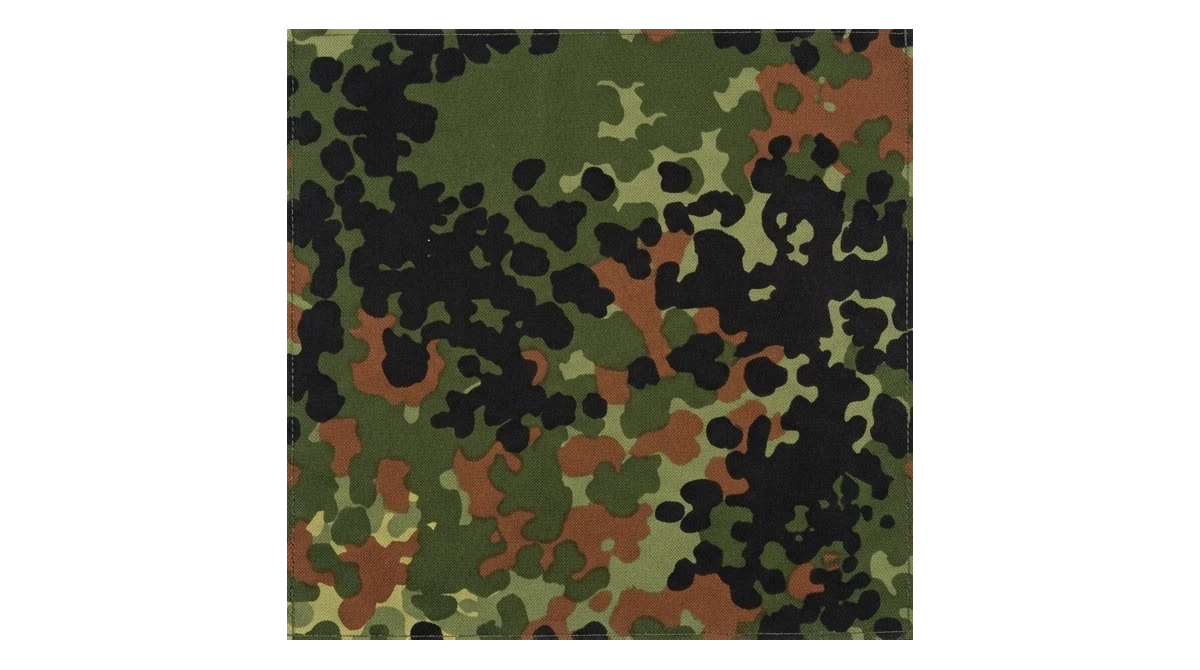
Camouflage pattern
Flecktarn
Tracing its heritage to WWII Waffen-SS dithered spot patterns (Erbsenmuster / Platanenmuster), modern Flecktarn (5-Farben-Tarndruck) was refined by the Bundeswehr in the late 1970s and 1980s using clustered spots that eliminate hard edges between color boundaries, creating a natural dithering effect similar to later digital patterns.
Community
Loading…
Pattern
- Country
 Germany
- Adopting service(s)
- Bundeswehr
- Pattern type
- woodland
- Era
- Cold War → current
- Years in use
- 1990–present (Bundeswehr general issue)
- Colours
- 5 colours: dark green, light green, red-brown, black, green-olive
- Predecessor
- Strichtarn-era / Bundeswehr olive
- Successor
- Multitarn (specialist)
- Data Trust
- Partial — public secondary sources; not fully verified
Variants
| Name | Years | Notes |
|---|---|---|
| Flecktarn | — | — |
| Tropentarn | — | desert |
| Schneetarn | — | snow |
| Danish M/84 derived | — | — |
Specifications
- Category
- Camouflage pattern
- Country
- Germany
- Manufacturer
- Marquardt & Schulz / Bundeswehr Technical Center for Protective and Special Technologies (WIWeB)
- Introduced
- 1990
- Status
- Active (Standard Issue German Bundeswehr; transitioning gradually to Multitarn)
- Protection level
- —
- Material
- 65/35 Cotton-Polyester twill (Feldbluse/Feldhose), Gore-Tex trilaminate wet-weather gear, and Cordura nylon load-bearing vests
- Weight
- —
- Users
- —
- Color Palette
- 5-color organic dithered spot pattern: Light Green (15%), Light Olive (20%), Dark Green (35%), Red-Brown (20%), and Black (10%)
- Spectral & NIR Performance
- Strict German TL (Technische Lieferbedingungen) Near-Infrared reflectance tolerances ensuring low visual and IR signature in European woodlands
- Environmental Optimization
- Central and Northern European temperate forests, pine woodlands, and dense undergrowth
- Variants & modernizations
- 5-Farben-Flecktarn (Temperate), 3-Farben-Tropentarn (Arid/Desert), Schneetarn (Winter), and Multitarn (6-color universal transitional pattern introduced for German Special Forces and future Bundeswehr rollout).
History
Officially adopted upon German reunification in 1990 to replace monochrome olive-drab (Steingrau-Oliv) uniforms. Served across KFOR, ISAF, MINUSMA, and NATO Enhanced Forward Presence missions, and inspired foreign derivatives in Denmark (M/84), Russia (Izlom / Skol), China (Type 03 Tibetarn), and Japan (Type 2 Jieitai).
Related systems
—
Sources
- Data trust: Verified (Bundeswehr BAAINBw / TL 8305-0290 Technical Specifications)
- Pattern reference
- Data trust: partial (public secondary sources; not fully verified)
Community
Loading…
