
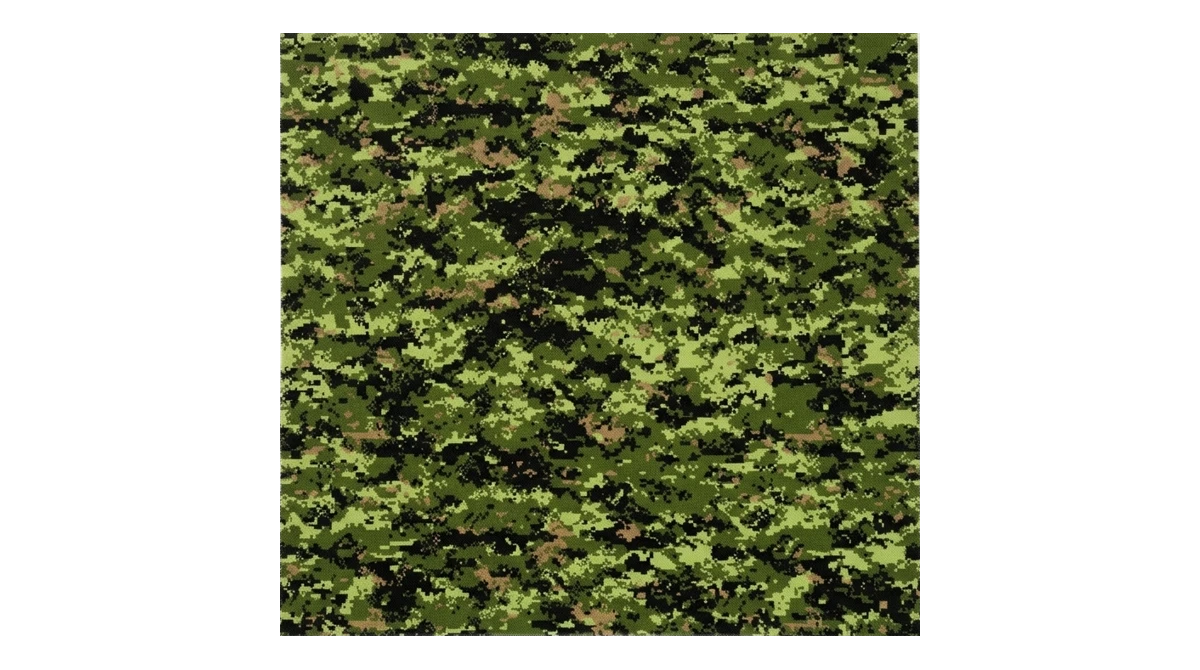
CADPAT
Developed by the Canadian Department of National Defence starting in 1988, CADPAT was the *world's first operationally fielded digital pixelated military camouflage pattern*. Rather than using traditional smooth organic brush strokes, CADPAT relies on computer-generated rectangular pixels combining macro-disruptive clusters (to break up human symmetry at long distances) with micro-dithering (to blend with leaf and bark texture at close range).
AI render based on photo by Canadian government, Public domain
Community
Pattern
- Country
 Canada
- Adopting service(s)
- Canadian Armed Forces
- Pattern type
- digital
- Era
- post-Cold War / current
- Years in use
- 1997/2002–present
- Colours
- greens, brown, black (TW)
- Predecessor
- Canadian olive drab
- Successor
- —
- Data Trust
- Partial — public secondary sources; not fully verified
Variants
| Name | Years | Notes |
|---|---|---|
| Temperate Woodland | — | TW |
| Arid Regions | — | AR |
| Multi-Terrain | — | MT, 2019 |
Specifications
- Category
- Camouflage pattern
- Country
- Canada
- Manufacturer
- Department of National Defence (DND) / HyperStealth Biotechnology Corp. / Peerless Garments
- Introduced
- —
- Status
- Active (Transitioning to CADPAT Multi-Terrain / CADPAT MT)
- Protection level
- —
- Material
- 50/50 Nylon-Cotton (NYCO) ripstop combat uniforms (IECS — Improved Environmental Clothing System) and 1000D Cordura tactical nylon vests/packs
- Weight
- —
- Users
- —
- Introduction dates
- 1997 (Operational fielding 2001–2002)
- Color Palette
- 4-color computer-generated micro- and macro-pixelated matrix:; Temperate Woodland (TW): Light Green, Dark Green, Brown, and Black; *Arid Regions (AR):* Light Tan, Medium Tan, and Dark Brown (3-color configuration)
- Spectral & NIR Performance
- Pioneered integrated Near-Infrared (NIR) reflectance suppression engineered specifically to match temperate leaf chlorophyll and mineral soil signatures under Gen 2/3 night-vision image intensifiers; fabrics treated with permethrin insect-repellent finish
- Environmental Optimization
- Temperate boreal/deciduous forests (TW) and desert/arid theaters (AR)
- Variants & modernizations
- CADPAT TW (Temperate Woodland), CADPAT AR (Arid Regions, 2002), CADPAT WO (Winter Operations), and *CADPAT MT (Multi-Terrain)* — adopted in 2021–2024 as a transitional multi-environment replacement.
History
Debuted operationally with Canadian peacekeeping forces in Bosnia-Herzegovina (1997–2001) and deployed extensively across Afghanistan (ISAF / Operation Athena), directly inspiring the U.S. Marine Corps MARPAT pattern and triggering the global shift toward digital camouflage in the 2000s.
Related systems
—
Sources
- Data trust: Verified (Canadian Department of National Defence Technical Specifications & NATO Camouflage Studies)
- Pattern reference
- Data trust: partial (public secondary sources; not fully verified)
