
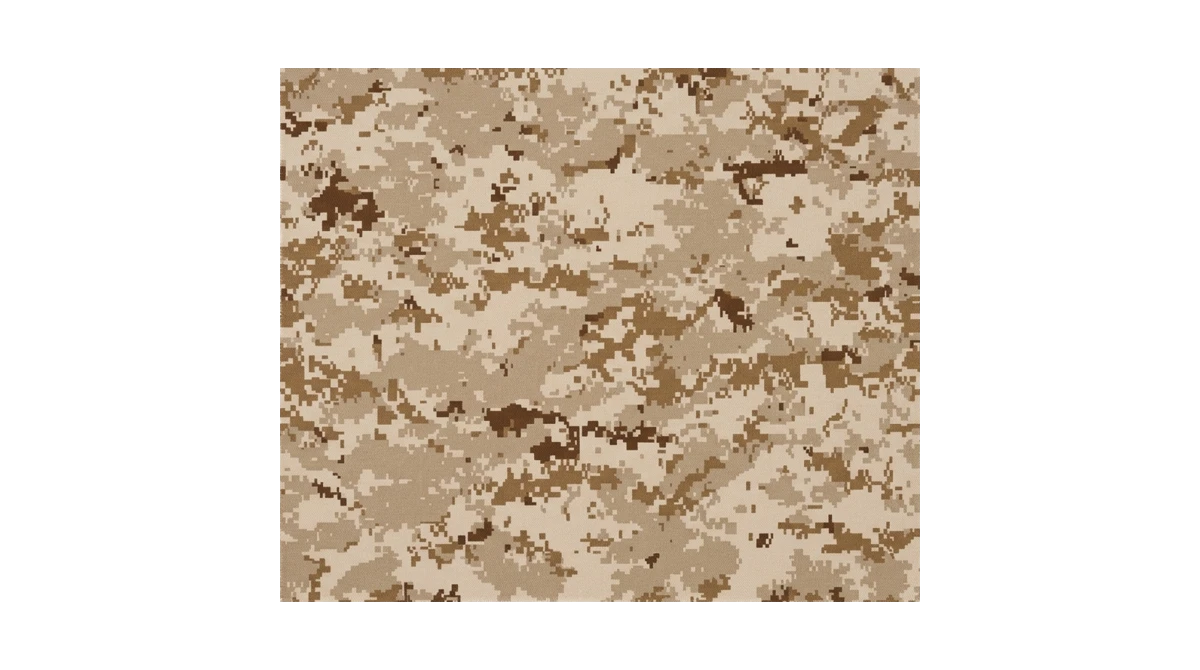
Camouflage pattern
MARPAT
Developed by the U.S. Marine Corps in 2001–2002 after studying the effectiveness of Canada's digital CADPAT pattern, MARPAT uses computer-generated rectangular pixels arranged in both macro-disruptive clusters and micro-texture dithering to break up human symmetry at both close and long ranges. Micro-Eagle, Globe, and Anchor emblems are embedded directly into the pattern print for authentication.
Community
Loading…
Pattern
- Country
 United States
- Adopting service(s)
- US Marine Corps
- Pattern type
- digital
- Era
- current
- Years in use
- 2002–present
- Colours
- woodland: greens/brown/black; desert: tans/brown
- Predecessor
- M81 Woodland / DCU
- Successor
- —
- Data Trust
- Partial — public secondary sources; not fully verified
Variants
| Name | Years | Notes |
|---|---|---|
| Woodland | — | — |
| Desert | — | Winter/urban limited |
Specifications
- Category
- Camouflage pattern
- Country
- United States
- Manufacturer
- United States Marine Corps Systems Command (inspired by Canadian CADPAT)
- Introduced
- 2002
- Status
- Active (Standard Issue U.S. Marine Corps)
- Protection level
- —
- Material
- 50/50 NYCO twill (MCCUU — Marine Corps Combat Utility Uniform) and flame-resistant rayon/para-aramid/nylon FROG (Flame Resistant Organizational Gear)
- Weight
- —
- Users
- —
- Color Palette
- 4-color micro- and macro-pixelated digital matrix: Woodland variant (Light Green, Olive Green, Dark Brown, Black); Desert variant (Light Tan, Coyote Tan, Light Brown, Dark Brown)
- Spectral & NIR Performance
- Advanced Near-Infrared (NIR) signature management calibrated to match woodland and desert vegetation under night-vision optics, paired with permethrin insect-repellent factory treatment
- Environmental Optimization
- Dual-environment system tailored separately for temperate/tropical woodland and arid desert operational theaters
- Variants & modernizations
- MARPAT Woodland, MARPAT Desert, MARPAT Snow/Winter overwhites, and FROG combat shirt/trouser ensembles.
History
Fielded operationally during the 2003 invasion of Iraq and worn by all U.S. Marines across Operation Iraqi Freedom, Operation Enduring Freedom, and global expeditionary deployments.
Related systems
—
Sources
- Data trust: Verified (USMC Systems Command / Marine Corps Uniform Board Specifications)
- Pattern reference
- Data trust: partial (public secondary sources; not fully verified)
Community
Loading…
