
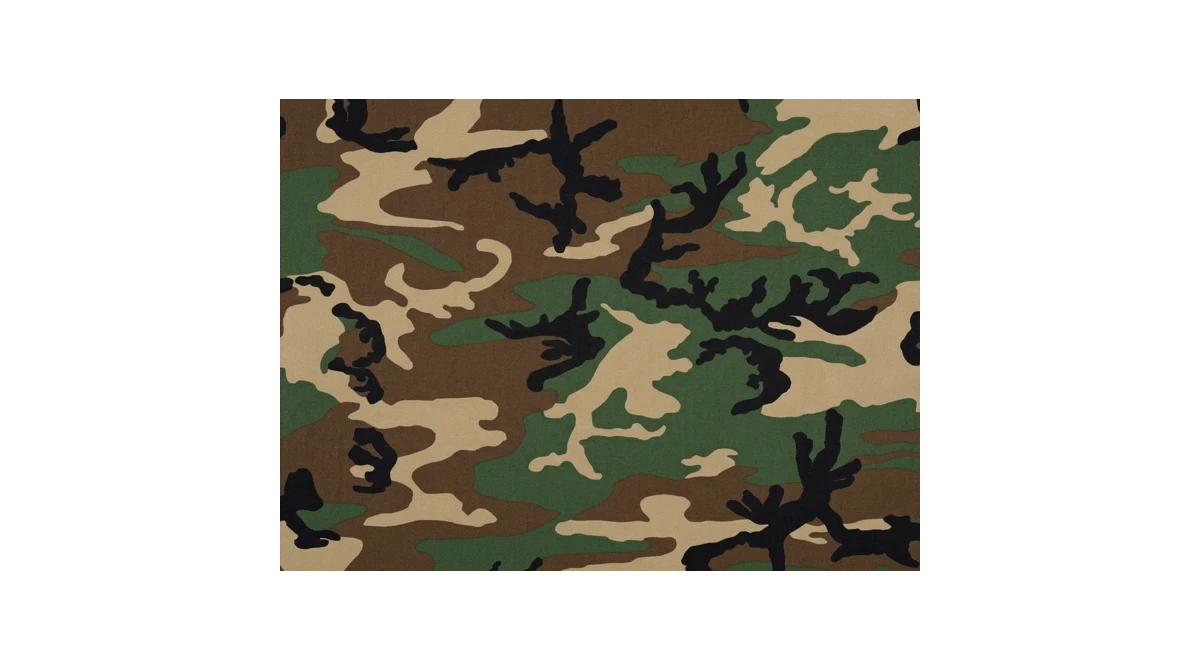
Camouflage pattern
M81 Woodland
Created by the U.S. Army Natick Laboratories in 1981 by enlarging the Vietnam-era ERDL (Engineer Research and Development Laboratory) leaf pattern by approximately 60% to prevent the smaller shapes from merging into a solid dark blob at longer combat engagement distances.
Community
Loading…
Pattern
- Country
 United States
- Adopting service(s)
- US Armed Forces (BDU)
- Pattern type
- woodland
- Era
- Cold War
- Years in use
- 1981–2000s (US)
- Colours
- light green, brown, black, sand
- Predecessor
- ERDL
- Successor
- UCP / MARPAT / OCP (by service)
- Data Trust
- Partial — public secondary sources; not fully verified
Variants
| Name | Years | Notes |
|---|---|---|
| standard woodland | — | — |
| widely copied abroad | — | — |
Specifications
- Category
- Camouflage pattern
- Country
- United States
- Manufacturer
- U.S. Army Natick Research and Development Laboratories
- Introduced
- 1981
- Status
- Retired (Replaced by UCP/MARPAT; still used by partner forces & irregular units)
- Protection level
- —
- Material
- 100% cotton ripstop (hot-weather) and 50/50 NYCO twill (temperate), paired with PASGT helmets/vests and ALICE nylon gear
- Weight
- —
- Users
- —
- Color Palette
- 4-color high-contrast organic disruptive pattern: Light Olive Green, Dark Forest Green, Brown, and Black
- Spectral & NIR Performance
- Early standardized Near-Infrared (NIR) dye compliance on Battle Dress Uniform (BDU) fabrics to prevent silhouette blooming under Gen 2/3 night-vision devices
- Environmental Optimization
- Temperate deciduous/coniferous forests, tropical jungle, and European woodland theaters
- Variants & modernizations
- M81 Woodland BDU (standard), RAID-modified BDU (special operations pocket configuration), and dozens of international derivatives (including Italian Vegetato/Woodland, Greek Lizard, and Turkish Woodland).
History
Introduced alongside the Battle Dress Uniform (BDU) in September 1981, M81 Woodland served as the iconic uniform pattern of all four branches of the U.S. Armed Forces throughout the late Cold War, Grenada, Panama, the Balkans, and the early stages of Afghanistan and Iraq, before being phased out between 2004 and 2008.
Related systems
—
Sources
- Data trust: Verified (U.S. Army NATICK Historical Specifications & MIL-C-44031 Standard)
- Pattern reference
- Data trust: partial (public secondary sources; not fully verified)
Community
Loading…
