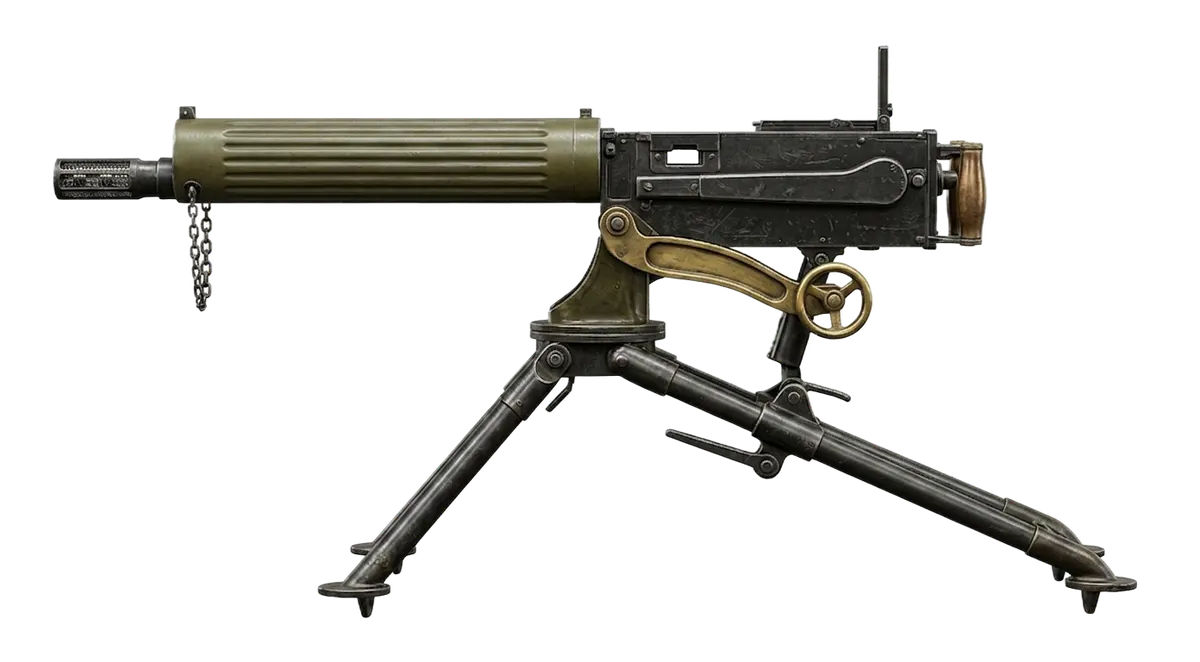
Vickers
British water-cooled medium machine gun in .303 British, evolution of the Maxim. Iconic for legendary reliability: sustained fire for days in WWI trenches.
Vickers
Community
Data trust
- Reliability
- Unverified
- Sources
- Sources pending review
Identity
- Designation
- Vickers
- Alias
- Vickers Machine Gun .303
- Manufacturer
- Vickers Limited
- Country
- United Kingdom
- Year
- 1912
- Category
- Medium machine gun
- Status
- Historic
Ballistics
- Caliber
- .303 British (7,7×56 mmR)
- Muzzle velocity
- 744 m/s
- Rate of fire
- ~500 rpm
- Effective range
- 2000 m
- Maximum range
- 4100 m
Dimensions
- Barrel length
- 721 mm
- Overall length
- 1156 mm
- Empty weight
- 15 kg
Mechanics
- Operating system
- Rinculo a canna corta con toggle lock
- Bolt / action
- Recoil-operated, otturatore a ginocchiera
Feed
- System
- Nastro in tela da 250 colpi
- Standard capacity
- 250 rounds
Fire modes
Historical profile
Development and Origins of the Project
The acquisition of the Maxim Gun Company by Vickers Limited in 1897 laid the foundations for the refinement of Hiram Maxim's revolutionary self-loading weapon. The British War Office sought a lighter and more manageable variant than the 1904 model, leading to the formal development of the prototype in 1910.
Following rigorous testing conducted at Hythe, the weapon was officially adopted by the British Army on November 26, 1912, as the standard machine gun for infantry battalions. Despite the high initial production cost, the Vickers demonstrated such tactical superiority that it justified the complete replacement of old Maxims and less reliable Hotchkiss guns.
Technical Architecture and Cooling
The ingenuity of the Vickers lay in the inversion of the return spring and the toggle mechanism, with the hinge opening downwards instead of upwards. This structural modification allowed for a lighter receiver and simplified internal maintenance while keeping the chamber locked until the pressure was fully dissipated.
The liquid cooling system utilized a steel jacket containing approximately four liters of water, connected via a flexible hose to a condensing tin for steam recovery. In the absence of water, crews often reported using emergency substitutes, including urine, to keep the weapon operational during prolonged defensive barrages.
Wartime Employment and Specialized Units
With the outbreak of the Great War, the employment of the Vickers was centralized in 1915 with the creation of the Machine Gun Corps, transforming the machine gun into a heavy support weapon capable of indirect fire. This tactic allowed for striking targets beyond the visual horizon, turning the Vickers into a form of rapid-fire light artillery.
During the Second World War, the weapon was used extensively in North Africa and Europe, equipped with Mk VIIIz ammunition to extend its effective range. Beyond the infantry, modified variants such as the Mk II and Mk III armed Royal Flying Corps fighters, utilizing synchronization gears to fire through the propeller arc.
Decommissioning and Historical Legacy
The Vickers remained in active service with the British Army well beyond the end of the Second World War, serving with distinction during the Korean War and the Malayan Emergency. Its extraordinary longevity officially ended only in 1968, when the L7 GPMG general-purpose machine gun in 7.62 NATO caliber definitively took its place.
Beyond the United Kingdom, the Vickers was adopted by numerous Commonwealth nations such as Australia, Canada, and India, and produced under license in the United States by Colt as the Model 1915. Today, it is remembered by technicians as one of the most reliable weapons ever built, capable of firing tens of thousands of rounds without suffering critical mechanical deformations.
Variants
Main users
United Kingdom · Commonwealth · Australia · Canada · India · Sudafrica
Key components
- ●Stock — Shoulder rest.
- ●Receiver — Weapon body with internal mechanisms.
- ●Grip — Primary grip.
- ●Magazine — Cartridge feed.
- ●Barrel — Guides the projectile.
Community
Recent reviews
Similar systems
Vickers Mk I
1912
Lewis
1914
MG 08
1908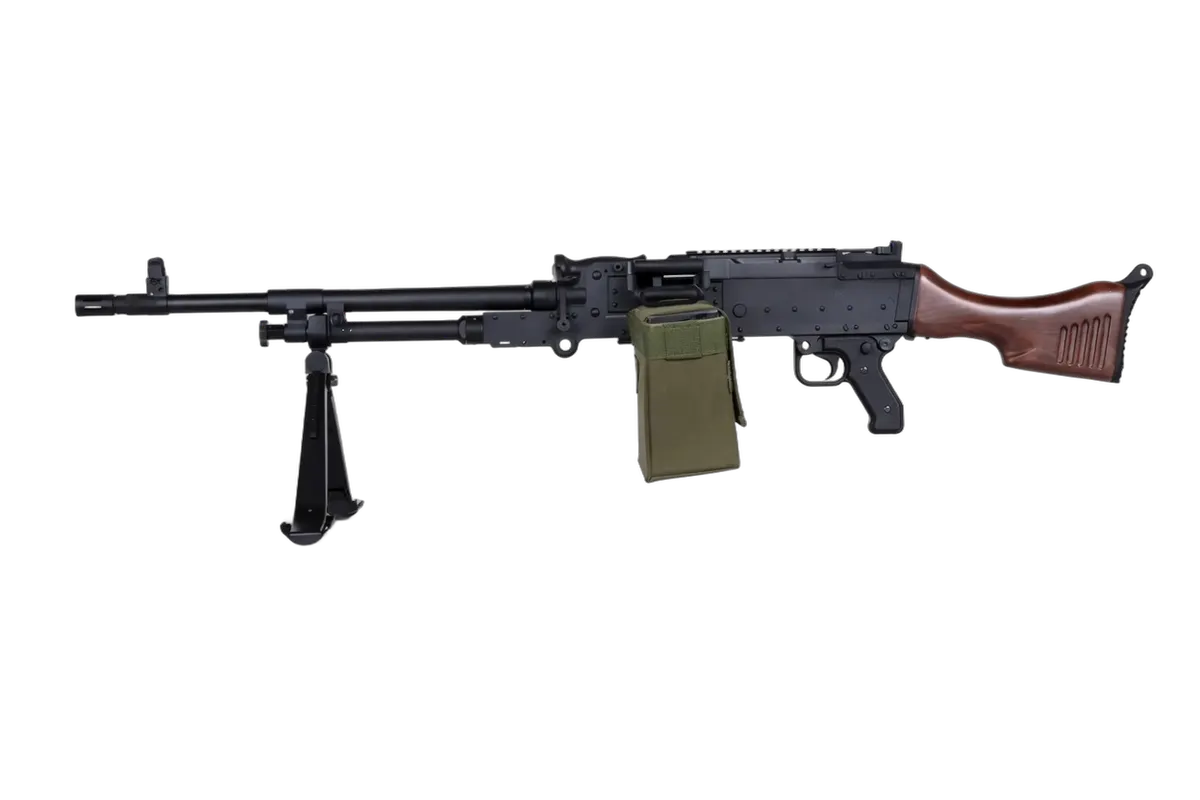
L7A2 GPMG
1957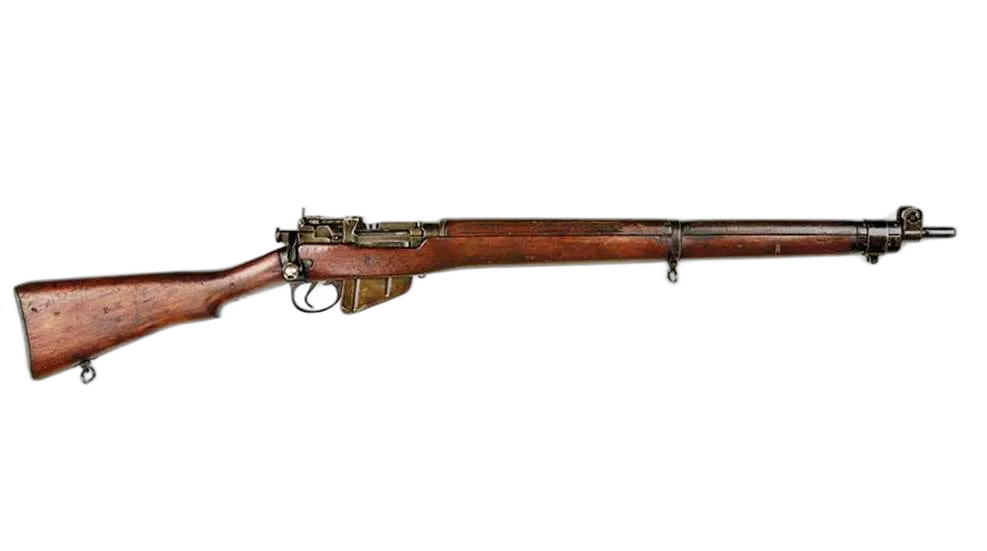
Lee-Enfield No.4 Mk I
1941