Lewis
Air-cooled .303 British light machine gun with a 47/97-round pan magazine on top. Recognizable by its wide finned radiator around the barrel. WWI standard.
Lewis
Community
Data trust
- Reliability
- Unverified
- Sources
- Sources pending review
Identity
- Designation
- Lewis
- Alias
- Lewis Automatic Machine Gun
- Manufacturer
- Birmingham Small Arms (BSA) / Savage Arms
- Country
- United Kingdom
- Year
- 1914
- Category
- Light machine gun
- Status
- Historic
Ballistics
- Caliber
- .303 British (7,7×56 mmR)
- Muzzle velocity
- 740 m/s
- Rate of fire
- ~550 rpm
- Effective range
- 800 m
- Maximum range
- 3200 m
Dimensions
- Barrel length
- 670 mm
- Overall length
- 1280 mm
- Empty weight
- 13 kg
Mechanics
- Operating system
- Presa di gas, pistone a corsa lunga
- Bolt / action
- Rotating bolt
Feed
- System
- Tamburo (pan magazine) superiore
- Standard capacity
- 47 rounds
Fire modes
Historical profile
Development and Anglo-American Origins
The origins of the Lewis date back to 1911, when Colonel Isaac Newton Lewis perfected a design based on patents by Samuel Maclean. Despite convincing demonstrations, the hostility of the United States Ordnance Department toward Lewis forced the inventor to relocate to Belgium, where he founded Armes Automatiques Lewis in Liège to facilitate European production.
Official adoption occurred in 1913 by the Belgian Army, but the outbreak of the Great War ensured its global success through the Birmingham Small Arms (BSA) company. The British government ordered the first batches in 1914 in .303 British caliber, subsequently signing massive contracts with Savage Arms in the United States to meet the demands of the Western Front.
Technical Innovation and Cooling System
The weapon was distinguished by a gas-operated system with a rotating bolt and a characteristic 47 or 97-round rotating pan magazine. The most evident technical feature was the complex forced-air cooling system, consisting of an aluminum finned radiator enclosed in a steel shroud that utilized the Venturi effect produced by muzzle gases.
This configuration allowed fresh air to be drawn along the barrel with every shot, reducing the risk of overheating without the bulk of the water jackets found on heavy machine guns. The Lewis also featured an internal clock-type recoil spring, adjustable via an external key to vary the rate of fire based on environmental conditions and ammunition types.
Field and Aerial Service in the Great War
During the First World War, the Lewis transformed British infantry tactics by providing mobile firepower superior to that of German units, which initially lacked an equivalent weapon. Every platoon received dedicated Lewis sections, allowing for offensive maneuvers that did not rely solely on the support of Vickers guns positioned in the rear.
In the aerial theater, the Lewis became the standard armament for observers and pilots of the Royal Flying Corps, often stripped of its heavy aluminum radiator to save weight. Specialized versions such as the Mk II and Mk III were mounted on Scarff rings or above the top wings of fighters like the S.E.5a, where the 97-round magazine provided superior fire endurance during dogfights.
From the Second World War to Retirement
Although officially replaced by the Bren gun in 1938, the Lewis saw a massive return to service in 1940 to fill the gaps left after the Dunkirk evacuation. Thousands of units were pulled from reserves and issued to the Home Guard for coastal defense and to Royal Navy units as close-range anti-aircraft weapons aboard merchant ships and escorts.
The weapon also served in the North African campaigns with the Long Range Desert Group and in the Pacific with Australian and Dutch forces until the end of hostilities. Its final withdrawal from front-line units occurred only in the mid-1940s, marking the end of an era for one of the most iconic and versatile automatic weapons of the first half of the twentieth century.
Variants
Main users
United Kingdom · Belgium · United States · France · Italia · Commonwealth
Key components
- ●Stock — Shoulder rest.
- ●Receiver — Weapon body with internal mechanisms.
- ●Grip — Primary grip.
- ●Magazine — Cartridge feed.
- ●Barrel — Guides the projectile.
Community
Recent reviews
Similar systems
Besal
1942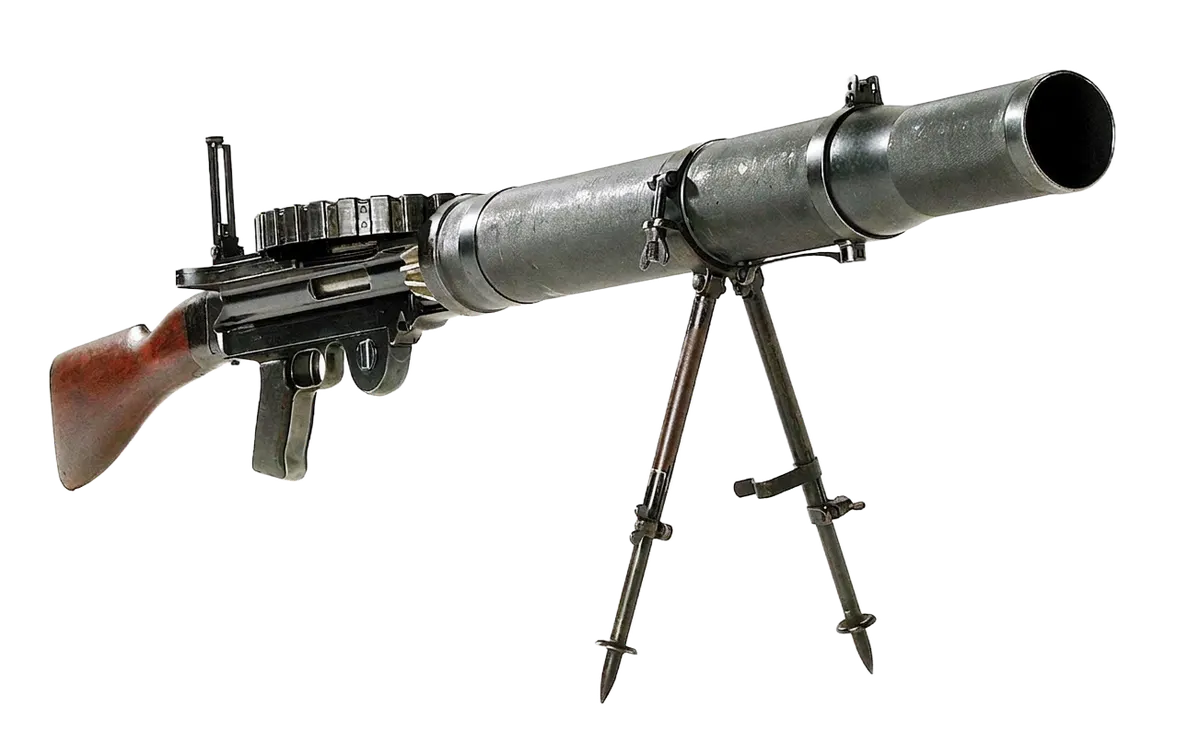
Lewis Gun
1914
Vickers
1912
Chauchat M1915
1915
Huot Automatic Rifle
1916