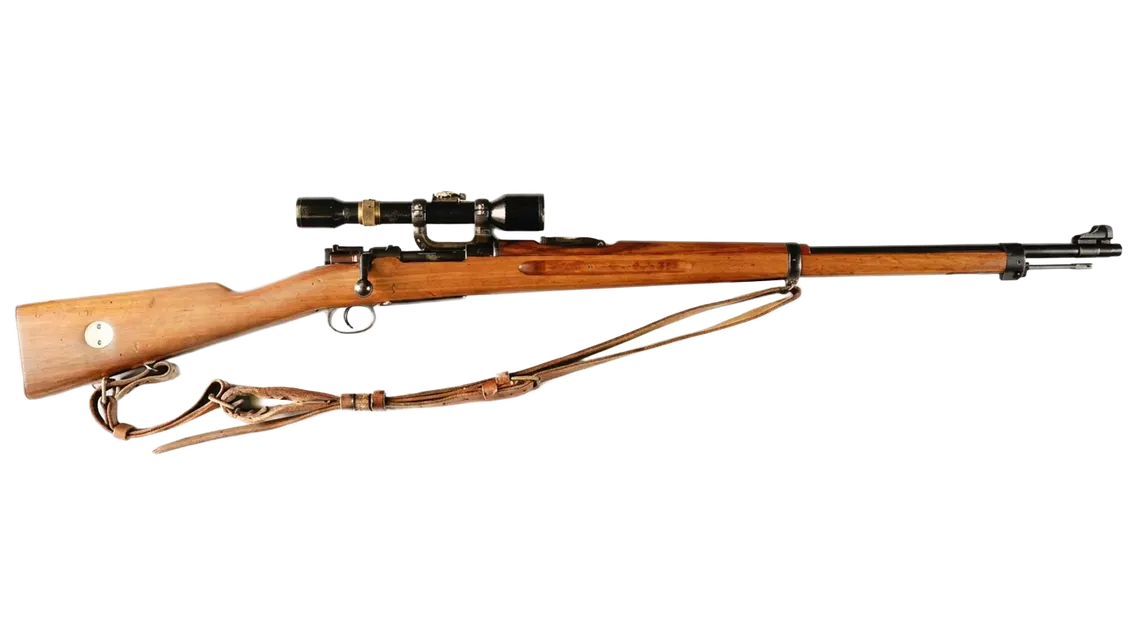
Lee-Enfield No.4 Mk I
British bolt-action rifle in .303 British, Commonwealth standard infantry weapon in both World Wars. Famous for its fast action ("mad minute") and 10-round magazine.
Lee-Enfield No.4 Mk I
Community
Data trust
- Reliability
- Unverified
- Sources
- Sources pending review
Identity
- Designation
- Lee-Enfield No.4 Mk I
- Alias
- SMLE / Lee-Enfield
- Manufacturer
- Royal Small Arms Factory Enfield / BSA / Long Branch / Savage
- Country
- United Kingdom
- Year
- 1941
- Category
- Sniper rifle
- Status
- Historic
Ballistics
- Caliber
- .303 British (7,7×56 mmR)
- Muzzle velocity
- 744 m/s
- Effective range
- 500 m
- Maximum range
- 2700 m
Dimensions
- Barrel length
- 640 mm
- Overall length
- 1129 mm
- Empty weight
- 4.11 kg
Mechanics
- Operating system
- Otturatore girevole-scorrevole manuale (cock-on-closing)
- Bolt / action
- Bolt-action
Feed
- System
- Caricatore fisso, ricarica con stripper clip da 5
- Standard capacity
- 10 rounds
Fire modes
Historical profile
Development and Wartime Origins
The development path leading to the No.4 began in the late 1920s with the experimental No.1 Mk VI models, aimed at addressing the production shortcomings of the older SMLE. Final standardization occurred in 1939, but actual mass production was delayed until 1941 due to the priority given to existing weaponry following the Dunkirk evacuation.
The program involved not only British factories such as RSAF Enfield and BSA, but also strategically extended to North America through the Lend-Lease program. Savage Arms in the United States and Long Branch in Canada provided millions of units, ensuring a steady supply during the most critical phases of the global conflict.
Design Features and Variants
The No.4 Mk I featured a reinforced receiver and a heavier "floating" barrel, which significantly improved consistent accuracy over its predecessor. The most prominent innovation was the adoption of a receiver-mounted aperture sight, providing the infantryman with a longer and more intuitive sight radius compared to the older tangential sights.
During the conflict, the No.4 Mk I* variant was introduced, featuring a simplified bolt release through a notch in the bolt head track. This model became the standard variant for Canadian and American production, optimizing machining times without sacrificing the reliability of the Lee bolt action system.
Operational Service and Combat Use
The weapon became the symbol of the British and Commonwealth soldier on every front, from North Africa to the Burmese jungles and the Normandy landings. A trained soldier could exploit the fast bolt action to perform the "mad minute," maintaining a rate of fire superior to any other bolt-action rifle of the era.
Beyond its standard infantry role, the No.4 served as the basis for the No.4 Mk I (T) sniper rifle, equipped with the No.32 scope and selected for its exceptional barrel accuracy. This specialized version was extensively used by Allied snipers, remaining effective even in extreme environmental conditions thanks to the robustness of the Enfield action.
Post-War Evolution and Legacy
In the post-war era, the rifle saw the introduction of the No.4 Mk 2 version, featuring a trigger pivoted directly on the receiver rather than the trigger guard for improved pull consistency. Many existing weapons were updated to this standard, designated as Mk I/2 or Mk I/3 depending on the original version.
Although replaced by the semi-automatic L1A1 in 1957, the design survived for decades as the L42A1 sniper rifle chambered in 7.62 NATO. Today, the No.4 remains a military collecting icon and continues to serve in some paramilitary or ceremonial units, as well as being used by the Canadian Rangers until their recent transition to the C19.
Variants
Main users
United Kingdom · Canada · Australia · India · Sudafrica · oltre 30 paesi del Commonwealth
Key components
- ●Stock — Shoulder rest.
- ●Receiver — Weapon body with internal mechanisms.
- ●Grip — Primary grip.
- ●Magazine — Cartridge feed.
- ●Barrel — Guides the projectile.
Community
Recent reviews
Similar systems
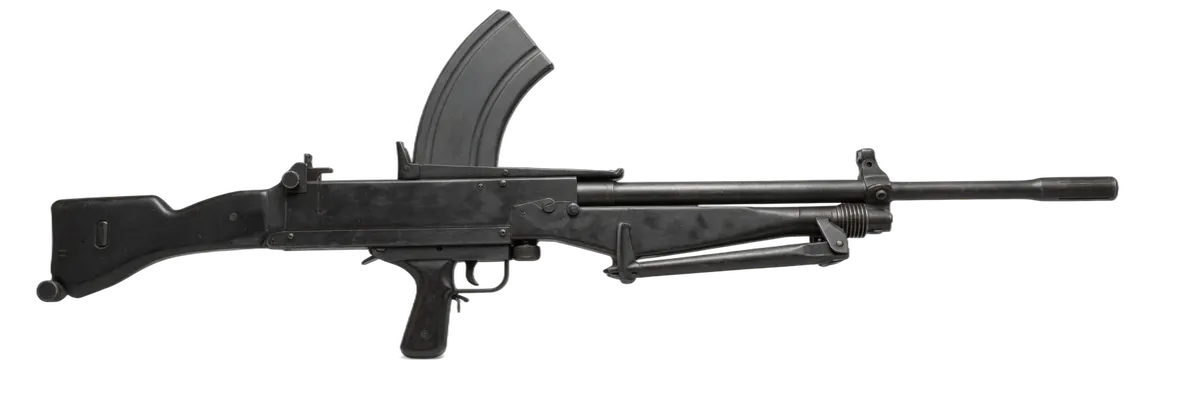
Besal
1942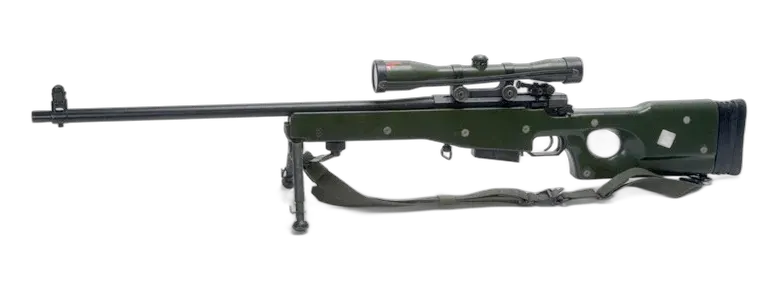
L96A1
1985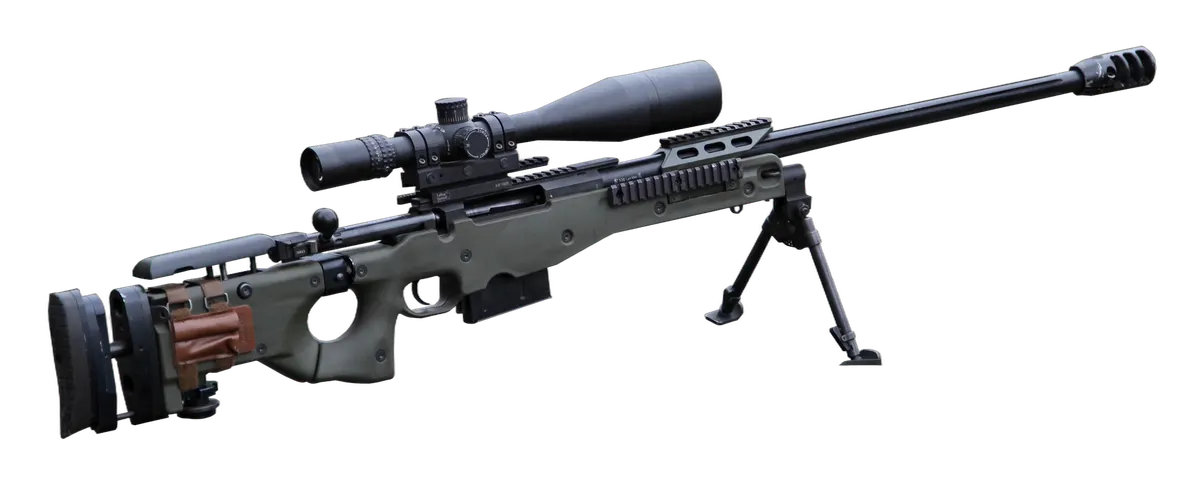
AW (Arctic Warfare)
1988
AXMC
2013
Carcano Mod. 91/38
1938