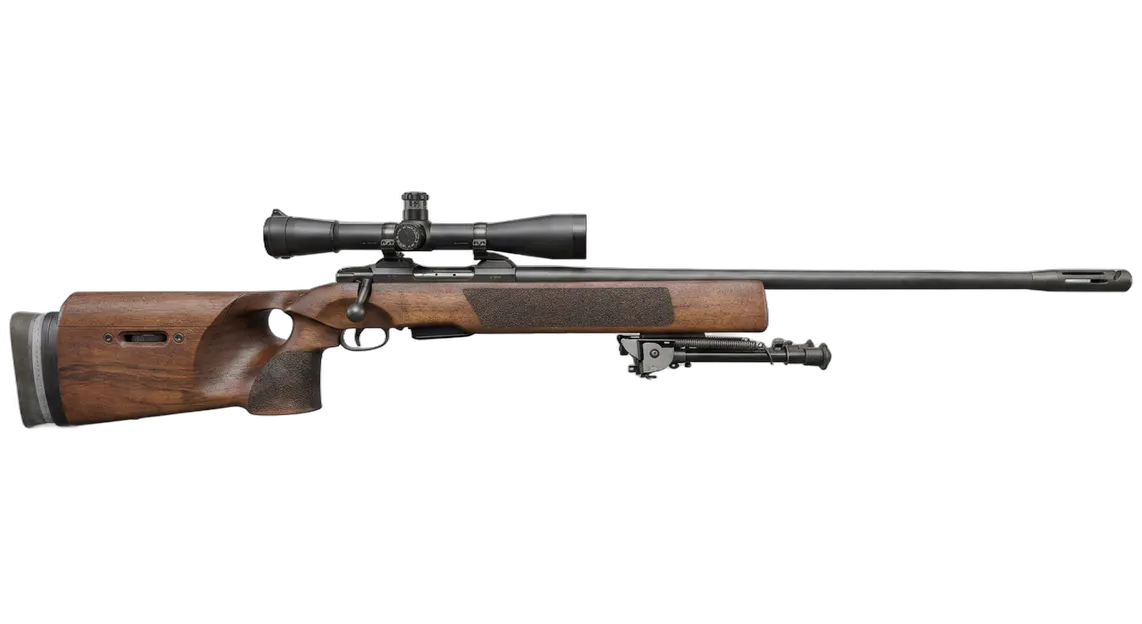
AW (Arctic Warfare)
Family of bolt-action sniper rifles evolved from the L96A1, designed for arctic climates (special lubricants, anti-freeze bolt). Calibres from 7.62 NATO up to .338 LM with the AWM.
AW (Arctic Warfare)
Community
Data trust
- Reliability
- Unverified
- Sources
- Sources pending review
Identity
- Designation
- AW (Arctic Warfare)
- Alias
- L118A1 / AWM / L115A3
- Manufacturer
- Accuracy International
- Country
- United Kingdom
- Year
- 1988
- Category
- Sniper rifle
- Status
- In service
Ballistics
- Caliber
- 7,62×51 NATO / .300 WM / .338 Lapua Magnum
- Muzzle velocity
- 936 m/s
- Effective range
- 1100 m
- Maximum range
- 1500 m
Dimensions
- Barrel length
- 660 mm
- Overall length
- 1200 mm
- Empty weight
- 6.8 kg
Mechanics
- Operating system
- Otturatore girevole-scorrevole manuale
- Bolt / action
- Bolt-action
Feed
- System
- Caricatore amovibile
- Standard capacity
- 10 rounds
Fire modes
Historical profile
Development and Strategic Genesis
The Arctic Warfare project originated in the late 1980s as a response to a requirement from the Swedish Armed Forces, who needed a sniper rifle capable of operating in extreme climatic conditions. The British company Accuracy International evolved the previous PM model, which had won the L96A1 British adoption trial, by implementing substantial mechanical modifications to guarantee reliability at temperatures as low as minus forty degrees Celsius.
The British Ministry of Defence subsequently formalized the adoption of the new AW version in 1991 under the L118A1 designation, gradually replacing previous models and the aging Enfield L42A1. The design effort then expanded to the creation of magnum variants, such as the AWM, to meet the growing demand for an effective range superior to the standard 7.62x51mm NATO round in use at the time.
Technical Architecture and Innovation
The distinctive feature of the AW is the aluminum chassis on which the action rests, enclosed in two thermoformed polymer skins that ensure superior ergonomics and simplified maintenance. The bolt features longitudinal grooves that prevent seizure due to ice or debris, while the trigger group is designed to operate with surgical precision even under high environmental stress.
The AWM version, chambered in .300 Winchester Magnum or .338 Lapua Magnum, introduced a reinforced action and a stainless steel fluted barrel to handle the high pressures of magnum loads. This modular system allows the installation of Schmidt & Bender optics via the integrated rail, making the weapon an extremely versatile platform for engaging targets at distances exceeding 1200 meters.
Operational Service and Military Records
The weapon saw intensive use during the conflicts in Iraq and Afghanistan, where the L115A3 version demonstrated clear ballistic superiority in open areas and mountainous environments. In addition to the famous 2009 record, the Arctic Warfare has been adopted by over sixty nations, including Germany which designated it G22 and Sweden which fielded it as the PSG 90.
Special units worldwide, such as the British SAS and the German KSK, integrated various variants including the integrally suppressed AWS and the AWF folding stock version. The effectiveness of the weapon system was confirmed by its ability to neutralize targets protected by heavy body armor at distances where traditional rifles lost all kinetic effectiveness.
Evolution and Modern Legacy
Despite the introduction of the new AX and AXMC models, the Arctic Warfare series remains a benchmark for the precision firearms industry due to its indestructibility and consistent sub-MOA accuracy. Many nations continue to update their weapon inventories with conversion kits, maintaining the original AI mechanical core that redefined modern sharpshooter standards.
The influence of the AW extends to the civilian and sporting markets, where the precision of its design inspired a generation of competition rifles based on the metallic chassis concept. The technological legacy of this British rifle remains solid, representing the pinnacle of bolt-action engineering applied to twenty-first-century tactical requirements.
Variants
Main users
United Kingdom · Germania · Sweden · Australia · Paesi Bassi · Spain · oltre 60 paesi
Key components
- ●Stock — Shoulder rest.
- ●Receiver — Weapon body with internal mechanisms.
- ●Grip — Primary grip.
- ●Magazine — Cartridge feed.
- ●Barrel — Guides the projectile.
Community
Recent reviews
Similar systems
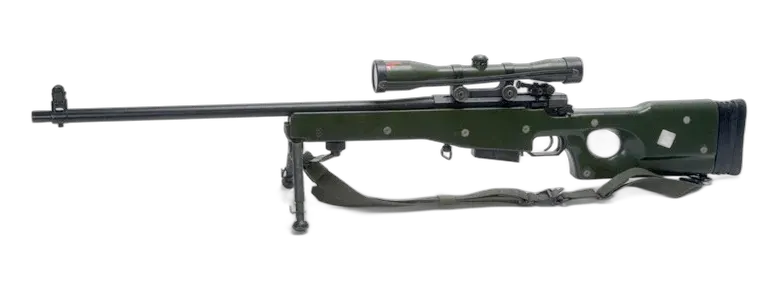
L96A1
1985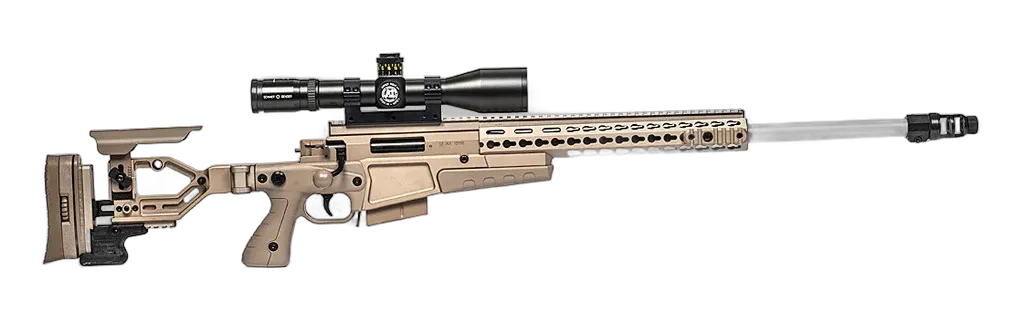
AXMC
2013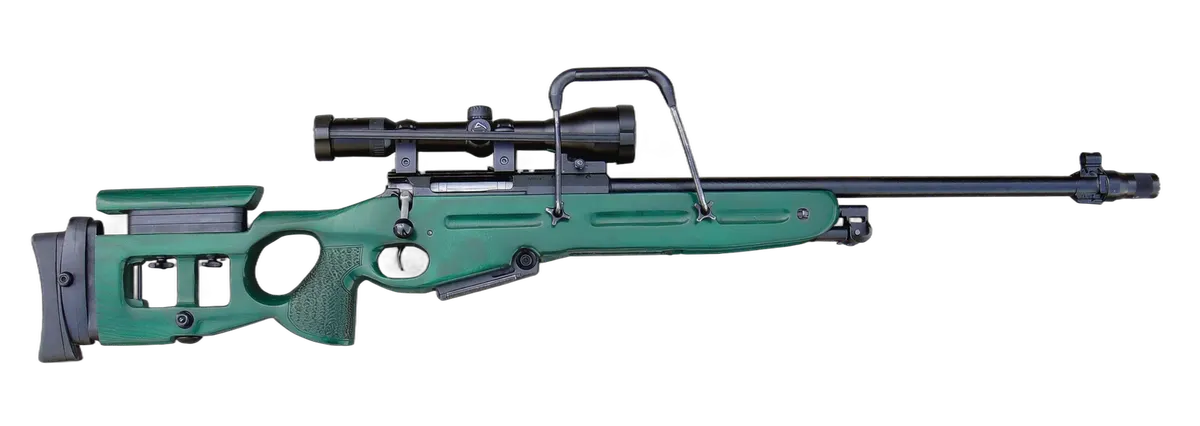
SV-98
1998
Denel NTW-20
1998
Lee-Enfield No.4 Mk I
1941