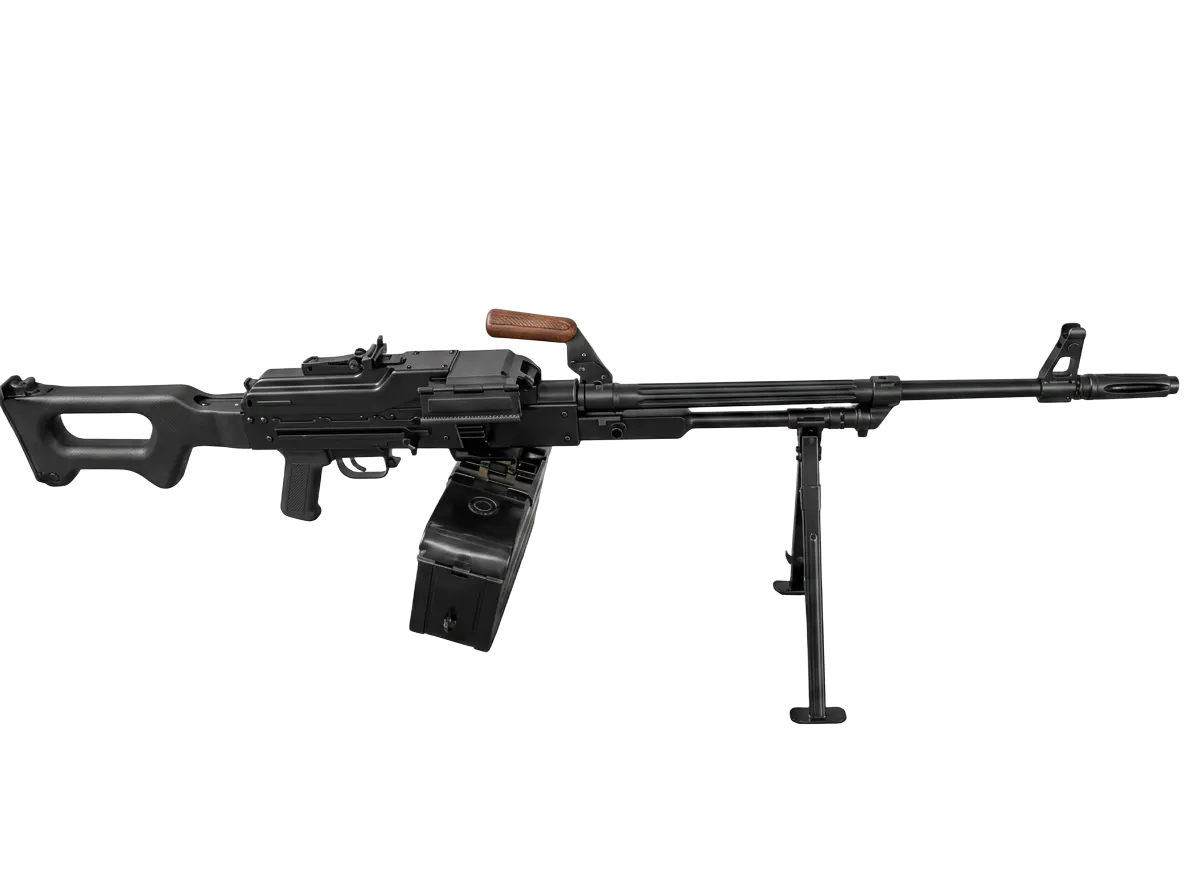
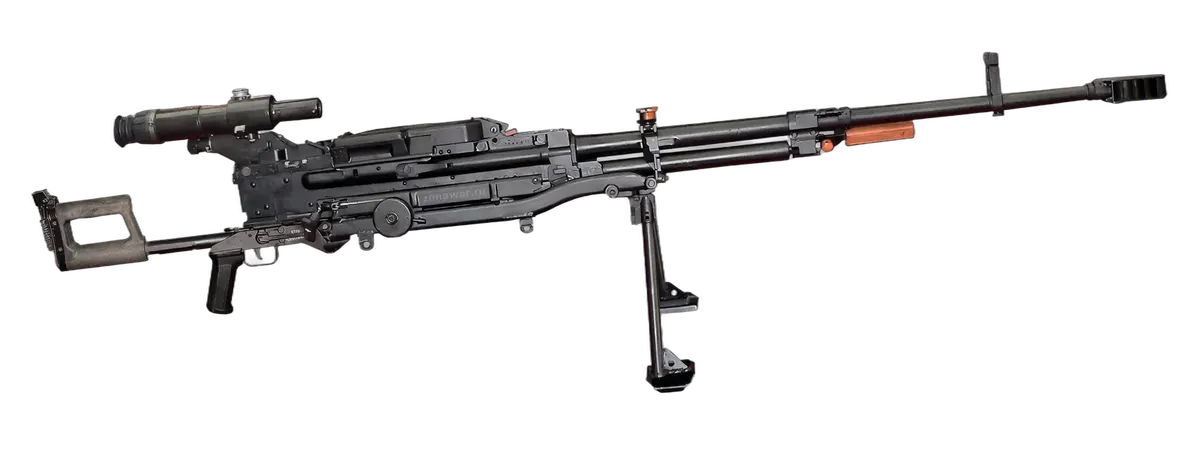
PKP Pecheneg
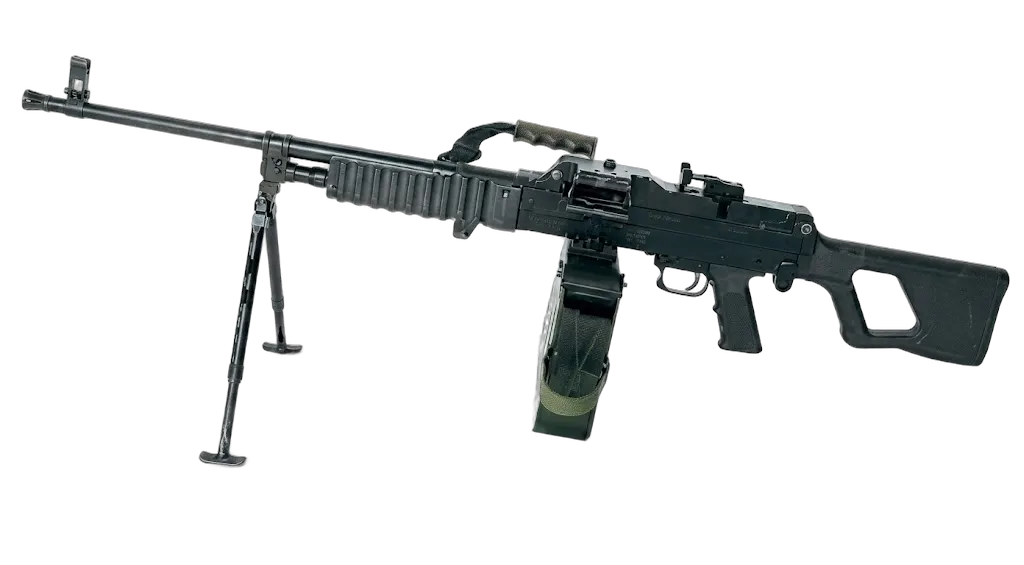
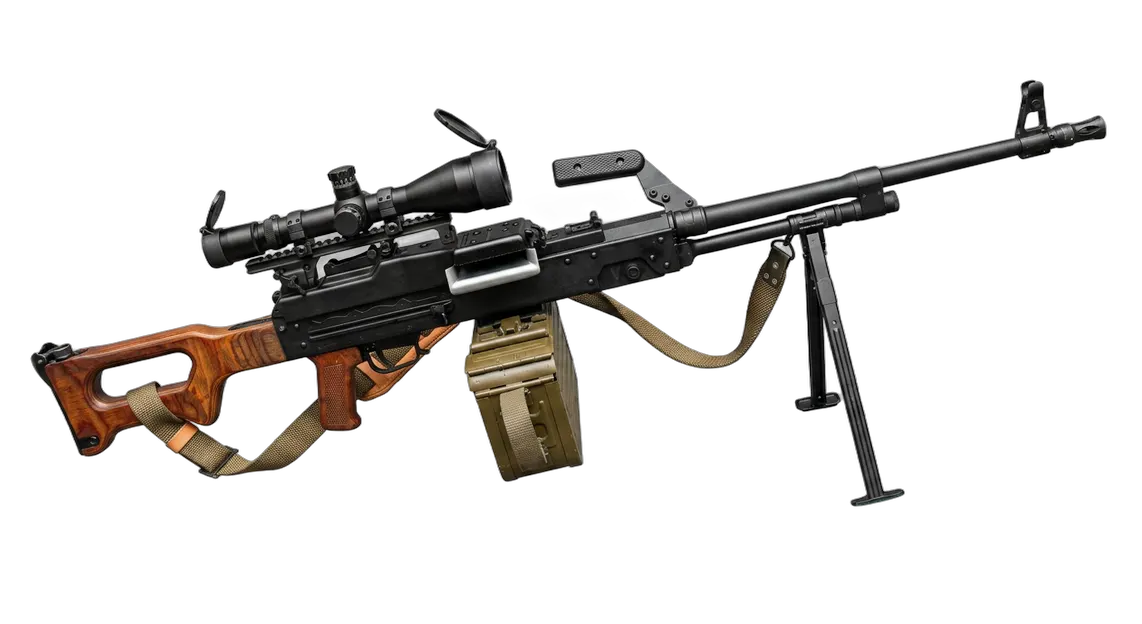
Russian general-purpose machine gun in 7.62×54R, an evolution of the PKM with a forced air-cooling barrel that removes the need for a barrel change in combat.
PKP Pecheneg
Community
Data trust
- Reliability
- Unverified
- Sources
- Sources pending review
Identity
- Designation
- PKP Pecheneg
- Alias
- 6P41 «Печенег»
- Manufacturer
- TsNIITochMash / Degtyarev Plant
- Country
- Russia
- Year
- 1999
- Category
- Medium machine gun
- Status
- In service
Ballistics
- Caliber
- 7,62×54R
- Muzzle velocity
- 825 m/s
- Rate of fire
- ~650 rpm
- Effective range
- 1500 m
- Maximum range
- 3800 m
Dimensions
- Barrel length
- 658 mm
- Overall length
- 1155 mm
- Empty weight
- 8.2 kg
Mechanics
- Operating system
- Sottrazione di gas, otturatore rotante
- Bolt / action
- Long-stroke piston
Feed
- System
- Nastro non disintegrabile
- Standard capacity
- 100 rounds
Fire modes
Historical profile
Development and Strategic Genesis
The genesis of the PKP Pecheneg lies in the Russian armed forces' need to overcome the logistical limitations of the PKM during the intense urban and mountain skirmishes of the 1990s. The project was entrusted to the TsNIITochMash institute, under the leadership of designers Babkin, Denisov, and Zhukov, with the aim of creating a general-purpose machine gun that did not require carrying spare barrels.
Final testing took place between 1995 and 1999, focusing on the structural resistance of the new thermal dissipation system compared to Russian infantry standards. The weapon was officially cataloged with the GRAU index 6P41, marking the transition to a new employment philosophy that prioritized sustained fire over the extreme maneuverability offered by traditional quick-change barrels.
Engineering and Cooling Mechanism
The primary innovation lies in the fixed barrel equipped with radial fins and enclosed in a metal shroud that utilizes the Venturi effect for air induction. During firing, high-pressure gases exiting the muzzle create a vacuum that channels fresh air from the rear of the shroud along the entire surface of the barrel, preventing premature overheating.
In addition to thermal management, Russian technicians moved the bipod from the barrel to the muzzle to improve stability and accuracy during sustained bursts in the prone position. This configuration drastically reduces harmonic vibrations and optical distortion caused by radiant heat, allowing the operator to maintain constant target acquisition even after several hundred consecutive rounds.
Operational Service and Combat Employment
Active service introduction occurred within Spetsnaz units and Airborne Forces (VDV), where the Pecheneg immediately demonstrated its effectiveness in the Chechen deserts and forests. The ability to deliver a constant volume of fire without technical pauses made it the preferred support weapon for ambushes and isolated perimeter defense, surpassing the PKM in long-range accuracy.
Subsequently, the weapon has been widely employed in conflicts in South Ossetia, Syria, and during operations in Ukraine, where modernized variants faced testing the durability of the 7.62×54R belt in extreme climates. Beyond Russia, the Pecheneg has been adopted or evaluated by security forces in Kazakhstan, Kyrgyzstan, and various special units in Southeast Asia and the Middle East.
Evolution and Specialized Versions
The legacy of the PKP was consolidated with the development of the PKP-SP variant, introduced around 2013, which features a design aimed at ergonomic modernization through the use of advanced polymers and rail interfaces. This version includes an adjustable and folding stock, a tactical forward grip, and the ability to remove the bipod, making the machine gun more suitable for special operations in confined spaces.
Furthermore, a Bullpup configuration exists, developed for FSB and GRU units, which drastically reduces the weapon's overall length by 28% while maintaining the standard barrel. This constant update process ensures that the Pecheneg system remains the pillar of Russian infantry firepower, ensuring an operational longevity that continues the tradition of the famous automatic weapons designed by Mikhail Kalashnikov.
Variants
Main users
Russia · Bielorussia · Kazakhstan · Vietnam
Key components
- ●Stock — Shoulder rest.
- ●Receiver — Weapon body with internal mechanisms.
- ●Grip — Primary grip.
- ●Magazine — Cartridge feed.
- ●Barrel — Guides the projectile.