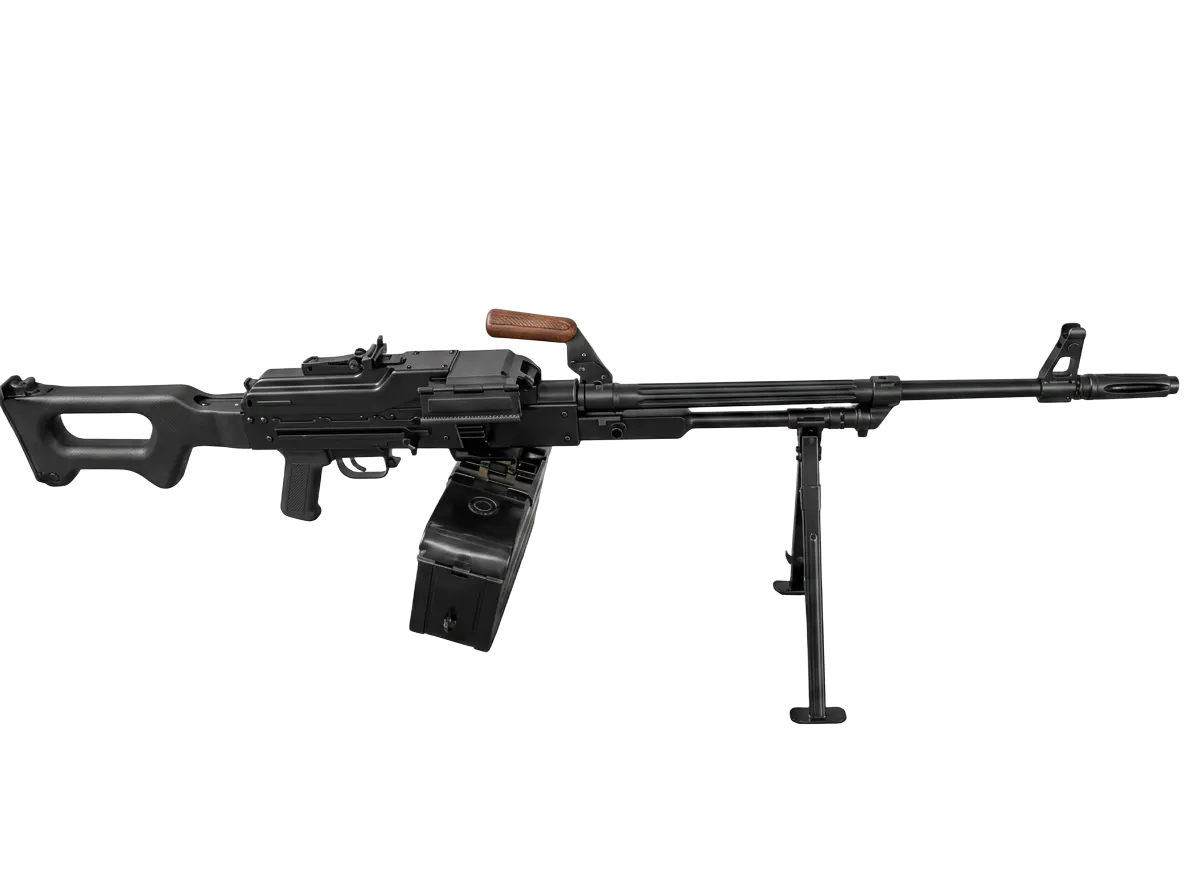
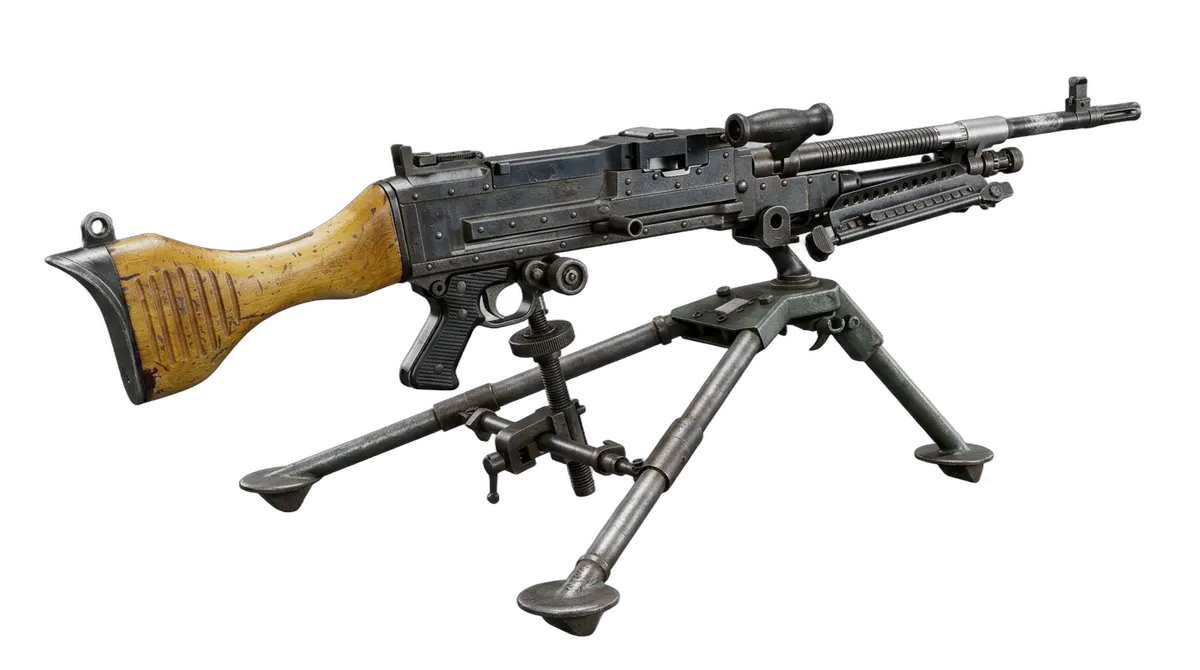
GShG-7.62
Country:  RussiaManufacturer: KBP Instrument Design Bureau (Gryazev-Shipunov)
Four-barrel Gatling-type aircraft machine gun in 7.62×54R designed by Gryazev and Shipunov, mounted on Mi-24 and Ka-29 helicopters with a rate of fire up to 6000 rpm.
GShG-7.62
Community
Data trust
- Reliability
- Unverified
- Sources
- Sources pending review
Identity
- Designation
- GShG-7.62
- Alias
- ГШГ-7,62 / 9-A-622
- Manufacturer
- KBP Instrument Design Bureau (Gryazev-Shipunov)
- Country
- Russia
- Year
- 1976
- Category
- Medium machine gun
- Status
- In service
Ballistics
- Caliber
- 7,62×54R
- Muzzle velocity
- 850 m/s
- Rate of fire
- ~6000 rpm
- Effective range
- 1500 m
- Maximum range
- 3800 m
Dimensions
- Barrel length
- 615 mm
- Overall length
- 880 mm
- Empty weight
- 19 kg
Mechanics
- Operating system
- Gatling, azionamento a gas (4 canne)
- Bolt / action
- Rotary, gas-driven
Feed
- System
- Nastro a maglie disintegrabili
- Standard capacity
- 1800 rounds
Fire modes
Historical profile
Origins and Strategic Development
The development of the GShG-7.62 formally began in 1968 at the KBP Instrument Design Bureau in Tula, under the leadership of renowned designers Vasily Gryazev and Arkady Shipunov. The primary objective was to provide next-generation attack helicopters with an extremely high rate of fire weapon capable of rapidly saturating enemy landing zones during airborne operations.
The project received the official GRAU index designation 9-A-622 and was finalized in 1976 after successfully passing state acceptance tests. The weapon was conceived to overcome the limitations of single-barrel machine guns, offering a volume of fire comparable to Western rotary systems while maintaining a lower overall mass for installation on sub-wing pylons.
Mechanical Architecture and Design
Unlike the American Minigun which utilizes an external electric motor, the GShG-7.62 employs a gas-operated drive system to rotate its four-barrel assembly. This technical solution allows the weapon to function autonomously without drawing power from the aircraft's electrical grid, making it ideal for GUV-8700 external pods that also house two 12.7mm Yak-B machine guns.
The weapon is fed via linkless 7.62x54R ammunition belts, featuring a feeding system designed to ensure reliability at high cyclic speeds. The rate of fire is selectable between two modes, 3500 and 6000 rounds per minute, allowing the pilot to manage ammunition consumption based on the target profile and mission duration.
Operational Service in Soviet Conflicts
The weapon entered large-scale operational service during the Soviet intervention in Afghanistan, primarily mounted on the mobile nose turrets of Kamov Ka-29 helicopters and in the sub-wing pods of Mil Mi-24V units. In this theater, the GShG-7.62 proved devastating against Mujahideen ambushes, where high fire density was essential to suppress enemy positions in rugged mountainous terrain.
Beyond its helicopter applications, the system was integrated into close-in defense complexes for ground installations and on light Soviet Navy vessels for defense against mines and small boats. Despite its high effectiveness, the weapon required rigorous maintenance due to the extreme temperatures reached by the barrel assembly during the prolonged bursts typical of close air support.
Evolution and Current Status
Following the end of the Cold War, the machine gun's use extended to the armed forces of the Russian Federation and several former Eastern Bloc nations, seeing action in the Chechen Wars and various regional conflicts. Although the Russian trend has shifted toward larger caliber automatic cannons like the GSh-23L, the GShG-7.62 remains in inventory for niche roles where light weight and fire volume are prioritized.
Recently, some units have been spotted in modernized configurations for use on unmanned ground vehicles (UGVs) and on new Ka-29 variants destined for special operations units. Its ability to deliver a hail of bullets in fractions of a second continues to make it a psychologically and materially effective weapon for perimeter defense and the neutralization of asymmetric threats.
Variants
Main users
Russia · Belarus · India · Vietnam
Key components
- ●Stock — Shoulder rest.
- ●Receiver — Weapon body with internal mechanisms.
- ●Grip — Primary grip.
- ●Magazine — Cartridge feed.
- ●Barrel — Guides the projectile.