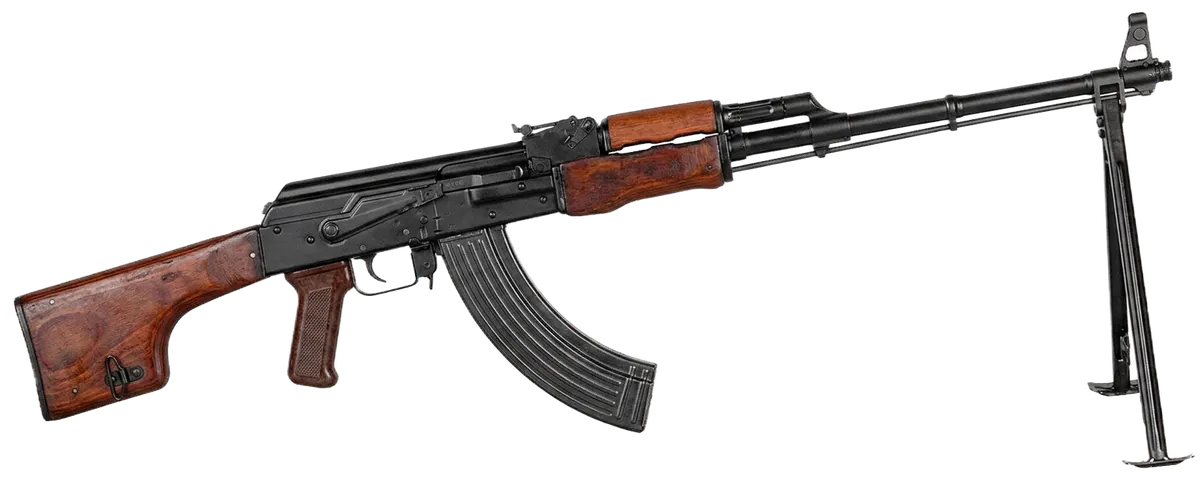
Besal
Country:  United KingdomManufacturer: Birmingham Small Arms (BSA)
British emergency light machine gun in .303 British, developed by BSA during WWII as a fallback in case Bren production was destroyed by bombing.
Besal
Community
Data trust
- Reliability
- Unverified
- Sources
- Sources pending review
Identity
- Designation
- Besal
- Alias
- Faulkner Light Machine Gun / BESA Light
- Manufacturer
- Birmingham Small Arms (BSA)
- Country
- United Kingdom
- Year
- 1942
- Category
- Light machine gun
- Status
- Historic
Ballistics
- Caliber
- .303 British (7,7×56 mmR)
- Muzzle velocity
- 745 m/s
- Rate of fire
- ~600 rpm
- Effective range
- 500 m
- Maximum range
- 1800 m
Dimensions
- Barrel length
- 558 mm
- Overall length
- 1180 mm
- Empty weight
- 9.75 kg
Mechanics
- Operating system
- Presa di gas, pistone a corsa lunga (otturatore aperto)
- Bolt / action
- Rotating bolt
Feed
- System
- Caricatore superiore (compatibile Bren)
- Standard capacity
- 30 rounds
Fire modes
Historical profile
Origins and Strategic Development
The need for the Besal emerged during the most critical phase of the Battle of Britain, when the British Ministry of Supply feared a total disruption of the Bren light machine gun supply chain. The project was entrusted to Birmingham Small Arms (BSA) under the direction of engineer Henry Faulkner, with the aim of creating an emergency weapon that did not rely on specialized machinery from the Royal Small Arms Factory at Enfield.
The development program was accelerated within a few months between 1941 and 1942, leading to a weapon that utilized stamping and welding techniques common in civilian industries. Although not intended to replace the Bren under normal conditions, the Besal was meant to ensure that Home Guard and frontline units had a steady flow of automatic weapons even under constant Luftwaffe bombing raids.
Technical Characteristics and Design
From a mechanical standpoint, the Besal was a gas-operated light machine gun utilizing a tilting bolt locking system partially derived from the BESA heavy machine gun. It was designed to chamber the standard .303 British cartridge and use the Bren's 30-round curved magazines, facilitating logistical integration with existing ammunition and accessories.
The weapon featured a minimalist design with a tubular metallic stock and a fixed carrying handle positioned above the barrel to facilitate rapid changes during overheating. Production simplification allowed BSA to drastically reduce the man-hours required for manufacturing by eliminating the complex milling from solid billets that made Bren production slow and expensive.
Evaluation and Aborted Operational Service
Military trials conducted in 1942 proved that the Besal was a surprisingly reliable and accurate weapon, capable of performance comparable to the Bren despite its crude aesthetics. In March 1943, the weapon was officially designated as the Faulkner Light Machine Gun to distinguish it from the BESA tank machine gun, though the name Besal remained most common among technicians.
Despite successful testing, the Besal never saw large-scale active service because the Royal Small Arms Factory managed to disperse Bren production into shadow factories and underground facilities, nullifying the risk of a production halt. By 1944, the massive volume of Bren guns supplied by the Commonwealth and allies made the use of a less refined emergency variant redundant.
Legacy and Historical Preservation
The Besal represents one of the most emblematic examples of necessity-driven wartime engineering, witnessing the British industry's ability to adapt rapidly to existential threats. The end of World War II and the post-war adoption of the 7.62mm NATO caliber ensured the final obsolescence of this project, which remained confined to the stage of advanced prototypes and pre-series batches.
Currently, the only surviving specimens of this rare machine gun are found in collections reserved for researchers and firearm historians. Significant pieces are displayed at the Royal Armouries in Leeds and the Imperial War Museum, where the Besal is studied as a fundamental chapter in the history of the United Kingdom's logistics and emergency industrial production.
Variants
Main users
United Kingdom (prototypes, never entered operational service)
Key components
- ●Stock — Shoulder rest.
- ●Receiver — Weapon body with internal mechanisms.
- ●Grip — Primary grip.
- ●Magazine — Cartridge feed.
- ●Barrel — Guides the projectile.
Community
Recent reviews
Similar systems
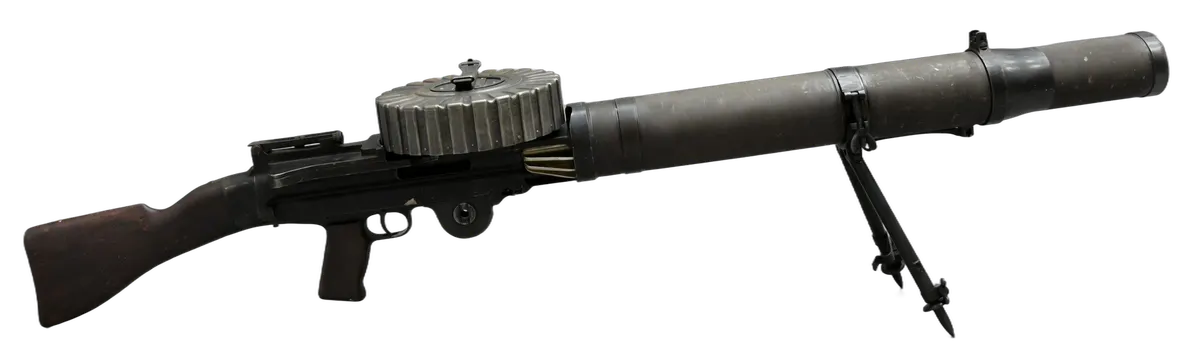
Lewis
1914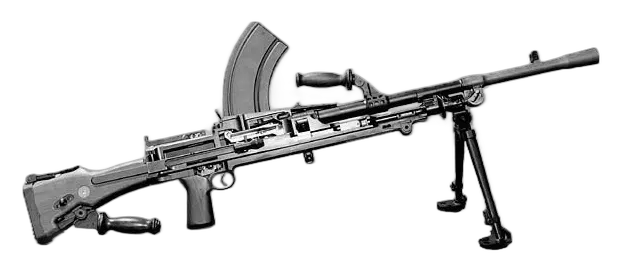
Bren
1938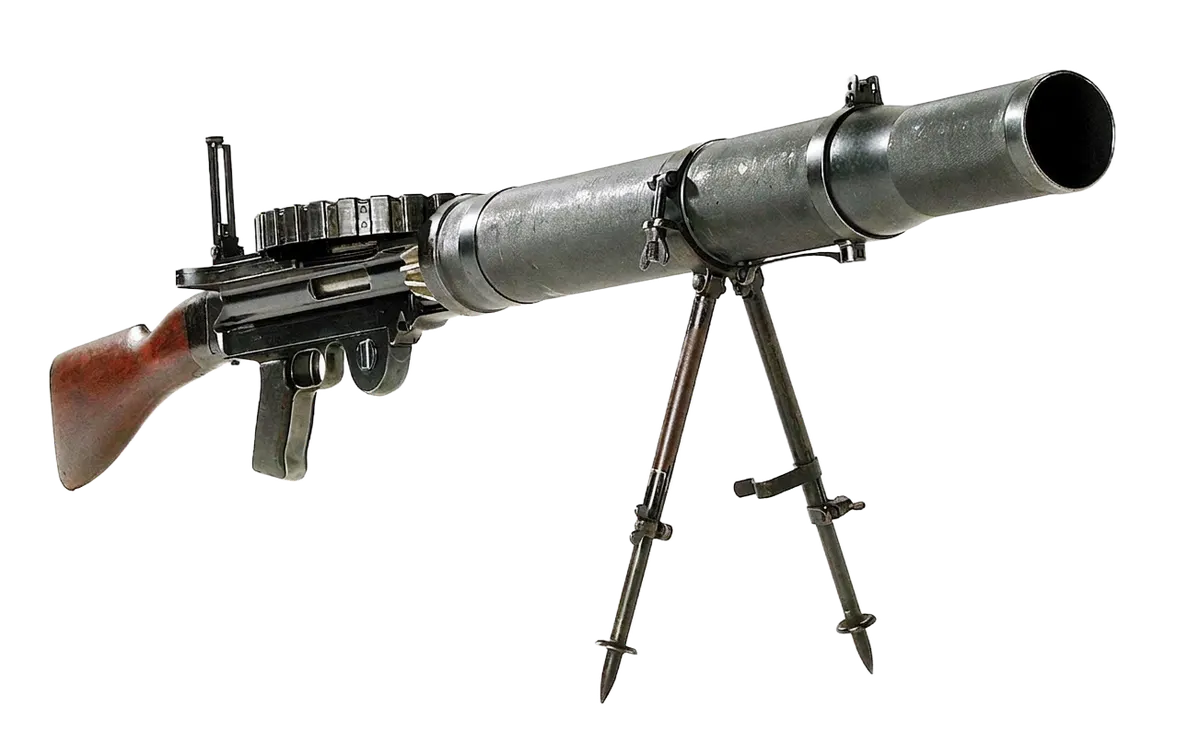
Lewis Gun
1914
Lee-Enfield No.4 Mk I
1941
Breda 30
1930