
Body armor & plates
PASGT vest
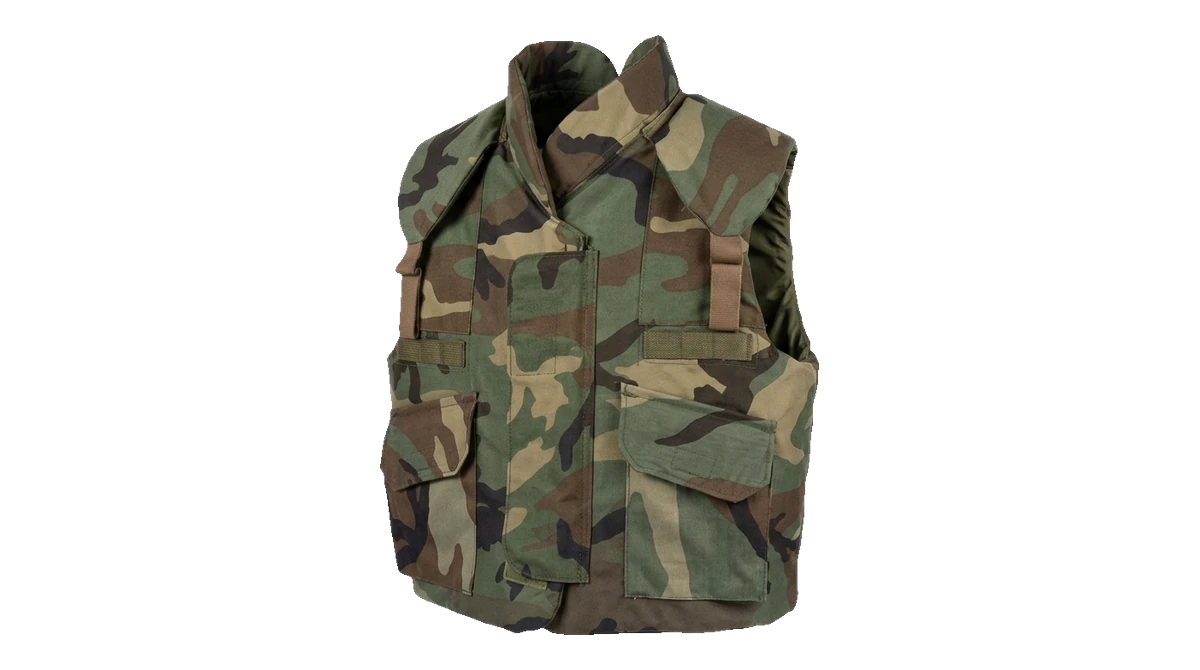
Developed by the U.S. Army Natick Soldier Systems Center to replace the Vietnam-era M-1969 nylon fragmentation vest. The Personnel Armor System for Ground Troops (PASGT) vest was the first standard-issue U.S. military body armor constructed from DuPont Kevlar, delivering vastly improved shrapnel protection without sacrificing mobility.
AI render based on photo by U.S. Army Natick Soldier Systems Center photo by G. T., Public domain
Community
Loading…
Specifications
- Category
- Body armor & plates
- Country
- United States
- Manufacturer
- UNICOR / Point Blank / Gibraltar Industries
- Introduced
- 1983
- Status
- Retired (Replaced by IBA; legacy/training use in partner forces)
- Protection level
- NIJ Level II / IIIA fragmentation standard; protects torso, shoulders, and neck collar against shell fragments, shrapnel, and 9×19 mm handgun projectiles (V50 ≈ 510 m/s against 17-grain FSP)
- Material
- 13-ply water-repellent treated Kevlar 29 para-aramid ballistic fabric inside ballistic nylon shell (M81 Woodland / DBDU)
- Weight
- ~4.08 kg (9.0 lb) size Medium (ranges from 3.4 kg XS to 4.9 kg XL)
- Users
- —
- Hard Plate Compatibility
- None natively (later upgraded with Interim Small Arms Protective Overvest — ISAPO — to hold ceramic plates)
- Modularity & Load Carriage
- Non-modular; featured two front chest pockets, two shoulder pads, and a grenade hanger loop, requiring external ALICE load-bearing suspenders/belt over the vest
- Variants & modernizations
- Standard PASGT Vest (M81 Woodland, Desert 6-Color, DCU), ISAPO (1996 ceramic plate carrier overvest).
History
Debuted in Grenada (Operation Urgent Fury, 1983) and served across Panama (1989), the Persian Gulf War (1991), Somalia (1993), and Bosnia/Kosovo peacekeeping before being superseded by the rifle-plate-capable Interceptor Body Armor in the late 1990s.
Related systems
—
Sources
- Data trust: Verified (U.S. Army NATICK Technical Reports & MIL-B-44053 Standard)
Community
Loading…
