
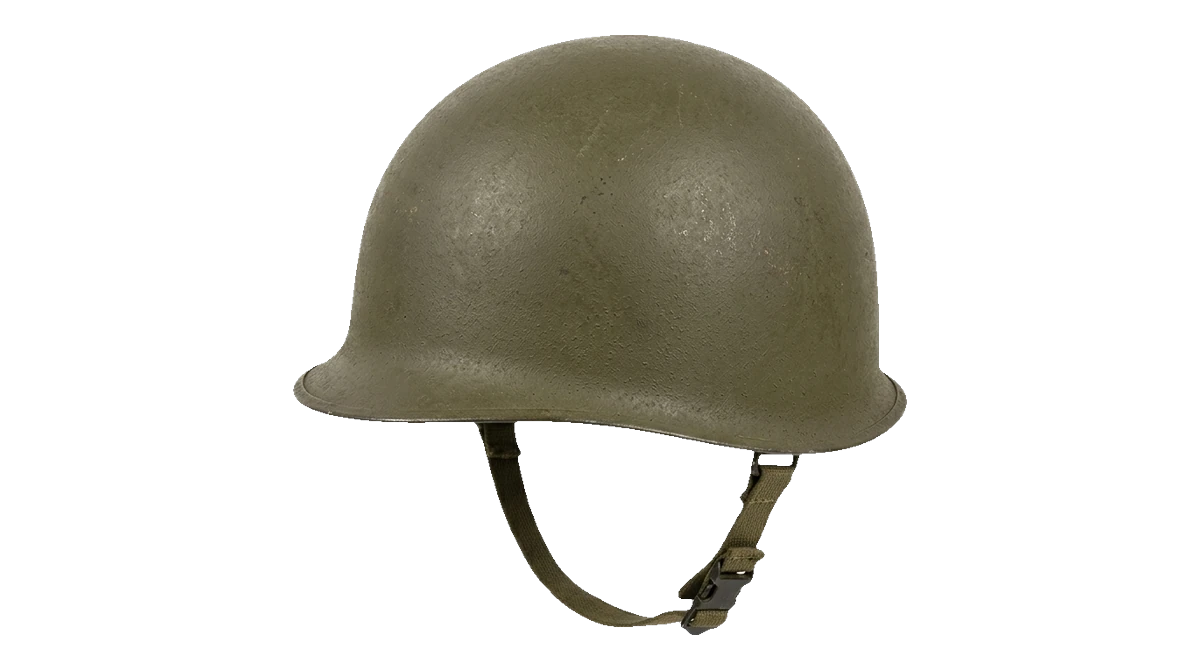
M1 helmet
Developed by the U.S. Army Ordnance Department to replace the WWI-era M1917 Kelly helmet, the M1 introduced a two-piece architecture consisting of a deep-drawn Hadfield manganese steel outer shell and a removable, adjustable inner liner. The steel outer shell could also be used independently as a field utility vessel when separated from the liner.
Community
Specifications
- Category
- Ballistic helmet
- Country
- United States
- Manufacturer
- McCord Radiator Manufacturing Company / Schlueter Manufacturing Company (Shells); Westinghouse / Firestone (Liners)
- Introduced
- 1941
- Status
- Retired (Ceremonial / Reserve Use in Selected Nations)
- Protection level
- Fragmentation and low-velocity shrapnel protection (V50 ≈ 240–270 m/s against 1.1 g FSP); not rated against direct rifle or high-velocity pistol projectiles
- Material
- Hadfield manganese austenitic steel (non-magnetic)
- Weight
- ~1.36 kg (3.0 lb) complete (shell + liner)
- Users
- —
- Suspension / Liner
- Separate high-pressure laminated phenolic resin / cotton duck liner with Riddell-style cradle suspension and leather sweatband
- Accessories & Mounting
- Cloth camouflage covers (Frogskin, Mitchell, ERDL, M81 Woodland), elastic foliage bands, early night-vision/flash mounts
- Variants & modernizations
- M1 Fixed-Bail (1941), M1 Swivel-Bail (1943), M1C Paratrooper variant (with chin cup and A-yoke straps), M2 Paratrooper (D-ring bales), and post-war P64 / Vietnam-era low-profile chinstrap updates.
History
Standardized in June 1941, over 22 million M1 helmets were produced during World War II alone. It served as the iconic headgear of the U.S. Armed Forces across World War II, the Korean War, and the Vietnam War, and was adopted or license-produced by dozens of NATO and allied militaries worldwide (including Canada, West Germany, Israel, and South Korea) until replaced by the Kevlar PASGT helmet in the 1980s.
Related systems
—
Sources
- Data trust: Verified (U.S. Army Ordnance Historical Specifications & NATICK Soldier Systems Archives)
