Sterling L2A3
Country:  United KingdomManufacturer: Sterling Armaments Company
British 9×19 submachine gun, successor to the Sten but far better finished: perforated barrel shroud, folding metal stock, curved 34-round magazine. In British Army service from 1953 to 1994.
Sterling L2A3
Community
Data trust
- Reliability
- Unverified
- Sources
- Sources pending review
Identity
- Designation
- Sterling L2A3
- Alias
- Patchett Machine Carbine
- Manufacturer
- Sterling Armaments Company
- Country
- United Kingdom
- Year
- 1953
- Category
- Submachine gun
- Status
- Historic
Ballistics
- Caliber
- 9×19 mm Parabellum
- Muzzle velocity
- 390 m/s
- Rate of fire
- ~550 rpm
- Effective range
- 200 m
- Maximum range
- 300 m
Dimensions
- Barrel length
- 198 mm
- Overall length
- 483 / 690 mm
- Empty weight
- 2.7 kg
Mechanics
- Operating system
- Massa battente (blowback) a otturatore aperto
- Bolt / action
- Open bolt
Feed
- System
- Caricatore laterale curvo
- Standard capacity
- 34 rounds
Fire modes
Historical profile
Military Origins and Development
The Sterling's journey began in 1944 when engineer George Patchett submitted a prototype to the Testing Establishment designed to address the structural deficiencies of the Sten. Although some units were tested by airborne troops during the final stages of World War II, the weapon underwent extensive post-war comparative trials against the BSA design and the MCEM-2.
The British Army sought a submachine gun that provided greater reliability and safety than the cheap emergency models used throughout the conflict. After several iterations designated the Patchett Machine Carbine, the design was officially standardized in 1953 as the L2A1, marking the start of a long production run by the Sterling Armaments Company in Dagenham.
Technical and Design Details
The L2A3, the final version adopted in 1956, was distinguished by its all-metal construction based on a tubular steel receiver with circular cooling vents. The most distinctive feature was the bolt featuring helical grooves that acted as scrapers to remove dirt and carbon fouling from the firing chamber, significantly increasing reliability in harsh environments.
The feeding system employed a curved 34-round double-stack magazine equipped with two internal rollers to reduce friction during the lift of the 9x19mm Parabellum cartridges. The metal under-folding stock ensured compactness, while the flip-type rear aperture sight was calibrated for engagement distances of 100 and 200 yards.
Global Operational Service
The weapon became the backbone of close-quarter armament for British NCOs during the decolonization era and Cold War conflicts. From the jungles of Malaya to the streets of Aden and Belfast, the Sterling proved superior to the Sten in accuracy and ruggedness, being widely issued to tank crews and paratroopers.
During the 1982 Falklands War, the Sterling was utilized by both sides, as Argentine forces employed both British-purchased models and license-produced versions. Its last major operational appearance with the British Army occurred in 1991 during Operation Granby, prior to its final replacement by the L85A1 assault rifle.
Evolution, Variants and Legacy
In addition to the standard variant, the famous L34A1 was produced, an integrally suppressed version used by the SAS and SBS for clandestine operations thanks to its ported barrel surrounded by a sound-damping sleeve. Outside the UK, India produced the weapon as the SAF Carbine 1A and 2A at the Kanpur arsenal, keeping it in active service for several decades after British decommissioning.
Despite production ending in 1988, the Sterling has maintained a steady presence in popular culture, serving as the basis for the E-11 blaster in the Star Wars saga. Today it remains an icon of 20th-century mechanical design, prized by collectors for its perfect balance between manufacturing simplicity and refined craftsmanship.
Variants
Main users
United Kingdom · Canada · India · New Zealand · Ghana · over 40 countries
Key components
- ●Stock — Shoulder rest.
- ●Receiver — Weapon body with internal mechanisms.
- ●Grip — Primary grip.
- ●Magazine — Cartridge feed.
- ●Barrel — Guides the projectile.
Community
Recent reviews
Similar systems
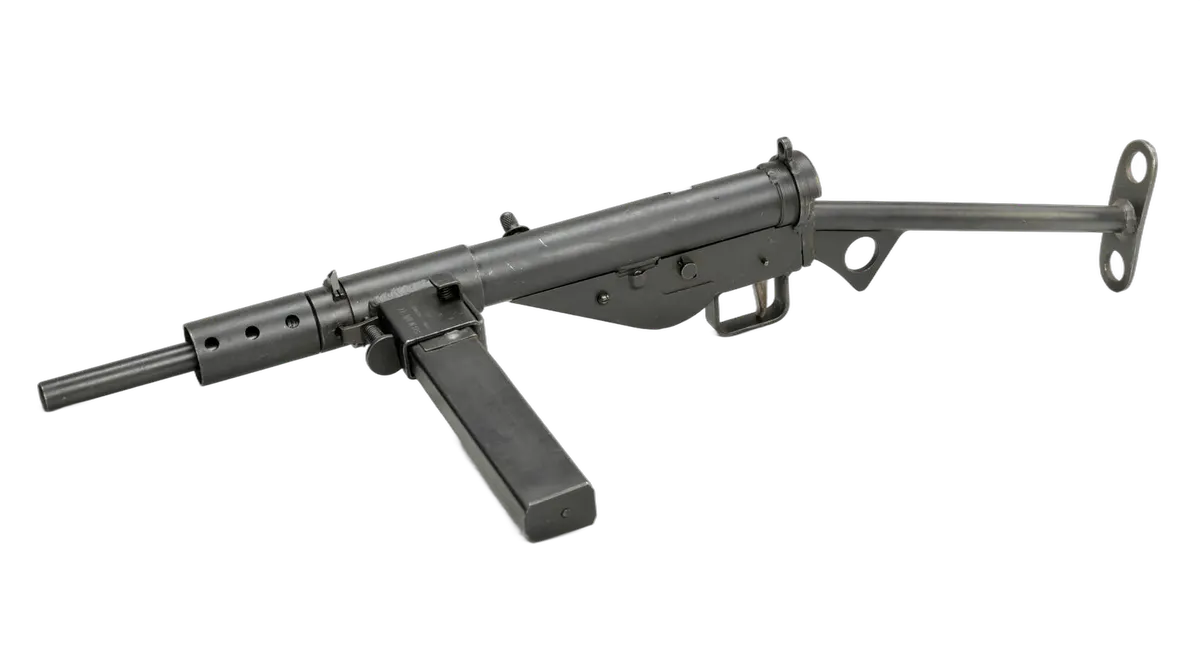
Sten
1941
Hispano-Suiza MP43
1943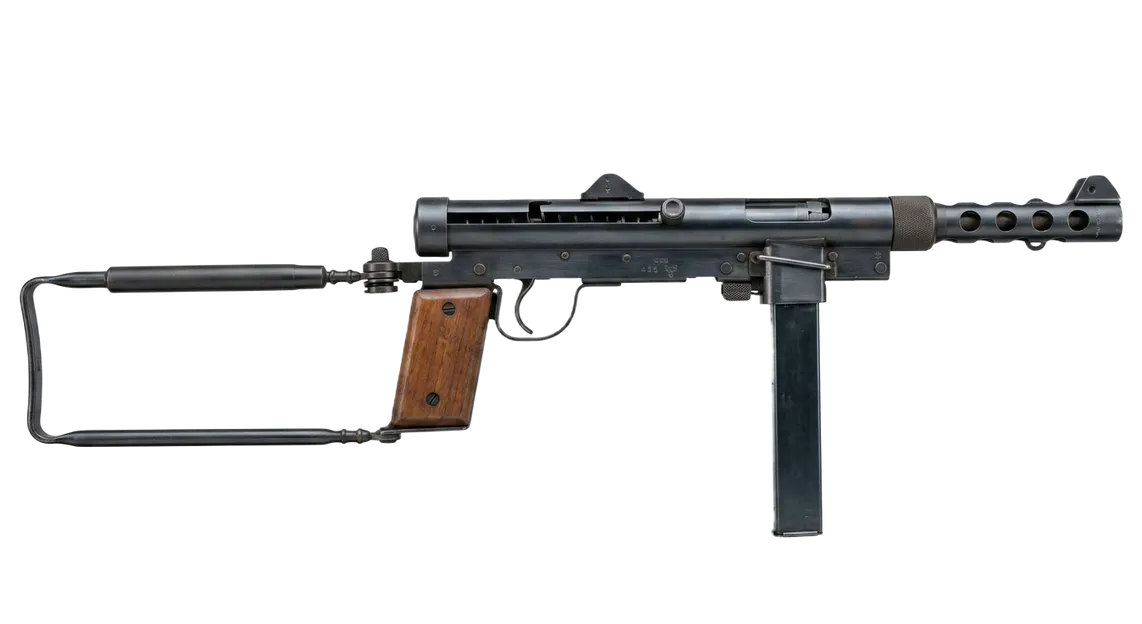
Kulsprutepistol m/45
1945
MAT-49
1949
IWI Uzi
1954