Glock 17
Striker-fired semi-automatic pistol with polymer frame and 17-round double-stack magazine in 9×19 mm: standard sidearm of the Austrian Army since 1982 and of hundreds of military and law-enforcement agencies worldwide.
Glock 17
Community
Data trust
- Reliability
- Partially verified
- Sources
- GLOCK 17 — The OriginalGLOCK · Accessed
- Last reviewed
Identity
- Designation
- Glock 17
- Alias
- Pistole 80 (P80)
- Manufacturer
- Glock GmbH
- Country
- Austria
- Year
- 1982
- Category
- Pistol
- Status
- In service
Ballistics
- Caliber
- 9×19 mm Parabellum
- Muzzle velocity
- 375 m/s
- Effective range
- 50 m
Dimensions
- Barrel length
- 114 mm
- Overall length
- 204 mm
- Empty weight
- 0.625 kg
- Loaded weight
- 0.905 kg
Mechanics
- Operating system
- Corto rinculo della canna, chiusura Browning modificata
- Bolt / action
- Striker-fired, Safe Action
Feed
- System
- Caricatore bifilare amovibile
- Standard capacity
- 17 rounds
Fire modes
Production & service
- ●Glock 17 Gen 5 — Fifth generation: Marksman barrel, no finger grooves, MOS optic-ready.
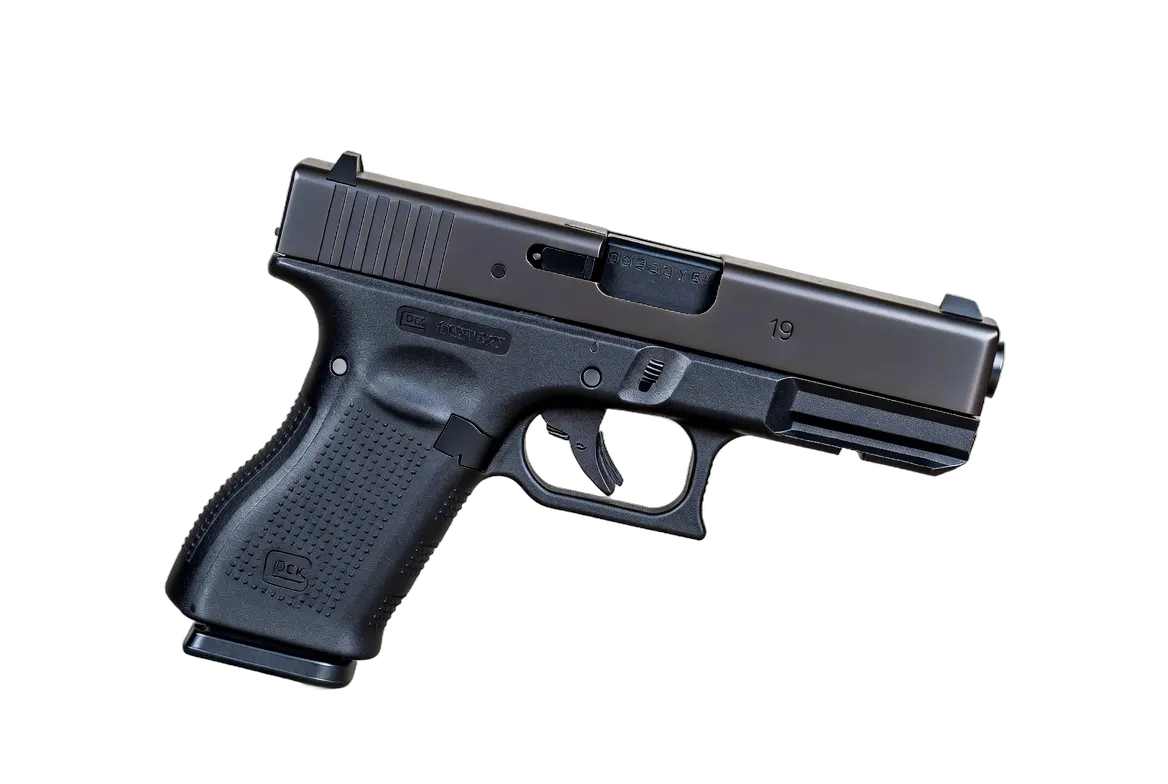
- ●Glock 19 — Compact version, 102 mm barrel, 15-round magazine.
- ●Glock 18 — Selective full-auto variant for military/police use.
Historical profile
Development and Military Origins
The genesis of the Glock 17 dates back to 1980, when the Austrian Ministry of Defence published requirements for a new service pistol intended to replace the aging Walther P38. Although Gaston Glock had no previous experience in firearms design, his deep knowledge of advanced polymers and automated industrial processes allowed him to conceive a radically innovative prototype in just six months.
The competition saw participation from historic manufacturers such as Heckler & Koch, SIG Sauer, and Beretta, but the Glock model successfully bypassed the rigorous reliability and torture tests. In 1982, after passing drop tests, cycles of thousands of rounds without jamming, and resistance to extreme temperatures, the weapon was officially adopted by the Austrian armed forces under the ministerial designation Pistole 80.
Technical Innovation and Design
The most revolutionary aspect of the Glock 17 lies in the adoption of the high-strength Nylon 6 frame, which ensures a reduction in overall weight and exceptional corrosion resistance. The Safe Action trigger system introduced three independent automatic safeties, eliminating the need for external manual levers while ensuring the weapon can only fire if the trigger is intentionally pulled.
The slide and barrel are made of steel treated with a ferritic nitrocarburizing process, which gives a surface hardness close to that of a diamond and an extremely durable finish. The internal configuration utilizes a short recoil system based on the modified Browning principle, optimized for rapid firing cycles and simplified maintenance consisting of only 34 total parts.
Operational Service and Global Distribution
Following success in Austria, the Glock 17 entered the US market in 1986, revolutionizing the equipment of local and federal law enforcement agencies that were then transitioning from revolvers to semi-automatic pistols. Its simplicity and high 17-round magazine capacity quickly made it the de facto standard, being adopted by agencies such as the FBI and later by elite units like the Navy SEALs in 9mm caliber.
Beyond the United States, the pistol became the standard issue weapon for nations such as Norway, the Netherlands, and the United Kingdom, where it officially replaced the Browning Hi-Power as the L131A1 in 2013. In combat, its robustness has been widely proven in the conflicts in Iraq and Afghanistan, demonstrating superior resilience in desert and dusty climates compared to traditional metal platforms.
Evolution and Historical Significance
The Glock 17 has undergone five generations of improvements, moving from Gen1 with a smooth grip to the 2017 Gen5, which introduces the Marksman barrel and the removal of finger grooves. Specialized variants include the long-barreled G17L for competitive shooting and the G17T for training, confirming the versatility of a modular platform that redefined the modern concept of a combat pistol.
The legacy of the Glock 17 is visible in nearly every modern polymer-framed pistol produced by competitors, who had to adapt their technological standards to the success of the Austrian model. Today, the weapon is not only a professional tool but a cultural and industrial icon that demonstrated how the use of synthetic materials could overcome the structural limits of metal in the firearms industry.
Variants
Main users
Austria · Norway · Sweden · United Kingdom · oltre 60 paesi
Key components
- ●Slide — Slide of the full-size 9×19 mm GLOCK 17 pistol, above its polymer frame.
- ●Telaio — Polymer frame of the striker-fired GLOCK 17, rather than a metal-framed service pistol.
- ●Grip — Full-size GLOCK 17 grip surrounding its detachable magazine; compact GLOCK 19 dimensions do not apply.
- ●Grilletto — GLOCK Safe Action trigger on the striker-fired G17; no generation-specific trigger feature is assumed.
- ●Magazine — Detachable box magazine for 9×19 mm ammunition; GLOCK lists a standard G17 capacity of 17 rounds.