
Silent Barker (NRO / USSF Geosynchronous Space Domain Awareness)
Country:  United StatesManufacturers: Lockheed Martin, Ball Aerospace (co-manufacturer)
Jointly developed by the NRO and U.S.
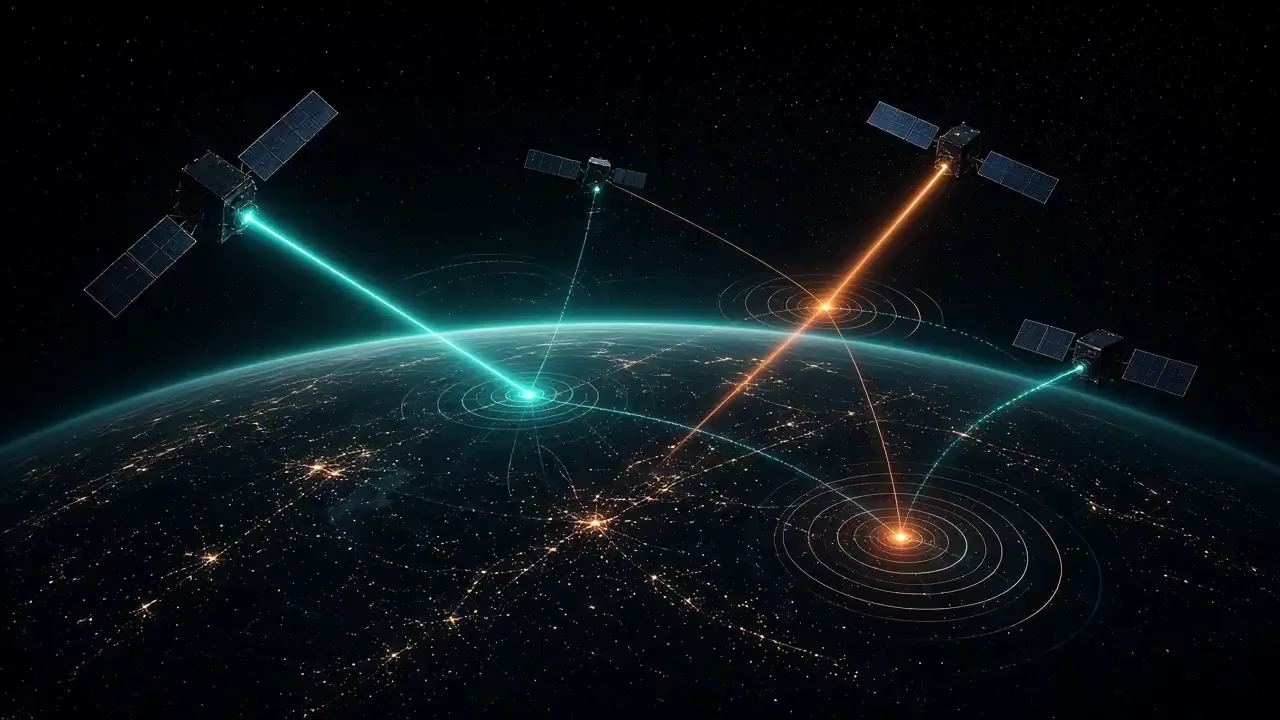
Generic satellite illustration — not a depiction of the actual system. CLASSIFIED is a visual label, not an official classification statement.
Community
Identity5 fields
- Country
- United States
- Manufacturer
- Lockheed Martin Space / Ball Aerospace
- Introduction
- —
- Status
- In service
- Category
- Space surveillance / inspector satellite
Mission9 fields
- Orbit
- Near-Geostationary Earth Orbit (Near-GEO surveillance constellation)
- Operator
- United States Space Force (Space Delta 2) / National Reconnaissance Office (NRO)
- Payload
- Wide-field-of-view space-based visible/infrared optical surveillance telescopes and autonomous on-orbit anomaly detection processors
- Introduction dates
- 2023 (Launched September 10, 2023 — NROL-107)
- Altitude & Inclination
- ~35,786 km circular | ~0°–3° inclination (distributed around the geosynchronous arc)
Data trust
- Reliability
- Unverified
- Sources
- Sources pending review
- Last reviewed

Historical profile
Jointly developed by the NRO and U.S. Space Force as a high-altitude "watchdog" constellation specifically designed to deter and detect orbital ambush tactics, co-orbital inspector satellites, and anti-satellite (ASAT) maneuvers in the critical 35,786 km geosynchronous belt. Complementing maneuverable close-approach GSSAP inspectors, Silent Barker maintains wide-area persistent surveillance to ensure no adversarial spacecraft can maneuver undetected.
Deployed into geosynchronous orbit in September 2023 (NROL-107), providing real-time indications and warning (I&W) to U.S. Space Command and the National Space Defense Center (NSDC) regarding foreign RPO and counterspace activities.
Variants and blocks: Silent Barker Block I (multi-satellite initial cluster; follow-on expansions planned for late 2020s).
