
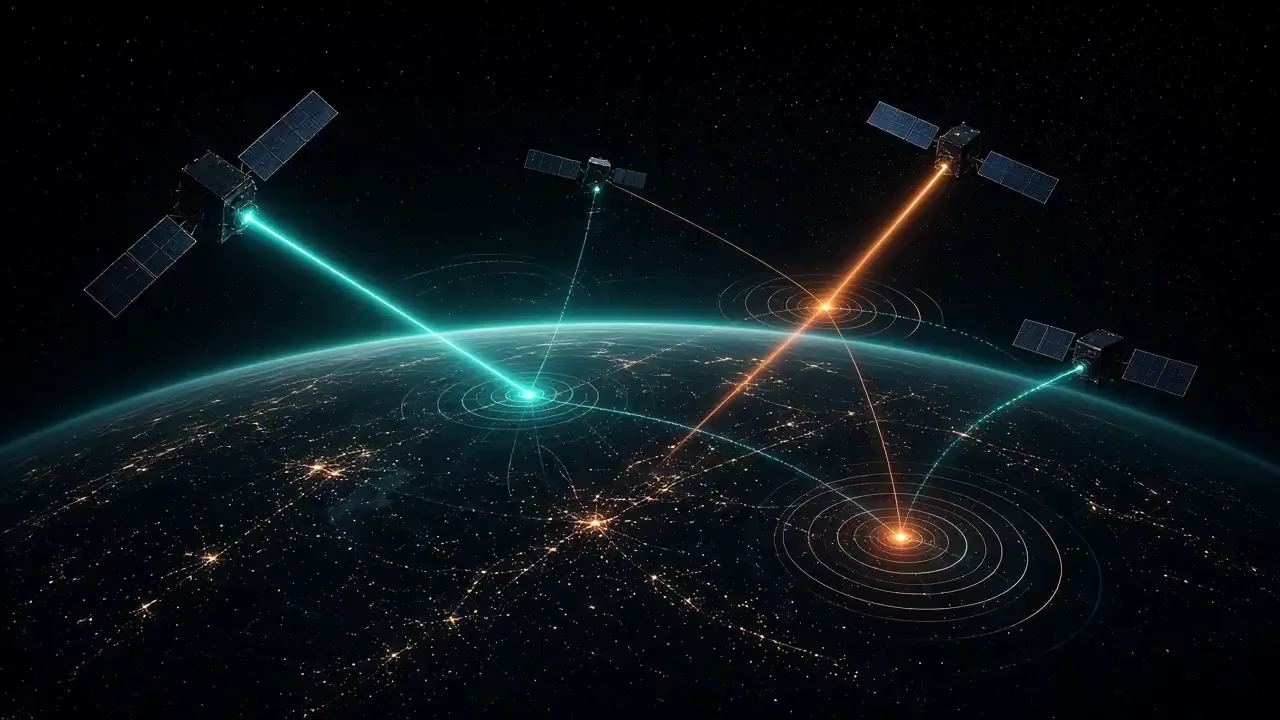
MUOS
Mobile User Objective System
Country:  United StatesManufacturer: Lockheed Martin
The Mobile User Objective System (MUOS) is a United States Space Force narrowband military communications satellite system serving a multi-service user community in the ultra high frequency (UHF) band. Lockheed Martin Space is the prime system contractor and satellite designer. The satellites are geosynchronous. MUOS-1 was launched on 24 February 2012.
AI-generated illustration based on a photo by US Navy, Public domain, via Wikimedia Commons
Wikimedia Commons referenceCommunity
Identity5 fields
- Country
- United States
- Manufacturer
- Lockheed Martin Space
- Introduction
- 2012
- Status
- In service
- Category
- Communications satellite
Mission9 fields
- Orbit
- GEO
- Operator
- United States Space Force
- Payload
- Narrowband UHF military satellite communications
- Altitude & Inclination
- 35,786 km circular | ~0° inclination (global coverage spanning 88^\circ\text{N}\text{ to }88^\circ\text{S})
- Launch Mass
- ~6,740 kg (fueled)
Data trust
- Reliability
- Partially verified
- Sources
- Mobile User Objective SystemWikipedia · Accessed
- Last reviewed

Historical profile
MUOS-1 launched on 24 February 2012 on an Atlas V 551, after weather delays, followed by MUOS-2 on 19 July 2013 and MUOS-3 on 20 January 2015. Public accounts describe four operational satellites on station at published longitudes.
The system adapts a commercial 3G WCDMA approach to a military UHF SATCOM service. This sheet does not record terminal inventories or a live traffic figure.
Developed as the next-generation narrowband tactical communications backbone for the U.S. Department of Defense and international partners. MUOS bridges mobile warfighters—including dismounted infantry, armored vehicles, submarines, aircraft, and special operations teams—into a global secure cellular network via space, enabling communications inside deep canyons, jungles, and urban structures where traditional line-of-sight radio fails.
Provided uninterrupted global tactical paging, secure voice, and IP data transfer across U.S. Central Command, Indo-Pacific Command, and European Command theaters.
Variants and blocks: MUOS-1 through MUOS-5 (plus orbital spare configured to operate across global nodal slots).
