
Galileo
Galileo global navigation satellite system
Country:  European UnionManufacturers: OHB, Surrey Satellite Technology (co-manufacturer)
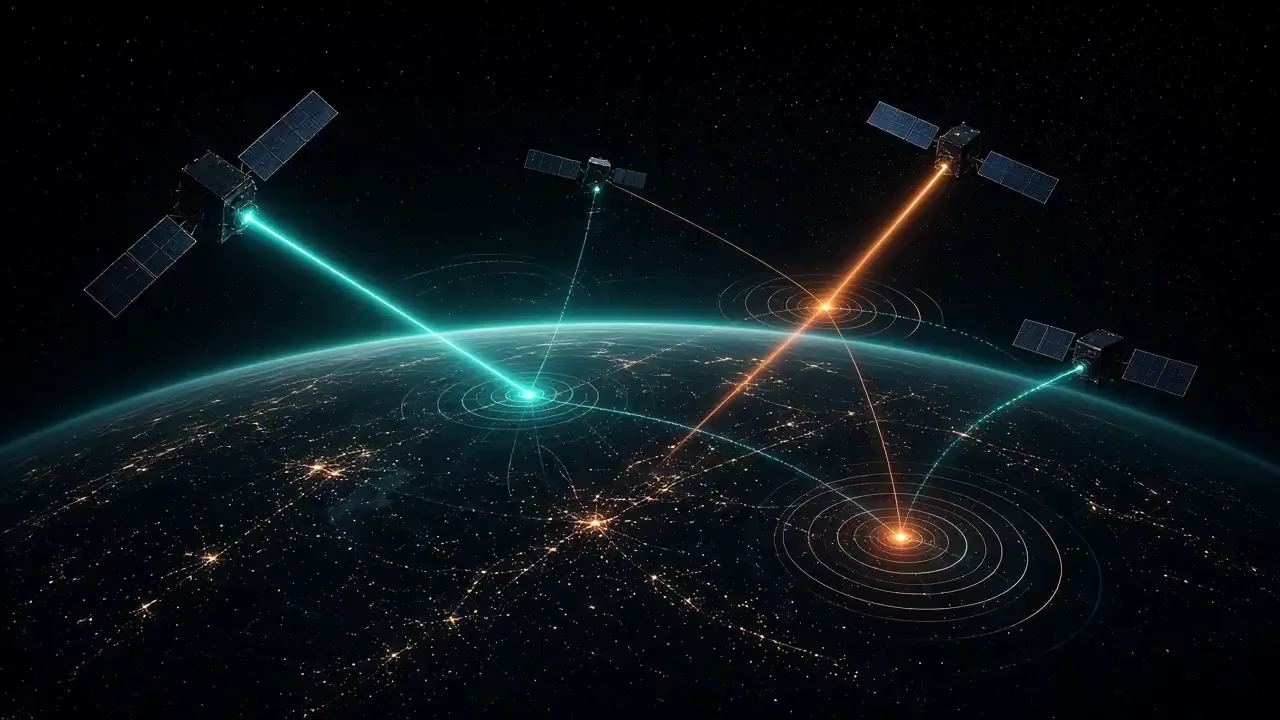
Galileo is the European Union's global navigation satellite system, created through the European Space Agency and operated by the European Union Agency for the Space Programme (EUSPA) with ESA. The satellites operate in medium Earth orbit. Initial services began on 15 December 2016.
AI-generated illustration based on a photo by European Space Agency, CC BY-SA 3.0 igo, via Wikimedia Commons
Wikimedia Commons referenceCommunity
Identity5 fields
- Country
- European Union
- Manufacturer
- OHB / Surrey Satellite Technology
- Introduction
- 2016
- Status
- In service
- Category
- Navigation satellite
Mission8 fields
- Orbit
- MEO
- Operator
- EUSPA / European Space Agency
- Payload
- Radio-navigation and timing
- Altitude & Inclination
- 23,222 km circular | 56° inclination (3 orbital planes)
- Launch Mass
- ~733 kg (Galileo FOC) | ~2,300 kg (Galileo Second Generation — G2G)
Data trust
- Reliability
- Partially verified
- Sources
- GalileoWikipedia · Accessed
- GalileoESA · Accessed
- Galileo begins serving the globeESA · Accessed
- GalileoEuropean GNSS Service Centre · Accessed
- Last reviewed

Historical profile
The first experimental test satellite, GIOVE-A, was launched on 28 December 2005, followed by GIOVE-B in April 2008. The first satellite belonging to the operational system was launched on 21 October 2011.
Galileo started offering Early Operational Capability on 15 December 2016. Most later programme satellites have been built by OHB, with contributions from Surrey Satellite Technology. This sheet covers the Galileo system, not a single satellite batch.
Developed jointly by the European Union and the European Space Agency (ESA) to provide Europe with an independent, high-precision PNT infrastructure under civilian governance, while incorporating a dedicated encrypted **Public Regulated Service (PRS)** restricted to EU member state defense ministries, intelligence agencies, and critical emergency services.
Integrated into European NATO military platforms, naval vessels, Eurofighter/Rafale avionics, and precision-guided munitions; Galileo Second Generation (G2G) introduces electric propulsion, inter-satellite links, and digitally configurable navigation antennas for enhanced anti-jamming resilience.
Variants and blocks: Galileo IOV (4 In-Orbit Validation satellites), Galileo FOC (Full Operational Capability — Batch 1, 2, 3), Galileo Second Generation (G2G).
