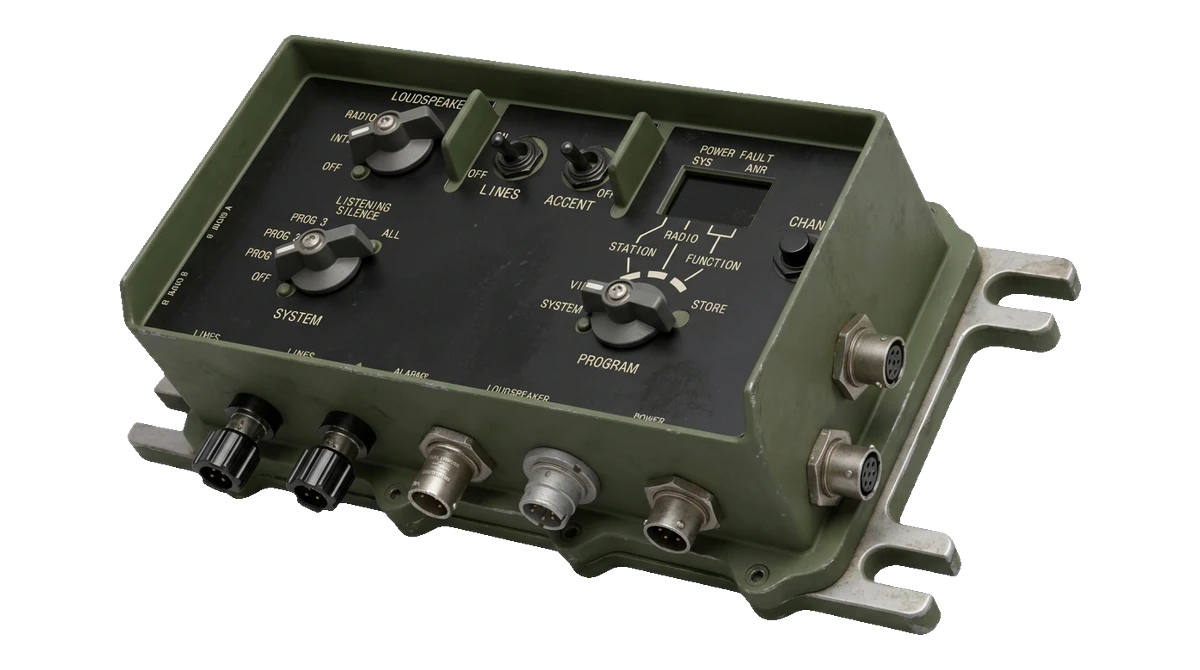
AN/VIC-3 intercom
The AN/VIC-3 is a digital vehicular intercommunications system developed in the United States for the U.S. Army, U.S. Marine Corps, and allied armed forces. Succeeding the analog AN/VIC-1, it represents a digital time-division multiplexed generation of armored vehicle communications. Its primary role is providing clear internal crew voice links with active noise reduction while integrating access to up to six external tactical combat-net radios inside tanks, infantry fighting vehicles, and tactical trucks.
Based on reference: https://www.chelton.com/product/rovis-vehicle-intercom-system/
Community
Data Trust
Not available
Specifications
- Category
- Vehicle & crew comms
- Country
- Not available
- Manufacturer
- Not available
- Introduced
- 1994
- Status
- Not available
- Frequency bands
- Not available
- Waveforms
- Not available
- Encryption
- Not available
- Data rate
- Not available
- RF power
- Not available
- Weight
- Not available
History
The AN/VIC-3 is a digital vehicular intercommunications system developed by Northrop Grumman (formerly Litton) and Cobham for the United States Army and Marine Corps to replace the legacy analog AN/VIC-1 intercom. Entering service in the mid-1990s, the AN/VIC-3 was engineered to provide clear internal crew communications, active noise reduction (ANR), and seamless access to up to six tactical combat-net radios—such as SINCGARS and EPLRS—inside high-noise armored fighting vehicles. Utilizing a digital time-division multiplexed architecture, it allows crew members in M1 Abrams tanks, M2 Bradley infantry fighting vehicles, Stryker carriers, and HMMWVs to monitor multiple radio nets simultaneously while isolating internal crew chatter from external transmissions. Widely deployed throughout operations in Iraq and Afghanistan and exported to numerous allied armies, the AN/VIC-3 has been supplemented and gradually succeeded by the upgraded, IP-capable AN/VIC-5 system, though it remains in widespread active service.
Related systems
Not available
Sources
ARSENALIS // Research desk
Dossier resources
- Listed · status unspecified
- Active
- Retired
- On order / future
- —No quantity recorded
No structured operator list recorded. Country of origin is not treated as an operator.
Quantities are shown only when published in structured operator data; otherwise “—”. Individual service status is unspecified unless explicitly recorded.
Operator list sources
- attributed to Wikipedia — Vehicular intercom system
- attributed to Service / introduction year
Select a country on the map or in the table to see its entry and other catalogued systems listing it as an operator.