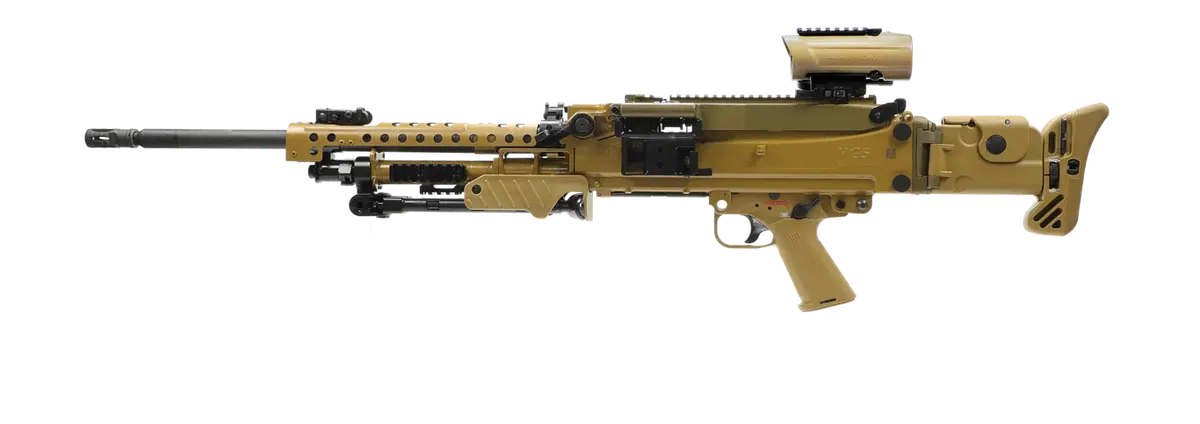
MG 34
The first true general-purpose machine gun in history: chambered in 7.92×57 mm Mauser, air-cooled with a quick-change barrel and a cyclic rate of around 800–900 rpm, it could serve as a light machine gun on a bipod or as a medium/heavy machine gun on the Lafette 34 tripod.
MG 34
Community
Data trust
- Reliability
- Unverified
- Sources
- Sources pending review
Identity
- Designation
- MG 34
- Alias
- Maschinengewehr 34
- Manufacturer
- Rheinmetall-Borsig / Mauser
- Country
- Germany
- Year
- 1934
- Category
- Medium machine gun
- Status
- Historic
Ballistics
- Caliber
- 7,92×57 mm Mauser
- Muzzle velocity
- 755 m/s
- Rate of fire
- ~850 rpm
- Effective range
- 1200 m
- Maximum range
- 3500 m
Dimensions
- Barrel length
- 627 mm
- Overall length
- 1219 mm
- Empty weight
- 12.1 kg
Mechanics
- Operating system
- Short recoil
- Bolt / action
- Rotating bolt
Feed
- System
- Nastro disintegrante da 50/250 colpi o tamburo Patronentrommel 34 da 75 colpi
- Standard capacity
- 75 rounds
Fire modes
Historical profile
Development
The MG 34 was developed by Heinrich Vollmer at Mauser-Werke in Oberndorf between 1930 and 1934, based on earlier Rheinmetall work.
Adopted by the Reichswehr in 1934, it is considered the first true 'general-purpose machine gun' (Einheitsmaschinengewehr), capable of serving interchangeably as a squad weapon (bipod), medium machine gun (tripod), anti-aircraft or vehicle weapon.
Design
Chambered in 7.92×57 mm Mauser, it operates on short barrel recoil with a rotating bolt. Very high cyclic rate for its time: 800-900 rpm.
Quick-change barrel (replaceable in 5-7 seconds), fed by 50- or 250-round belts or 75-round dual drums (Doppeltrommel). High-precision machining however made it expensive and sensitive to dirt.
Operational service
It was the standard support weapon of the Wehrmacht at the start of World War II, present in every rifle squad and on nearly every German vehicle.
Although gradually replaced by the MG 42 from 1942, it remained in production until 1945 and in service with numerous postwar forces (Czechoslovakia, Bulgaria, Israel, China) into the 1960s.
Variants
Main users
Germania (Wehrmacht, Waffen-SS, Luftwaffe) · China · Spain · Portogallo
Key components
- ●Stock — Shoulder rest.
- ●Receiver — Weapon body with internal mechanisms.
- ●Grip — Primary grip.
- ●Magazine — Cartridge feed.
- ●Barrel — Guides the projectile.
Community
Recent reviews
Similar systems
MG 42
1942
MG 08
1908
Gewehr 43
1943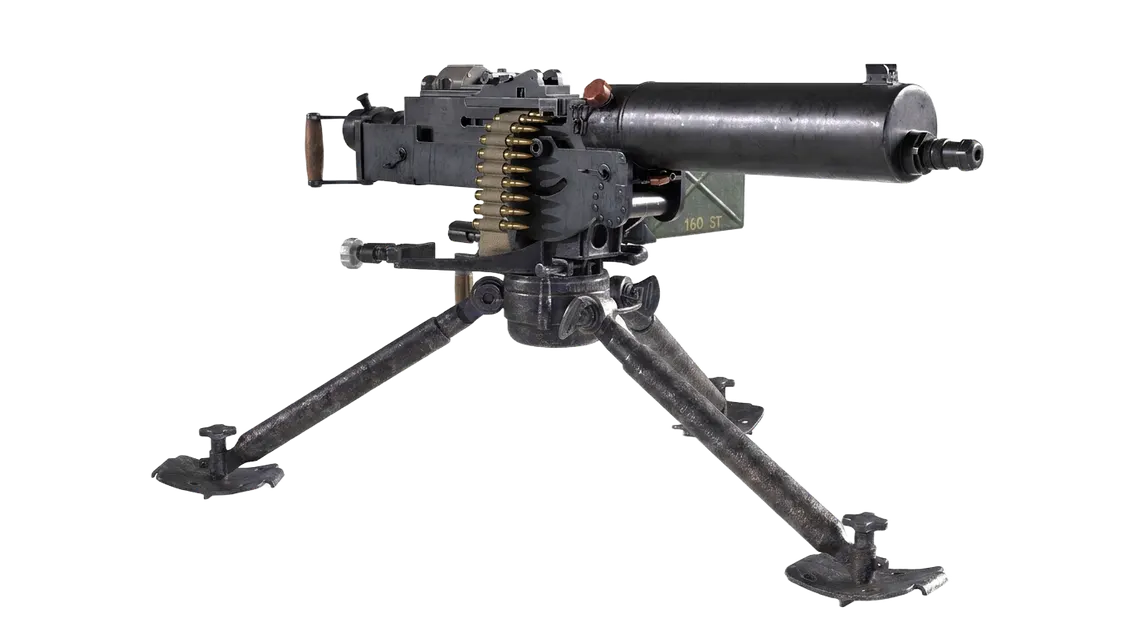
Kulspruta m/36
1936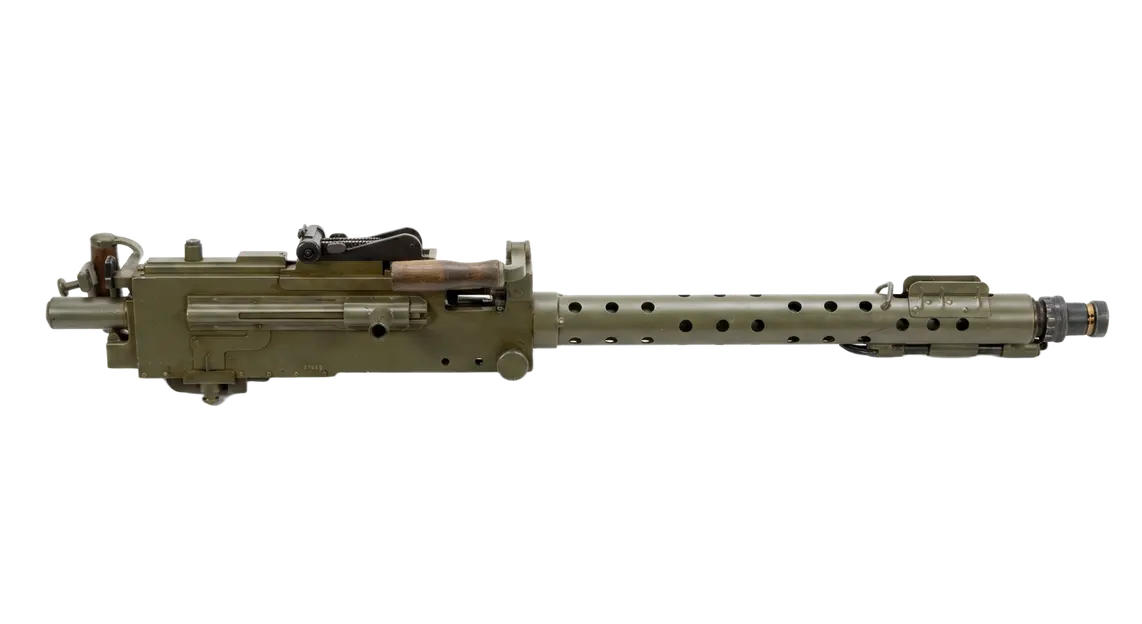
Kulspruta m/42
1942