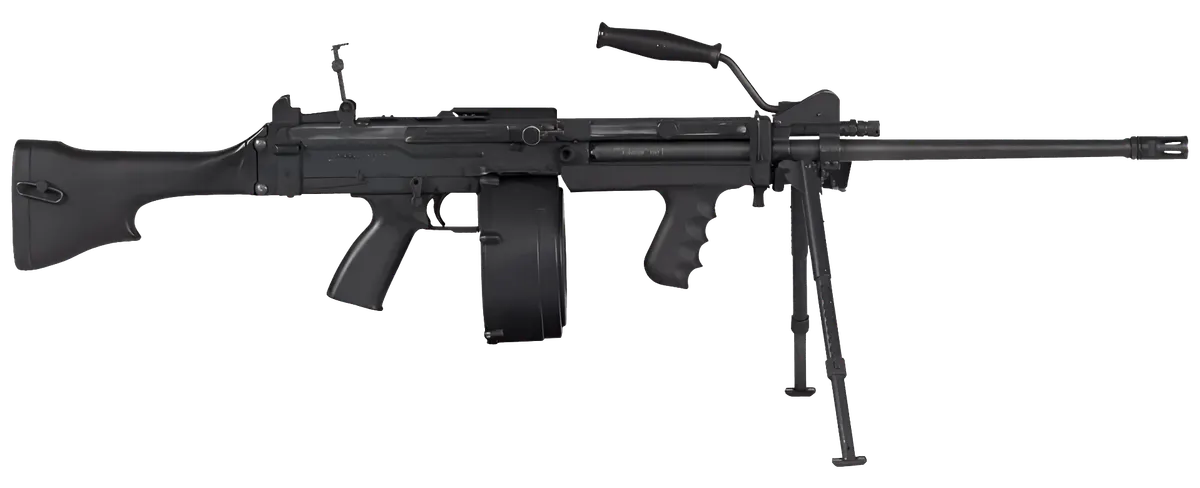
M249 SAW
FN Minimi-derived 5.56×45 NATO light machine gun: dual feed (disintegrating belt or STANAG magazine), issued as squad automatic weapon by the U.S. Army and USMC.
M249 SAW
Community
Data trust
- Reliability
- Unverified
- Sources
- Sources pending review
Identity
- Designation
- M249 SAW
- Alias
- FN Minimi
- Manufacturer
- FN Herstal
- Country
- Belgium
- Year
- 1984
- Category
- Light machine gun
- Status
- In service
Ballistics
- Caliber
- 5.56×45 mm NATO
- Muzzle velocity
- 915 m/s
- Rate of fire
- ~800 rpm
- Effective range
- 800 m
- Maximum range
- 3600 m
Dimensions
- Barrel length
- 465 mm
- Overall length
- 1041 mm
- Empty weight
- 7.5 kg
Mechanics
- Operating system
- Gas-operated, long-stroke piston
- Bolt / action
- Rotating bolt
Feed
- System
- Dual feed: belt or STANAG magazine
- Standard capacity
- 200 rounds
Fire modes
Historical profile
Development and Military Selection house
The weapon's genesis dates back to the early 1970s, when the United States Army initiated the Squad Automatic Weapon (SAW) program to bridge the tactical gap between the M16 assault rifle and the M60 medium machine gun. FN Herstal submitted the Minimi prototype, which competed against models such as the Rodman Laboratories XM248 and the Maremont XM233, passing rigorous endurance tests in extreme environments and sustained fire trials.
The Pentagon officially selected the Belgian design in 1982, designating it the M249, although large-scale adoption was delayed by budgetary constraints and refinements required in domestic production. Manufacturing was entrusted to the FN Manufacturing LLC subsidiary in Columbia, South Carolina, ensuring a steady supply for the U.S. armed forces starting in 1984.
Technical Features and Design
The M249 operates via a gas-actuated system with a rotating bolt, designed to fire from an open-bolt position to prevent cook-off during sustained bursts. The barrel features a chrome-lined bore and a quick-change system that allows the operator to replace an overheated component in seconds using a fixed carrying handle.
A distinctive feature of the weapon is the auxiliary feed system protected by a spring-loaded gate, allowing the insertion of 30-round STANAG magazines when belt-fed ammunition is unavailable. While this function provides tactical flexibility, the increased cyclic rate when using magazines can cause malfunctions, making it a solution reserved strictly for emergencies.
Operational Service and Variants house
The weapon's baptism by fire occurred during the 1989 invasion of Panama, but it was during Operation Desert Storm in 1991 that it proved its effectiveness in providing squad-level suppressive fire. In the 1990s, the Product Improvement Program (PIP) introduced essential modifications such as a synthetic stock with a recoil buffer, a ventilated handguard, and a simplified gas regulator to enhance mean reliability.
During the conflicts in Iraq and Afghanistan, the Special Operations Forces (SPW) and the MK46 variant were extensively used by elite units, removing the magazine feed system to reduce weight. The Para version, equipped with a telescopic buttstock and shortened barrel, became the standard for airborne troops and for use in confined spaces or urban warfare settings.
Evolution and Progressive Replacement house
Starting in 2011, the United States Marine Corps began partially replacing the M249 with the M27 Infantry Automatic Rifle (IAR), favoring a lighter and more accurate weapon based on the HK416 platform. Conversely, the Army has kept the M249 in active service, although it recently selected SIG Sauer's XM7 SAAW in 6.8mm caliber under the Next Generation Squad Weapon program to replace 5.56mm weapons.
Despite the design's age, the M249 remains a cornerstone of NATO doctrines, used by over 30 nations in various configurations, including the Canadian C9 and the Australian F89. Its legacy lies in having redefined the concept of portable volume of fire, providing a single infantry unit with the stopping power previously reserved exclusively for heavy machine gun teams.
Variants
Main users
United States (US Army) · USMC · Belgium · Canada · over 30 countries
Key components
- ●Stock — Fixed stock with cheek rest.
- ●Receiver — Stamped housing with top rail.
- ●Grip — Polymer pistol grip.
- ●Magazine — 200-round belt pouch/box or STANAG.
- ●Barrel — Quick-change barrel with integral bipod.
Community
Recent reviews
Similar systems
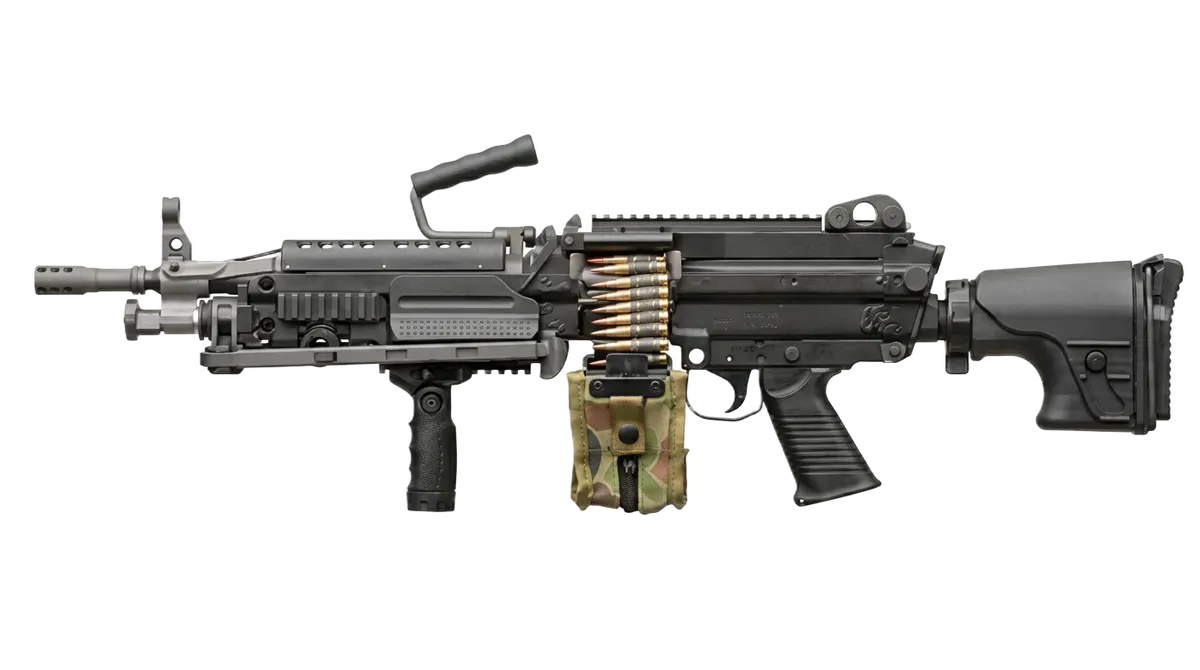
FN Minimi
1974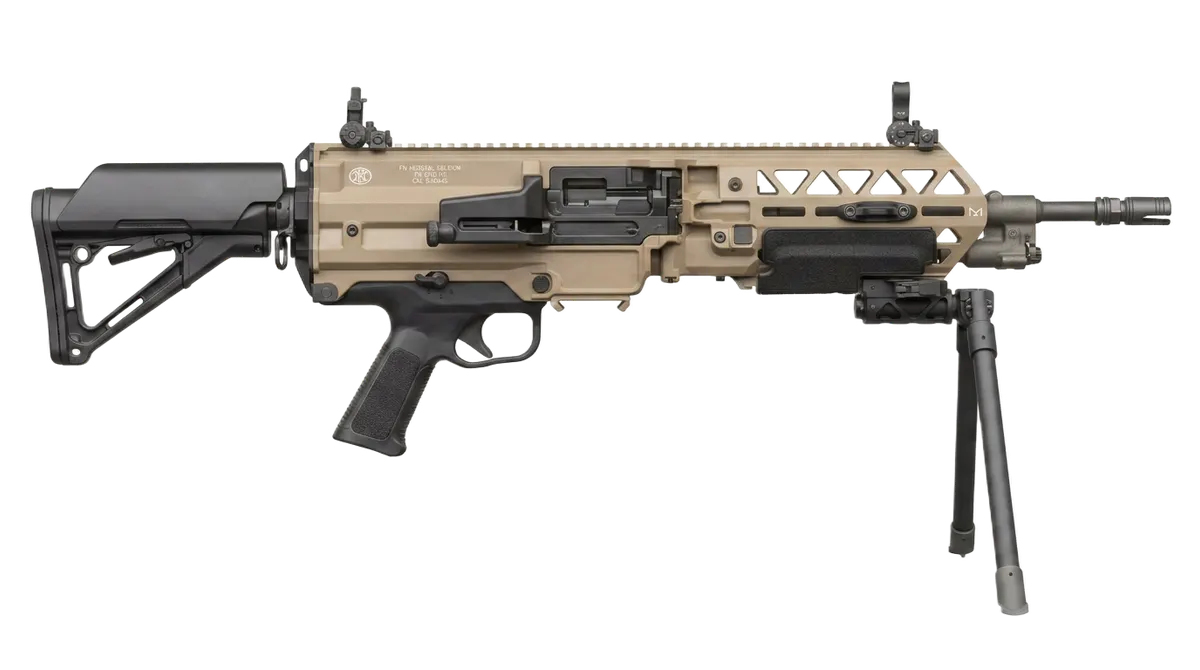
FN Evolys
2021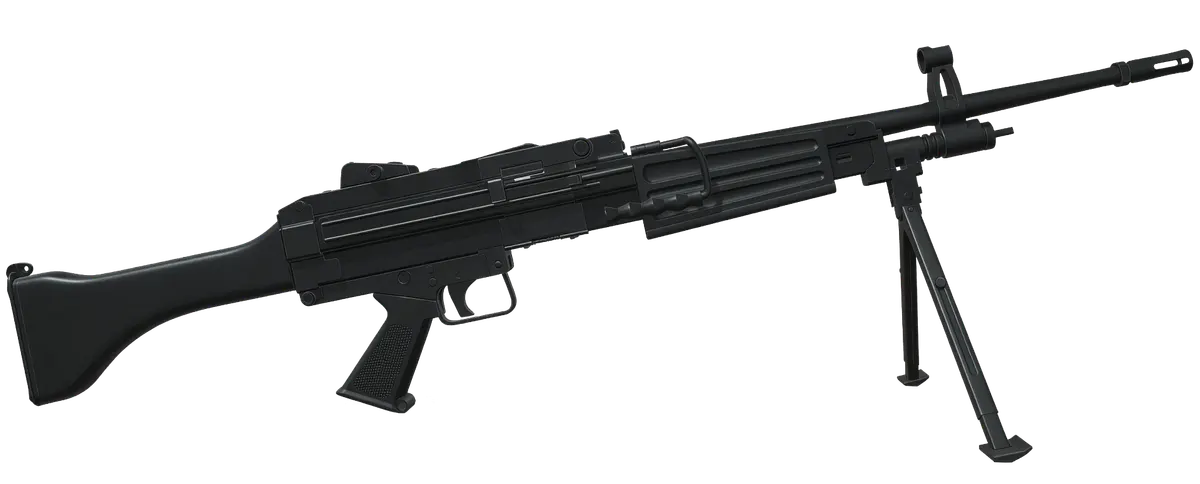
K3
1989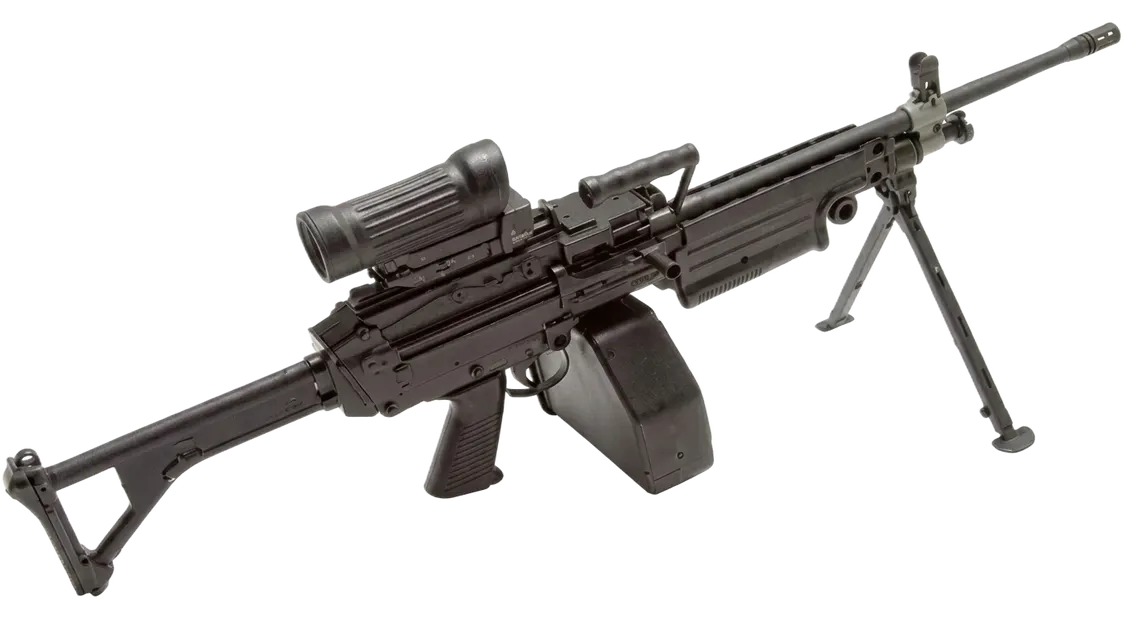
C9
1985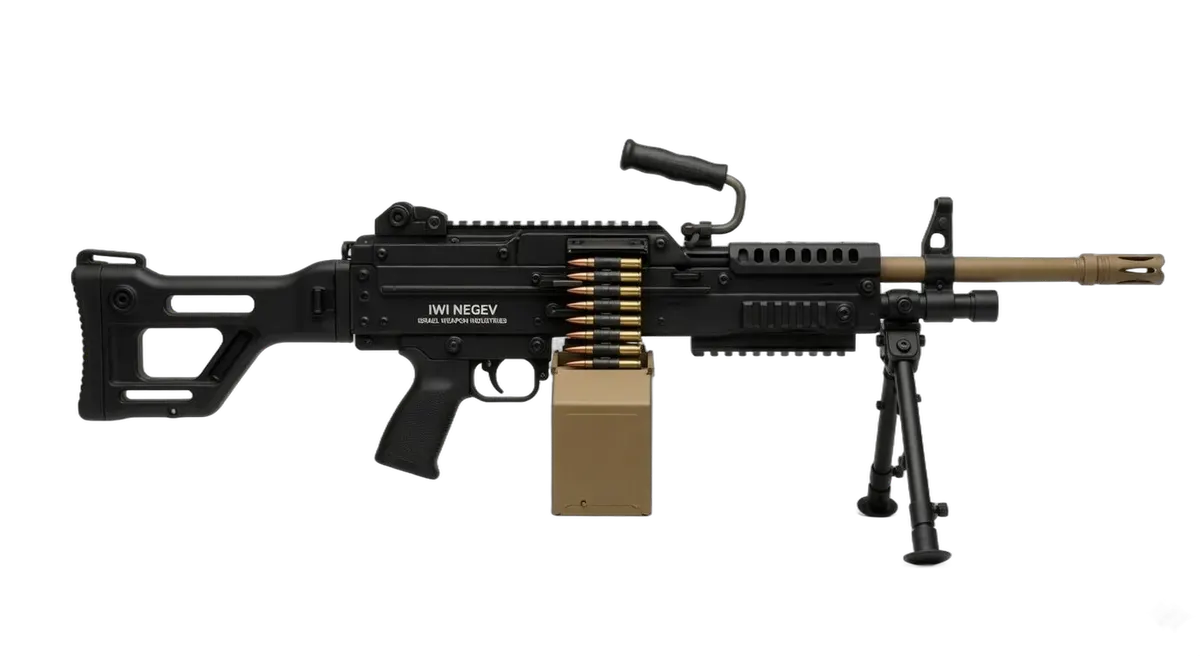
IWI Negev
1997