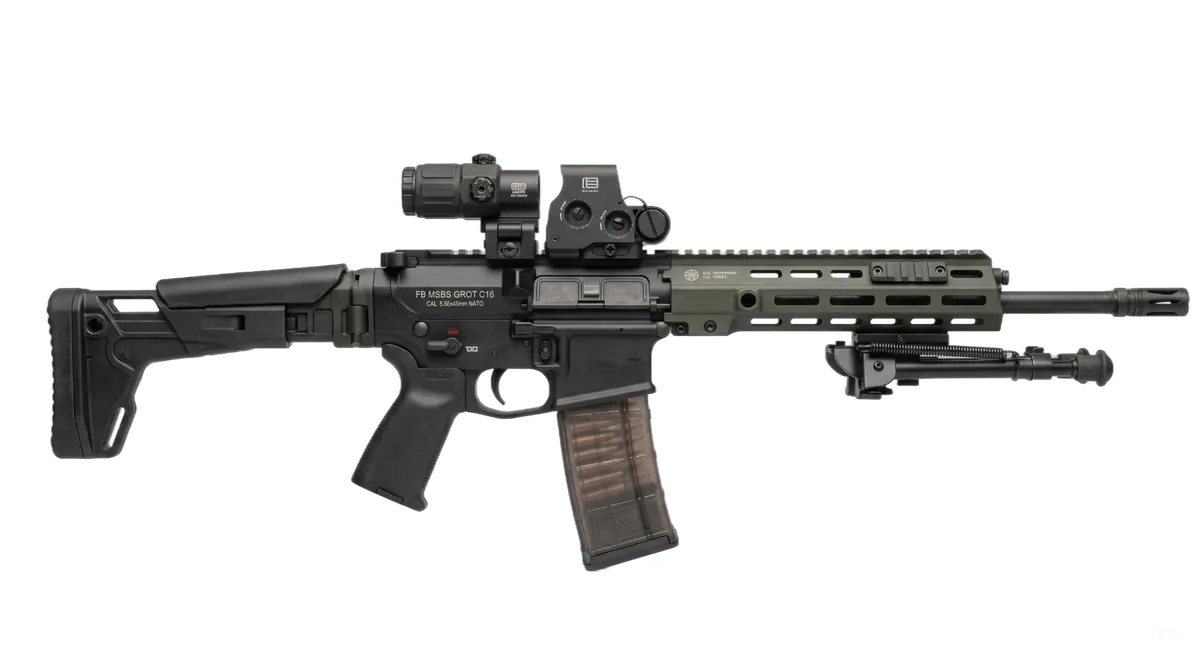
Daniel Defense M4A1 RIII
Premium-grade AR-15 carbine with low-profile M-LOK RIII handguard: chosen by several U.S. special units and police forces.
Daniel Defense M4A1 RIII
Community
Data trust
- Reliability
- Unverified
- Sources
- Sources pending review
Identity
- Designation
- Daniel Defense M4A1 RIII
- Manufacturer
- Daniel Defense
- Country
- United States
- Year
- 2020
- Category
- Assault rifle
- Status
- In service
Ballistics
- Caliber
- 5.56×45 mm NATO
- Muzzle velocity
- 880 m/s
- Rate of fire
- ~800 rpm
- Effective range
- 500 m
- Maximum range
- 600 m
Dimensions
- Barrel length
- 368 mm
- Overall length
- 743 / 826 mm
- Empty weight
- 2.95 kg
Mechanics
- Operating system
- Direct gas impingement
- Bolt / action
- Rotating bolt
Feed
- System
- STANAG magazine
- Standard capacity
- 30 rounds
Fire modes
Historical profile
Development and Commercial Origins
The evolution of the Daniel Defense platform is rooted in the U.S. infantry modernization programs of the early 2000s through the supply of critical components. Following the success of the RIS II system adopted for the SOPMOD Block II program, the company began developing its own line of complete carbines to meet the demand for lighter and more modular weapons than the contemporary military standard.
The transition to the RIII series represents the pinnacle of this refinement process that officially began with the launch of the first complete systems in 2009. This new iteration was designed to address the specific needs of operators requiring a slimmer weapon profile without sacrificing the structural robustness necessary for mounting optics and light intensifiers.
Technological Design Features
The heart of the M4A1 RIII lies in its innovative six-bolt attachment system that secures the handguard to the barrel nut, ensuring superior structural rigidity for laser zero retention. The 14.5-inch barrel is manufactured using the cold-hammer forging process with chrome-moly-vanadium steel, ensuring consistent accuracy and an extended service life even under sustained fire regimes.
The adoption of the M-LOK interface on the RIII generation marks the final departure from the old four-sided integral Picatinny system, drastically reducing overall weight and improving ergonomics. The weapon also integrates a fully ambidextrous lower receiver, allowing the operation of the safety, bolt release, and magazine release from both sides to facilitate hand transitions during close-quarters operations.
Adoption and Operational Service
Although the RIII configuration is a recent introduction, the DDM4A1 series has consolidated its presence within USSOCOM (United States Special Operations Command) since 2014. The weapon has been widely employed by various elite units in Middle Eastern theaters, where it demonstrated superior resilience to sand and mud infiltration due to tight manufacturing tolerance standards.
Beyond military use, the M4A1 RIII has become a reference standard for SWAT teams and U.S. federal agencies managing high-risk scenarios. Internationally, several European and Asian special forces units have begun acquiring variants of this platform to replace aging Colt models or heavier piston-driven weapons, prioritizing the versatility of the direct impingement gas system.
Legacy and Impact in the Arms Industry
The introduction of the RIII series has redefined professional market expectations regarding the balance between lightweight design and ballistic resistance in a modern assault rifle. Daniel Defense has successfully transformed from an accessory supplier into a manufacturer of complete weapon systems capable of competing directly with historic global defense giants, influencing the design of many competitors.
The M4A1 RIII currently represents the technological equilibrium point between the traditional AR-15 platform and the requirements of modern asymmetric warfare, where modularity and accuracy are top priorities. Its legacy lies in making military-grade construction quality accessible to a broad audience of professional users, setting new quality standards for the future of combat carbines.
Variants
Main users
United States (USSOCOM) · FBI HRT · U.S. police forces
Key components
- ●Stock — Shoulder rest.
- ●Receiver — Weapon body with internal mechanisms.
- ●Grip — Primary grip.
- ●Magazine — Cartridge feed.
- ●Barrel — Guides the projectile.
Community
Recent reviews
Similar systems
M4A1 Carbine
1994
M16A4
1997
CZ BREN 2
2015
Excalibur
2015
K2C1
2016