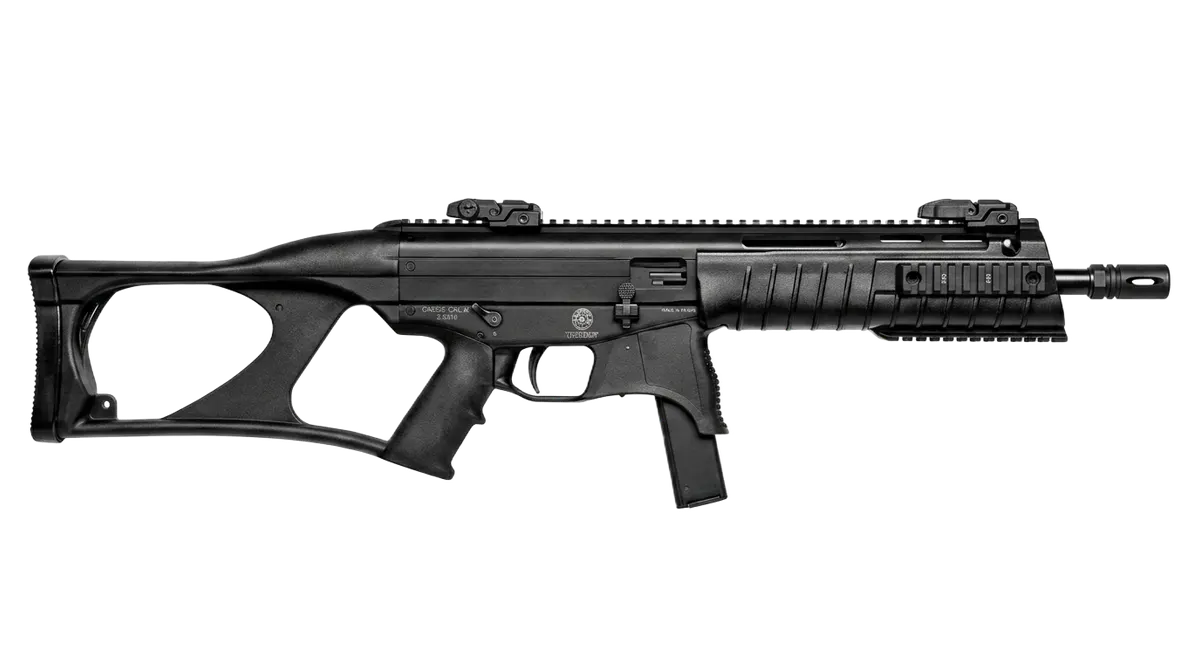
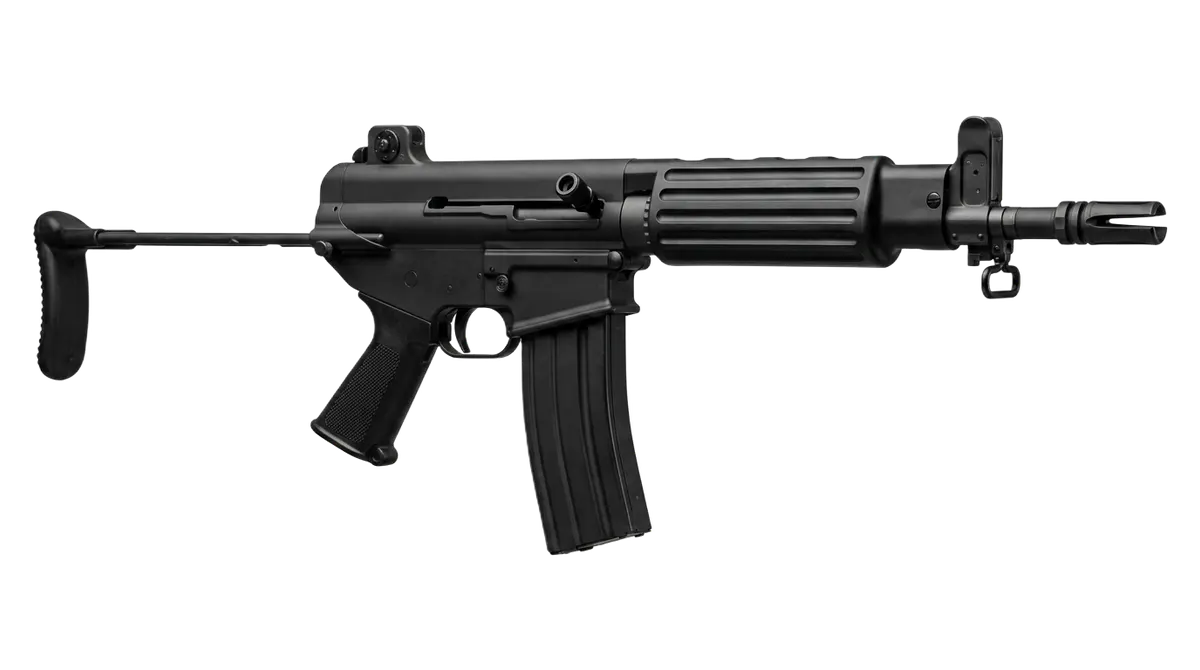
Beretta Cx4 Storm
Country:  ItalyManufacturer: Fabbrica d'Armi Pietro Beretta
Italian semi-automatic carbine in pistol calibres (9×19, .40 S&W, .45 ACP) designed by Beretta as a compact firearm for civilian, sport and police use, sharing magazines with the 92/Px4 series pistols.
Beretta Cx4 Storm
Community
Data trust
- Reliability
- Unverified
- Sources
- Sources pending review
Identity
- Designation
- Beretta Cx4 Storm
- Alias
- Cx4
- Manufacturer
- Fabbrica d'Armi Pietro Beretta
- Country
- Italy
- Year
- 2003
- Category
- Carbine
- Status
- In service
Ballistics
- Caliber
- 9×19 mm / .40 S&W / .45 ACP
- Muzzle velocity
- 420 m/s
- Effective range
- 100 m
- Maximum range
- 200 m
Dimensions
- Barrel length
- 422 mm
- Overall length
- 745 mm
- Empty weight
- 2.9 kg
Mechanics
- Operating system
- Massa battente, closed-bolt
- Bolt / action
- Blowback semi-auto
Feed
- System
- Caricatore amovibile (compatibile con pistole Beretta serie 92/Px4)
- Standard capacity
- 17 rounds
Fire modes
Historical profile
Development and Project Genesis
The Storm project was launched by Beretta in the early 2000s with the aim of creating an integrated ecosystem of small arms for the security and civilian markets. The Cx4 was conceived as the central piece of this family, leveraging the collaboration of industrial designer Giugiaro for a futuristic aesthetic combined with advanced ergonomics.
The primary intent of the Gardone-based manufacturer was to offer a patrol carbine that allowed operators to use the same ammunition and, crucially, the same magazines already issued with standard duty pistols. The official unveiling occurred in 2003, predating the Px4 Storm pistol and setting new standards for pistol-caliber carbines (PCC).
Technical Architecture and Design
The Cx4 Storm utilizes a blowback operating system with a telescoping bolt that wraps around the barrel, a solution that keeps the weapon's total length at just 755 mm. The frame is constructed from high-strength technopolymers, integrating a fixed stock with removable spacers to adjust the length of pull according to the user's physique.
The firearm is distinguished by extreme modularity, allowing the operator to move the charging handle and ejection port from one side to the other in minutes without special tools. The 16.6-inch barrel is cold-hammer forged and chrome-lined, ensuring superior accuracy compared to handguns while maintaining compatibility with 9x19 mm, .40 S&W, and .45 ACP calibers.
Operational Service and Law Enforcement
Despite its semi-automatic nature making it ideal for the American civilian market and practical shooting, the Cx4 has found significant use in law enforcement and paramilitary sectors. It has been adopted by various police departments in the United States, such as the Albany Police Department, and by security agencies in Europe for surveillance and urban patrol duties.
In Italy, the weapon has seen specialized use by certain units of the State Police and the Navy for protecting sensitive infrastructure and boarding operations. Its ease of concealment and accuracy at medium ranges of 50-100 meters make it preferable to assault rifles in urban settings where limiting bullet over-penetration is necessary.
Legacy and Variants Over Time
The legacy of the Cx4 Storm lies in popularizing the concept of a compact carbine linked to the individual pistol sidearm, influencing the development of later models like the Beretta PMX. Over the years, specific versions have been introduced, including long-barrel variants for the Canadian market and configurations equipped with multiple Picatinny rails for mounting optics and tactical accessories.
Today, the Cx4 remains a pillar in the Beretta catalog, valued for its ballistic reliability and simplified maintenance that does not require complete field stripping. Although it has been joined by 5.56 NATO caliber weapons in military spheres, its relevance in the home defense and private security sectors remains intact due to its unique ergonomic profile.
Variants
Main users
Italy (polizie locali) · Europe (sporting/civilian)
Key components
- ●Stock — Shoulder rest.
- ●Receiver — Weapon body with internal mechanisms.
- ●Grip — Primary grip.
- ●Magazine — Cartridge feed.
- ●Barrel — Guides the projectile.