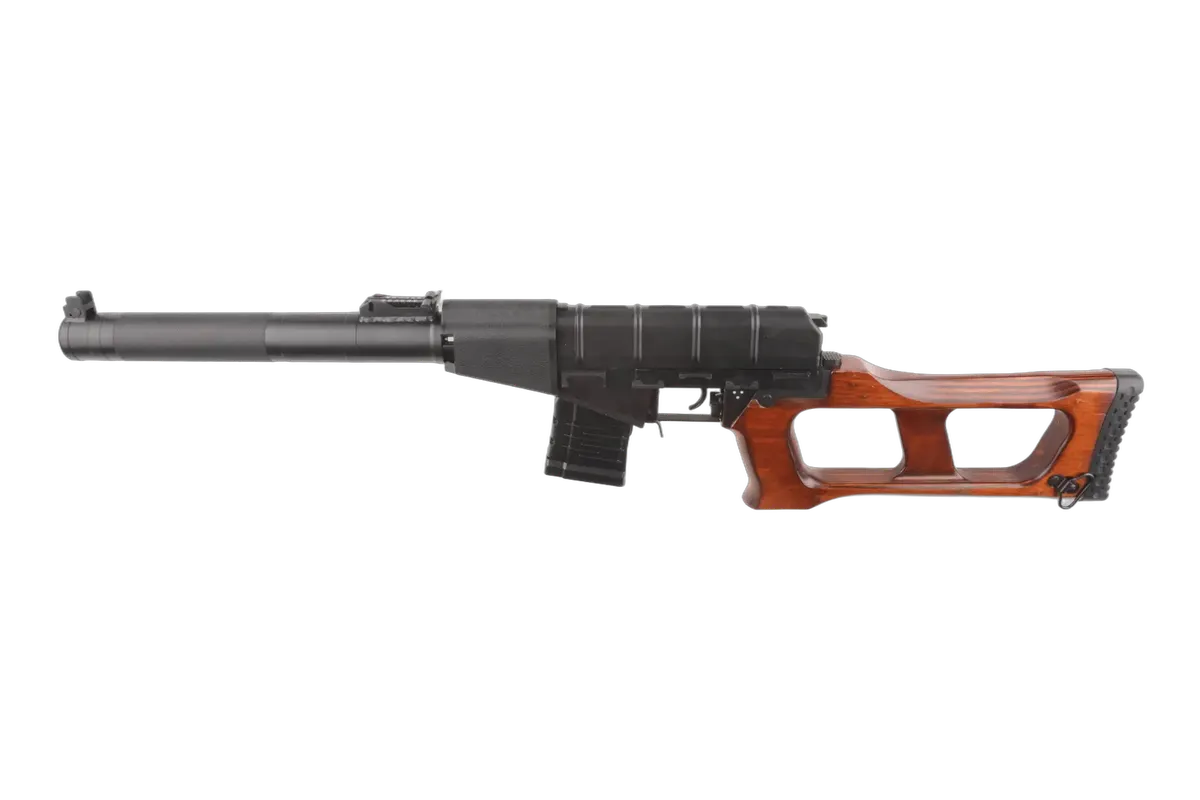
AS Val
Soviet/Russian suppressed assault rifle in 9×39 mm SP-5/SP-6: integral suppressor, tubular folding stock and heavy subsonic projectiles able to defeat body armour at 400 m.
AS Val
Community
Data trust
- Reliability
- Unverified
- Sources
- Sources pending review
Identity
- Designation
- AS Val
- Alias
- Автомат Специальный «Вал»
- Manufacturer
- TsNIITochMash
- Country
- Russia
- Year
- 1987
- Category
- Assault rifle
- Status
- In service
Ballistics
- Caliber
- 9×39 mm SP-5/SP-6
- Muzzle velocity
- 295 m/s
- Rate of fire
- ~800 rpm
- Effective range
- 400 m
Dimensions
- Barrel length
- 200 mm
- Overall length
- 615 / 875 mm
- Empty weight
- 2.5 kg
Mechanics
- Operating system
- Presa di gas a pistone lungo
- Bolt / action
- Rotating bolt
Feed
- System
- Caricatore bifilare amovibile
- Standard capacity
- 20 rounds
Fire modes
Historical profile
Strategic Development and Origins
The program for the development of the AS Val began in the early 1980s at the TsNIITochMash institute in Klimovsk, under the leadership of designers Pyotr Serdyukov and Vladimir Krasnikov. The objective was to create a silent weapon system that would overcome the limitations of the suppression kits applied to AKM and AK-74 rifles, which were often insufficient for clandestine special operations.
Development proceeded in parallel with the VSS Vintorez sniper rifle under the project codenamed Val, aimed at maximizing component interchangeability between the two platforms. The Soviet Ministry of Defense requested a weapon capable of engaging targets protected by NATO-class body armor at distances up to 400 meters, a performance level impossible for the 9x18mm Makarov ammunition of that period.
Mechanics and Technical Characteristics
The AS Val operates via a gas-operated system with a long-stroke piston and a six-lug rotating bolt, a configuration that ensures reliability even in extreme environmental conditions. The centerpiece of the design is the integral suppressor that encloses the entire short barrel, which features ports in the rifling that allow excess gases to flow into expansion chambers before the projectile leaves the muzzle.
Unlike the Vintorez, the AS Val features a tubular steel stock that folds to the left side to facilitate transport in confined spaces or during parachute jumps. The weapon primarily uses 20-round polymer magazines, although it remains fully compatible with the 10-round VSS magazines or the later 30-round magazines introduced for the SR-3 Vikhr.
Operational Service and Conflicts
Following its official adoption in 1987, the AS Val became the primary tool for GRU elite units and the KGB Alpha and Vympel teams, specialized in sabotage and deep reconnaissance. The weapon proved extremely effective during the Chechen conflicts, where the stopping power of the 9x39mm caliber was found to be superior to the 5.45x39mm in close-quarters urban combat.
In addition to the Russian Federation, limited examples have been spotted in Georgia and other former Soviet republics, often captured or inherited after the collapse of the USSR. More recently, the AS Val has been extensively documented during military operations in Syria and in the conflict in Ukraine, where it remains the weapon of choice for nocturnal infiltrations due to its near-total absence of muzzle flash.
Evolution and Modern Variants
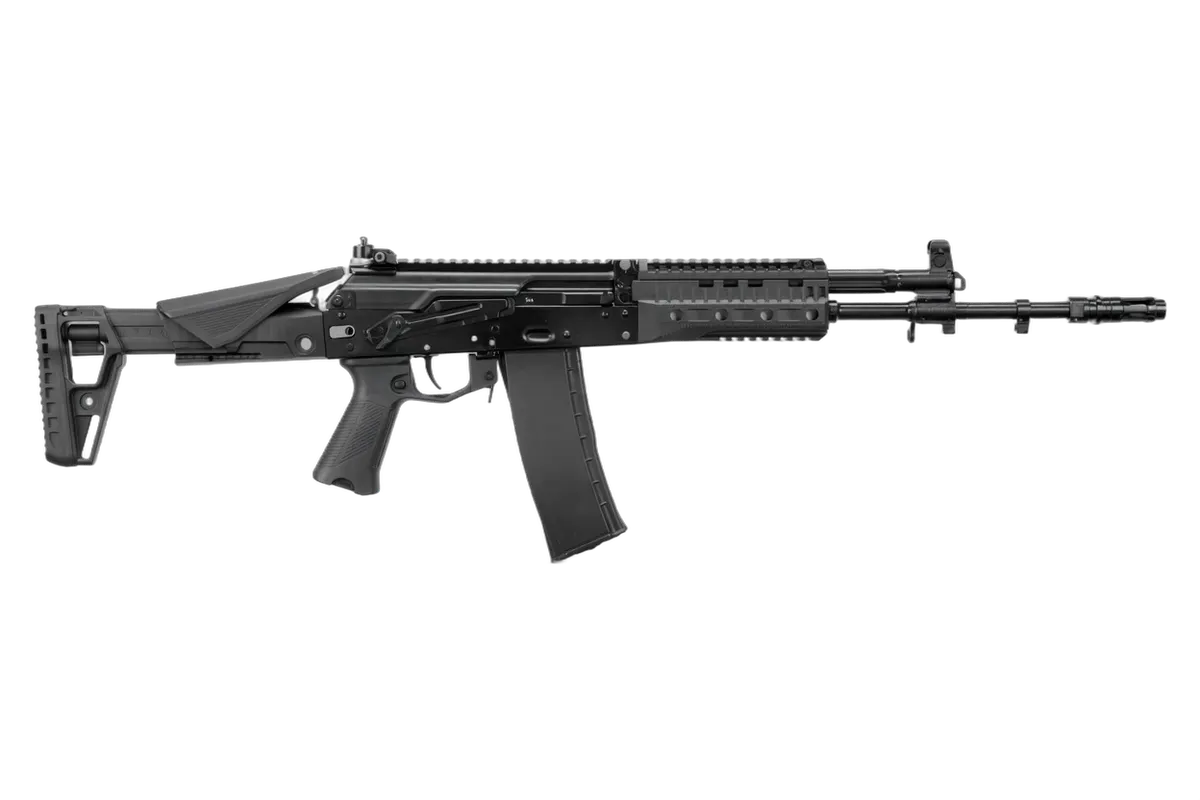
In the 2010s, the Russian Ministry of Defense launched a modernization program that led to the creation of the AS Val-M (6P30M). This updated variant introduces a reinforced receiver cover with an integrated Picatinny rail and a rail system on the suppressor for installing laser designators and tactical lights.
The legacy of the AS Val continues to influence the development of compact weapons like the SR-3M and the AMB-17, which seek to replicate its silent lethality in even more compact packages. Although new platforms have been introduced, the AS Val maintains an irreplaceable spot in the Russian special forces arsenal for its unique balance between ballistic concealment and armor-piercing capabilities.
Variants
Main users
Russia (Spetsnaz GRU, FSB, MVD)
Key components
- ●Stock — Shoulder rest.
- ●Receiver — Weapon body with internal mechanisms.
- ●Grip — Primary grip.
- ●Magazine — Cartridge feed.
- ●Barrel — Guides the projectile.