Type 56 Carbine
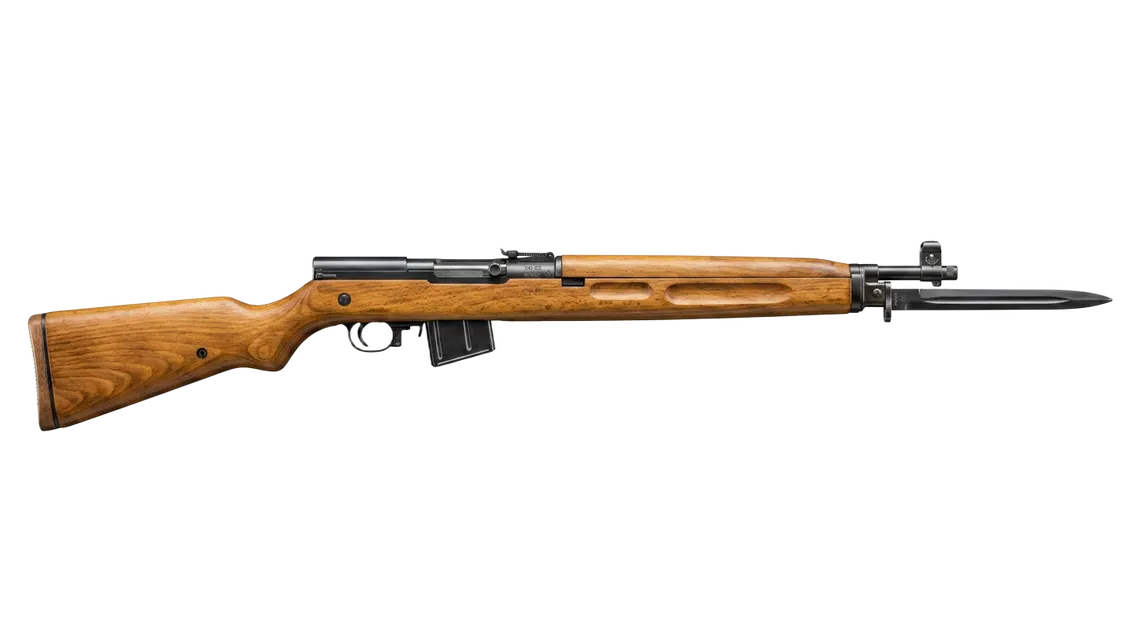
Chinese copy of the Soviet SKS: semi-automatic carbine in 7.62×39 mm with a fixed 10-round magazine and a folding spike or blade bayonet.
Type 56 Carbine
Community
Data trust
- Reliability
- Unverified
- Sources
- Sources pending review
Identity
- Designation
- Type 56 Carbine
- Alias
- Norinco Type 56 SKS
- Manufacturer
- Norinco / Jianshe Arsenal
- Country
- China
- Year
- 1956
- Category
- Carbine
- Status
- Historic
Ballistics
- Caliber
- 7.62×39 mm
- Muzzle velocity
- 735 m/s
- Effective range
- 400 m
- Maximum range
- 1000 m
Dimensions
- Barrel length
- 521 mm
- Overall length
- 1021 mm
- Empty weight
- 3.85 kg
Mechanics
- Operating system
- Gas-operated, short-stroke piston
- Bolt / action
- Otturatore a chiusura per inclinazione
Feed
- System
- Caricatore interno fisso, ricarica con stripper clip
- Standard capacity
- 10 rounds
Fire modes
Historical profile
Development
As part of the Soviet technology transfer of the 1950s, China also received the license to produce the Samozaryadny Karabin Simonova (SKS), a semi-automatic carbine chambered in the intermediate 7.62×39 mm cartridge.
Production began in 1956 at the Jianshe Arsenal in Chongqing, designated "Type 56 Carbine" to distinguish it from the contemporary Type 56 assault rifle. Although they share the name and cartridge, they are mechanically distinct designs.
Design
It operates on short-stroke gas piston with a tilting bolt, firing only in semi-automatic mode. The magazine is internal and fixed, with a 10-round capacity, reloaded via stripper clips from the top of the receiver.
Early Chinese versions feature a folding cruciform spike bayonet under the barrel; later production adopted the blade bayonet like the Soviet original. Stocks are made of hardwood, often lighter and more orange than Soviet walnut.
Operational service
Massively issued to Chinese armed forces and militia, it was also supplied in large quantities to North Vietnam, the Viet Cong and numerous liberation movements in Asia and Africa.
It remained in ceremonial and second-line service in the People's Liberation Army until recent times, while being progressively replaced as a combat weapon by the Type 56 (AK) as early as the 1960s–1970s.
Legacy
In the 1980s and 1990s Norinco exported millions of Type 56 Carbines to the U.S. and Canadian civilian markets, where its ruggedness, low price and use of the inexpensive 7.62×39 mm cartridge made it extremely popular.
Subsequent import restrictions (Bush 1989, Clinton 1994) limited entry into the U.S., but the Type 56 Carbine remains one of the most widespread historic semi-automatic firearms in the global surplus and collector market.
Variants
Main users
China · Vietnam del Nord · Albania · Pakistan · Bangladesh · movimenti di liberazione
Key components
- ●Stock — Shoulder rest.
- ●Receiver — Weapon body with internal mechanisms.
- ●Grip — Primary grip.
- ●Magazine — Cartridge feed.
- ●Barrel — Guides the projectile.